Why Intelligent LiDAR Solutions are the Next Frontier in Security and Safety
Securing critical infrastructure has never been more challenging or more urgent. Data centers, utilities, energy facilities, and other high-value industrial sites face a rising threat of sophisticated physical intrusions, unauthorized access attempts, and infrastructure sabotage.
At the same time, threats to physical security are increasingly intertwined with operational safety risks within the same environments such as unsafe interactions with dangerous equipment and blind spots. Organizations are progressively searching for better situational awareness by using modern technology like physical artificial intelligence (AI).
Most sites today rely on a traditional mix of sensors such as cameras and radar, and human supervision for environmental awareness and detection. While these technologies have proven value, most were not designed for the evolving threats and complexities of modern environments. Cameras struggle with depth perception and low-light performance, while radar sensors often lack the precision to classify or detect small, stationary objects. Additionally, relying on sensors that are limited to two-dimensional (2D) interpretation often leads to frequent false alarms.
To deliver reliable and proactive protection, physical security and safety monitoring requires a fundamental shift toward AI-powered solutions for the physical world. LiDAR is a proven, reliable solution for industrial and robotics applications—and now for physical security and safety.
Why Perimeter Security Demands More
LiDAR delivers advanced three-dimensional (3D) spatial awareness without relying on visible light. This sensor takes a fundamentally different, data-led approach to spatial awareness and detection. Rather than interpreting 2D images, it emits millions of laser pulses per second to create a precise, real-time 3D digital twin of the monitored environment or zone.
Paired with AI perception software, lidar reliably detects, classifies, and tracks people and objects in low-light or adverse weather conditions. When a threat is identified, the system automatically tracks the intruder, triggers alerts, and signals to cameras for visual verification, dramatically reducing response times and nuisance alarms.
For security and safety teams, LiDAR’s value is simple: a reliable, automated system that identifies and tracks real threats before they escalate.
This reliability delivers clear advantages across security and operations. For perimeter protection, it means accurately distinguishing real intrusions from shadows or wildlife, or detecting violations such as two people entering a secure facility by using a single badge. For security and safety teams, LiDAR’s value is simple: a reliable, automated system that identifies and tracks real threats before they escalate.
AI-powered LiDAR further unlocks operational efficiencies and measurable return on investment by turning real-time spatial awareness into actionable intelligence for business leaders.
Preventing Collisions and Protecting Workers
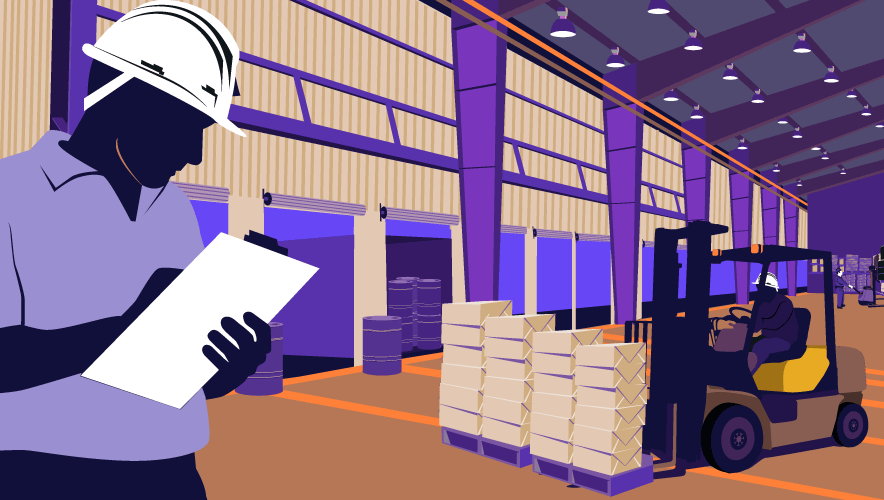
Yard environments such as logistics hubs, intermodal facilities, manufacturing plants, and distribution centers are some of the highest-risk areas for worker injury. Trucks, forklifts, and autonomous guided vehicles (AGVs) operate next to pedestrians and often in tight, cluttered spaces with poor visibility.
LiDAR enables a new tier of yard safety and efficiencies:
- Real-time detection and automated alerts of workers entering “red zones” around forklifts, trucks, and heavy machinery
- Improved visibility for operators or drivers, who may otherwise be navigating blind spots
- Monitoring at loading docks and entry points
- Insight into occupancy data, dwell times, and unloading times
- Anonymous tracking of workers and vehicles
ITK Engineering, a leading software and systems engineering Bosch company, sought to address poor truck visibility, blind spots, and the high cost of installing sensors on individual vehicles. By leveraging 3D high-resolution digital LiDAR data combined with AI-powered perception from Ouster Gemini, ITK can precisely detect and track the location, speed, and trajectory of vehicles and people across yards and loading docks. This enables real-time audio and alerts to drivers, improving situational awareness and reducing collision risk.
By shifting awareness from individual vehicles to a shared, yard-wide view, the solution overcomes the limitations of onboard sensors and significantly enhances both safety and operational efficiency.
“Using 3D digital LiDAR data, we can detect, classify and track vehicles and people throughout the yard,” says Nico Graf, program manager at ITK Engineering. “When someone or something is detected between a maneuvering truck and a loading bay, operators can receive real-time audio and haptic alerts via a mobile device. By extending awareness beyond what individual vehicle sensors can capture, this technology strengthens yard safety and helps streamline operations.”
Red-Zone Monitoring and Sensitive-Area Protection
Forward-thinking organizations are extending LiDAR beyond the traditional perimeter and into facilities themselves, recognizing that some of the greatest operational risks exist around high-value, mission-critical assets. This shift enables localized, high-fidelity monitoring that conventional security approaches cannot deliver.
Inside the perimeter, certain high-value and potentially hazardous areas are designated as “red zones” or spaces requiring strict access control due to their sensitivity or potential hazard. These include transformer banks, data-center racks, control rooms, and generator yards. Using precise 3D spatial data, operators can define unlimited, custom exclusion zones of any shape and size, creating invisible boundaries that immediately detect unauthorized access. By extending LiDAR’s spatial intelligence into these sensitive areas, organizations can proactively mitigate risks, improve staff safety, and protect the continuous operation of critical infrastructure.
Enhancing Crowd Safety and Event Management
LiDAR technology is rapidly gaining traction in dynamic environments where crowd safety is paramount, such as large stadiums, transit hubs, and corporate facilities. In these public and semi-public spaces, safety analytics must be meticulously balanced with stringent privacy regulations. LiDAR meets this challenge by delivering high-resolution, anonymous data. 3D LiDAR solutions can track movement and presence without collecting personally identifiable information, making it well suited for sensitive urban areas where safety cannot come at the expense of privacy.
This level of spatial awareness is transforming event management and daily safety protocols. LiDAR systems deliver granular, real-time intelligence for proactive crowd management, enabling operators to identify unsafe crowd densities, monitor flow patterns, and detect bottlenecks or congestion as they begin to form. In emergencies, LiDAR can instantly surface abnormal movement patterns, such as sudden surges or mass egress, giving operators and first responders immediate, actionable insight.
“Real-time LiDAR perception integrated into our analytics platform has enabled us to deliver precise crowd safety monitoring at music festivals and major sporting events,” says Greg Guzzetta, founder at SafeHaus Group. “Using just two of Ouster’s high-resolution sensors together with Ouster Gemini, our software achieved square-meter-level precision crowd density tracking, allowing us to detect dangerous congestion and potential crowd-crush risks as they emerged. The system also produced a complete 3D map of the area of interest. It’s not just precision but also reliability across all lighting and weather conditions, which is critical for maintaining safety operations.”
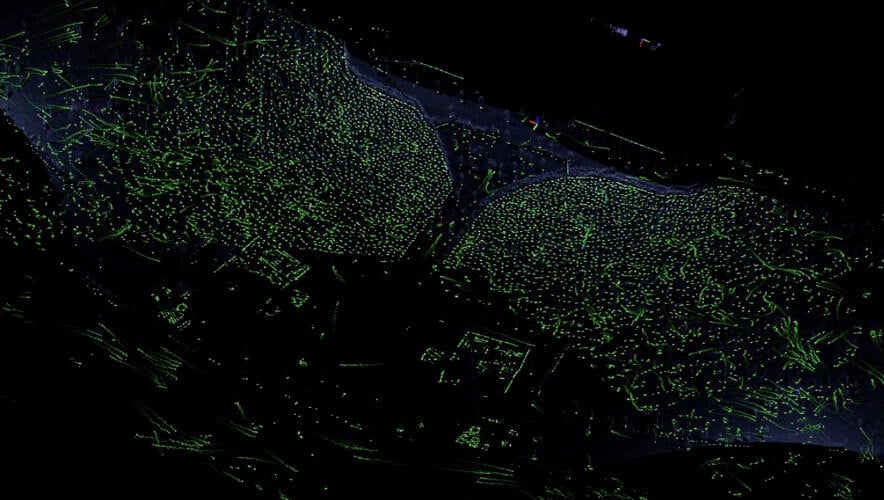 Image courtesy of SafeHaus Group
The Hidden ROI of AI-Powered Safety
As industrial and critical infrastructure environments grow more complex, safety and security no-longer need to remain reactive or disparate. They must become automated, predictive, and tightly integrated into one site and daily operations.
Intelligent LiDAR solutions deliver the consistent, high-precision visibility that today’s environments demand. Whether preventing collisions in busy yards, managing crowds, protecting restricted areas, or unlocking operational efficiencies, LiDAR provides a crucial 3D safety and security layer across the physical world.
For security and facility leaders, the question is no longer if LiDAR will be part of their system architecture, but when.
Dilip Vutukuru is the vice president and head of product at Ouster.