2025 in Review: Security Management’s Favorite Stories
The end of every year is an excellent time for reflection, charting a course for the next year while looking back at what you have accomplished (or at least endured). The Security Management team took a look back at some of our favorite or most enlightening articles of the past year, from burnout mitigation to EV ramming risks to how artwork can mitigate crime.
Read on for a look at the themes, topics, and articles that connected with the Security Management team the most in 2025. May they inspire you as you head into 2026!
Claire Meyer, Editor-in-Chief
Be a Good Human
A core theme of 2025 was disruption. Supply chains, labor pools, economic outlooks, geopolitical norms were all easily disrupted this year, throwing many organizations into continuous crisis response mode as they navigated this new abnormal. But while reporting on these issues, a solid piece of advice remained constant—be an empathetic and people-centric leader, especially during crises.
 In September, we published a series of articles about violent incident recovery and how to navigate these emotional situations. That includes debriefing after traumatic events, handling memorials, using therapy dogs, and leading with compassion. Self-regulation is essential to keep others calm, so knowing your own limits and pressure points can help you know when to step away.
Stressful incidents often involve investigations and interviews. Scot Walker, PCI, provided seven useful tips for conducting sensitive interviews with empathy while remaining professional, from setting up the interview room to bringing in additional people to support victims.
 Empathy and consideration can be differentiators for security and executive protection personnel, too. Looking at providing EP for female principals in particular, a little added consideration can go a long way to ensure that protection is accepted and valued, said EP professional and instructor Jessica Ansley.
“It’s the little things that make them a customer for life, make them want to build that rapport and confidence in you because you’re worried about those little things for them to allow them to just be themselves,” Ansley told Security Management.
Consideration extends beyond principals when extreme heat is concerned. Temperatures continue to climb, and many workplaces are struggling to adapt—including security guard teams. In May, we reviewed out how extreme heat can affect officers and what empathetic and proactive steps managers can take to reduce prolonged exposure and heat illness risks.
But sometimes people are jerks, regardless of the temperature. Michael Gips, CPP, broke down how gaslighters operate at work (including within security functions) and how to effectively and calmly document and manage the situation without flipping out. Gaslighters aren’t the only jerks at work, though; Gips introduces 10 different adversarial personalities, too. Try not to be any of these in 2026.
Nello Caramat, Publisher
Determined to Deter
There were many interesting and eye-opening stories this year. Security Management consistently does a thorough job covering a wide range of security topics. While several articles caught my attention, a few resonated with me in particular.
 In February, an article by Sara Mosqueda on convenience store security stood out. Stores like Circle-K, 7-Eleven, and Buc-ee’s are part of everyday life—we all visit them at some point. However, they naturally attract transient customers, such as travelers stopping for a quick break on the highway. This makes them easy targets. From smash-and-grab incidents (including ATM theft) to vehicle collisions, these locations face a variety of risks. The article emphasized that these stores don’t need a “Fort Knox” approach; instead, small changes can meaningfully deter crime. Low-effort deterrents included removing large window ads to improve visibility, lowering shelf heights to increase sightlines, improving lighting inside and outside, and installing bollards to reduce the impact of vehicle collisions.
Speaking of bollards, a contributed article in September explored perimeters, barriers, and the evolving risks posed by vehicles—especially electric vehicles (EVs). I found it eye-opening, particularly the discussion on how modern vehicle technology can increase damage to building façades and endanger pedestrians. Perhaps influenced by COVID-era outdoor dining, more people now spend time in outdoor spaces, which has led to increased vulnerability to vehicle collisions. The article highlighted that bollards play a critical role in layered security: detection and deterrence, delay and deflection, stopping and containment, and response and recovery. Still, human awareness and preparedness remain central to effective protection.
 In August, Megan Gates wrote a Today in Security piece about a global craze surrounding a toy—Labubus. While the creatures themselves were intriguing, the security perspective was even more compelling. Consumers rarely consider the security risks behind a fad. These concerns ranged from crowd control challenges to thefts and the rise of counterfeit Labubus. It was fascinating—and surprising—to see how much corruption could emerge from a trend centered on a toy.
Megan Gates, Senior Editor
Desperately Dependent on Decisiveness
At seemingly every security conference and meeting I’ve attended this year, someone has brought up how artificial intelligence (AI) is being used or will be used to address the problem at hand.
Yes, this technology is powerful. We hope that it’ll help us overcome more challenges than it creates in its wake. But it is not a be-all, end-all solution to our woes. We still need security leaders who are informed and capable of making the right decision when it matters most. Because the stakes for failing that test are dire.
 One horrible example comes from the UK’s recent inquiry into decision making during the COVID-19 pandemic. It found that the four national governments of the UK did “too little, too late” to stop the spread of the virus during the first quarter of 2020.
“All four governments failed to appreciate the scale of the threat or the urgency of the response it demanded in the early part of 2020, relying in part on misleading assurances that the UK was properly prepared for a pandemic,” said UK COVID-19 Inquiry Chair the Rt Hon Baroness Heather Carol Hallett in a statement. That inability to assess the risk and be decisive about how to respond likely contributed to the deaths of at least 23,000 people during the first wave of the pandemic.
Five years later, security leaders are still being asked to make difficult decisions about novel threats that have ramifications for the assets in their care. I’ve written about some of these predicaments during the past year, from recovering from an act of workplace violence to addressing an insider threat from your contract security provider to responding to an emerging virus that could kill your workforce. While each scenario was different, effectively addressing it required leadership to act quickly and choose a course of action based on the best information available at the time. Technology may have played a role in providing that information or connecting stakeholders, but at the end of the day human leaders were still being tasked with making the important risk management decisions.
 As security leaders increasingly leverage the power of AI to achieve their objectives, I worry that they might lose the ability to properly assess risk and act quickly without a technological prompt. This is why I found myself returning to our Security Management content on resilience, leading through change, and pandemic response as 2025 continued. The topics covered in these series are designed to help the security managers of today become the capable, confident security leaders we need to be decisive tomorrow.
Because as we know, good decision-making skills are only built if they are nurtured and practiced. And the stakes for losing them or letting them lapse could not be higher.
Tyler Stone, Director of Digital Design
Leveraging Art and Metrics to Connect Security and Business Goals
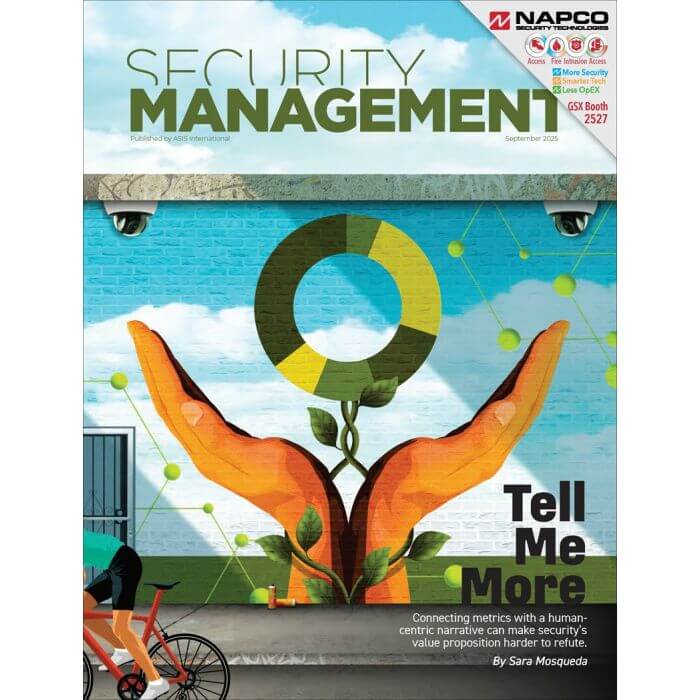 When a chain of convenience stores faced persistent crime despite traditional security measures like lighting, cameras, and fencing, the manager shifted to a different kind of deterrent: community-themed murals. The cover story from September’s print issue of Security Management focused on four of my favorite topics—crime prevention through environmental design (CPTED), metrics, C-suite buy-in, and art—and it brought these concepts together in a cohesive and effective way.
The murals featured local narratives, sports, and cultural touchpoints, embedding pride into the buildings themselves. The result was a significant drop in crime, saving the company thousands of dollars (with negligible costs), improving employee safety, and even generating free media coverage.
What elevated the article was how security leaders paired data with emotional storytelling to gain executive buy-in. Not only were the security managers able to demonstrate that the program worked, but they also connected its ROI to broader business goals. It’s an excellent example of how security strategy, when framed through both evidence and narrative, can resonate at the C-suite level.
How to Bypass Lobby Security with a Pizza
This short video interview with René Rieder, Jr., CPP, PSP, offers a simple idea for improving security at multitenant buildings: scrutinize and screen food delivery personnel before allowing them to proceed into the building without identification.
The idea that someone wearing nothing more than an Uber Eats–branded vest could easily gain access to restricted areas is both thought-provoking and alarming. Rieder highlights this loophole that, when addressed, can significantly strengthen a security team’s ability to counter social engineering attacks.
Sara Mosqueda, Associate Editor
Wading Through Uncertainty Together
 “You can’t pour from an empty cup,” is the adage (or cliché, take your pick) I’ve heard increasingly (and even said at least once) as the holiday season progresses. While this is usually in reference to the many demands that can seem to pile on at the end of the year, I think it also applies to the security industry. Those who work in security are dedicated to helping others, that doesn’t mean they don’t need support, too. Eric Davoine, CPP, and Gigi Agassini, CPP, explored this topic in their article, “Tackling Burnout in the High-Stakes World of Security,” in January.
This year—with significant slashing of U.S. federal agencies and workforces—has seen a wave of public sector professionals entering into the private sector job pool. Articles like July’s “Which Core Competencies CSOs Prioritize” and our December series on recruitment and retention look beyond what the job demands of security professionals. Instead, they provide a glimpse into where the overall industry is headed and give readers a chance to reflect on what they want their career to look like.
 Regular Security Management contributor Ralph “RC” Miles, CPP, always produces a good read, and in his November 2025 article, “To Find Your Footing in a Weightless Geopolitical Environment, Use Intelligence and ESRM,” he touches on how geopolitics and global events have become increasingly intertwined with security for various organizations—a theme that has come up often this year. But his article actually moves beyond that, homing in on how to leverage enterprise security risk management (ESRM) and intelligence to help leadership make smarter moves.