How a Vendor Vulnerability Enabled a Takeover at the U.S. Institute of Peace
Government leadership transitions can be tumultuous. One executive might favor your organization with funding, the next one might cut it. One moment, your team might be in full control of the security of your organization. The next, you might be standing outside on the sidewalk as law enforcement turns over the property to someone else against your wishes.
Former Chief Security Officer Colin O’Brien understands this dynamic all too well. In March 2025 he was escorted from the U.S. Institute of Peace (USIP) by Metropolitan Police Department officers as multiple levels of law enforcement converged on his workplace.
The USIP had just been “DOGEd”—taken over by the U.S. Department of Government Efficiency (DOGE), using aggressive tactics to bypass physical security measures that included coercing USIP’s former contract security provider to provide unauthorized access to the building.
Two months later, though, O’Brien was briefly back at work at USIP and figuring out how to secure the site and get it back to its mission of bringing people together to advance peacekeeping efforts around the globe.
“There is a sense of redemption with everything that happened, getting ordered out of my own place of employment under force of arms, to be able to walk back in that door was like wow,” O’Brien said at the time. “It’s a feeling I can’t put words to.”
The USIP Basics
USIP was created in 1984 under the Department of Defense Authorization Act of 1985 as an independent nonprofit corporation to serve the U.S. government and people through research, education, and training to promote international peace and conflict resolution without resorting to violence.
At the start of March 2025, USIP had more than 400 employees in Washington, D.C., and in more than 20 locations around the globe. O’Brien was hired in 2023 to build its corporate security program from the ground up. The security program already consisted of a few in-house security team members and a contracted guard force to manage the physical security of the headquarters campus.
Over time, O’Brien transitioned that program into an international security team capable of responding to and monitoring developments, threats, and incidents that directly affected USIP staff.
USIP’s security team had two additional full-time USIP staff members overseeing physical access to the headquarters facility. They were responsible for ensuring that USIP’s security systems were working properly, including electronic key cards, surveillance cameras, magnetic locks, and the anti-ram devices set up to control vehicular access.
Those staff members were also responsible for managing USIP’s contracted security guard force, supplied by Inter-Con Security. This was a longstanding contract that originated in 2011 or 2012, prior to when O’Brien joined USIP. Inter-Con provided special police officers, with responsibility to provide armed physical security and direct incident response.
“Had there been an active shooter or there’s a protester that gets in the building for an event, they’re essentially the first responders in the building,” O’Brien says. “They have the authority to arrest while they’re on duty. They have a higher level of training than an average security guard.”
During business hours, there were anywhere from nine to 14 Inter-Con security officers on duty at USIP headquarters. Overnight, the shift would usually have just six to seven officers. For large events, there could be 15 to 20 officers.
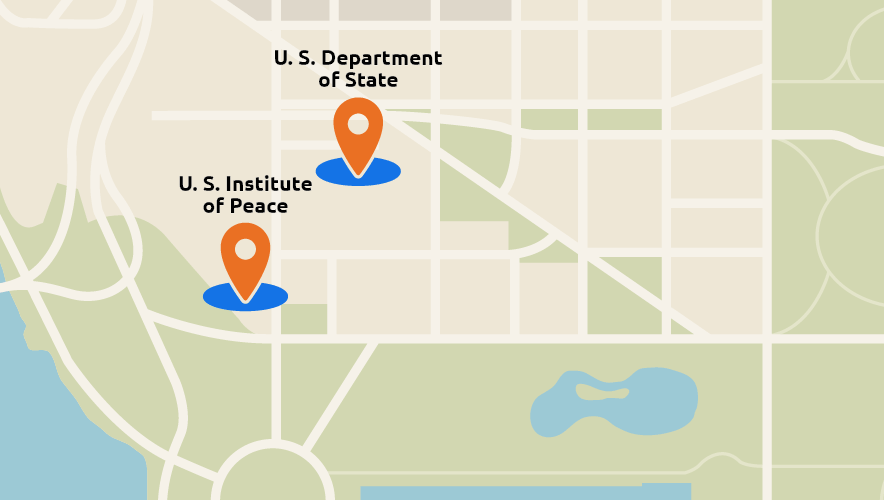
One of the main reasons that Inter-Con was selected for this long-term contract was because of its contract with the U.S. Department of State, which has a headquarters building across the street from USIP.
With the frequency of large events at USIP, O’Brien says it made sense to work with the same contractor that provided guard services to the State Department so it could easily be called upon for backup support.
“There was a synergy there. Even with things like active shooter response, that if you’re working with the same company and they’re right across the street, it does increase your capabilities,” O’Brien says.
Signs of Trouble
During U.S. President Donald Trump’s first term, USIP saw some of its largest organizational successes. It became involved in the Global Fragility Act, which was enacted in 2019 to improve how the U.S. government addresses conflict prevention and stabilization in fragile states. Its funding from Congress also increased.
When Trump was reelected to a second term in November 2024, O’Brien says there was a conscious effort at USIP to ensure that what it was working on would align with the incoming administration’s agenda.
As the transition from U.S. President Joe Biden’s administration to the new Trump administration in January 2025 unfolded, things were relatively calm at USIP, with business proceeding as usual. But then, on 19 February, the situation took a turn.
On that day, Trump issued Executive Order 14217 to reduce the federal bureaucracy and placed USIP on its list of organizations that should be “eliminated to the maximum extent consistent with applicable law.”
Right off the bat there was an issue. USIP maintains that it is not an executive branch agency but rather an independent nonprofit organization. It can seek funding from the U.S. Congress as well as income via private donations, government grants, and subscription and training fees. Its headquarters consists of three buildings: two were transferred to USIP by the U.S. Navy, with a third newly constructed and opened in 2011. USIP owns the buildings, but the U.S. government owns the land they occupy.
USIP has a 15-member board of directors. Three are ex officio members with roles in the U.S. executive branch, and the other 12 are appointed by the U.S. president and confirmed by the U.S. Senate. These 12 appointees must have experience in peace and conflict resolution but cannot concurrently be employed by the U.S. federal government, along with meeting other criteria. There is also a strict Congressionally mandated process for removing board members.
Within a week of the executive order being issued, DOGE—the Trump administration’s new department focused on cutting the federal budget—reached out to USIP’s chief operating officer and chief financial officer for a virtual meeting on 24 February. USIP’s outside legal counsel, George Foote, and President and CEO Ambassador George Moose also sat in on the call, in which DOGE representatives asked to bring a team to USIP to help out the institute.
O’Brien, who was briefed on the call immediately afterward, says the response from USIP was a respectful no. Leadership said it would submit a requested report to the U.S. Office of Management and Budget, per the executive order, but it would not grant DOGE staffers physical access to the building. The call ended with DOGE representatives promising to circle back.
Immediately, though, USIP leadership began thinking about what should happen if DOGE did show up at the headquarters site. It still believed that it could bring value to the administration and that there was a way to handle this situation without it escalating.
“Trump said on Inauguration Day, ‘I want to be a peacemaker.’ We, at the time, were the only publicly funded peace institute in the developed world,” O’Brien says. “One plus one should have been two here.”
O’Brien was tasked with creating a plan in case DOGE personnel arrived unexpectedly. It consisted of inviting DOGE representatives inside to a USIP conference room to sit down with legal counsel and senior leadership for an amicable meeting, while limiting access to materials and facilities DOGE did not have a legal right to have.
That initial plan soon changed, however, due to the tactics that DOGE used to gain access to organizations like the African Development Foundation in Washington, D.C. There DOGE representatives showed up at the foundation’s offices in a mixed-use building and requested entry but were denied. They then returned with federal law enforcement and forced their way into the facility to physically take over the premises. USIP wanted to avoid a similar confrontation.
“We had more latitude and flexibility in our planning because [the building] was wholly ours, controlled by us, and protected by a guard force that was directly contracted to us,” O’Brien says.
O’Brien created face sheets that contained a photo of a DOGE representative’s face, his or her name, and instructions to not let the individual into the building and to call senior leadership to respond. The sheets were placed so that the contract security officers would see them and respond appropriately to what USIP considered a legal issue.
Everything was quiet for a few days, and then someone tipped off O’Brien that DOGE was asking around at the Federal Protective Service (FPS) about USIP. FPS is a government security organization that generally provides security and support for government buildings. DOGE wanted to know if FPS provided security at USIP. Now, O’Brien says he was convinced that DOGE was planning to show up and try to enter the USIP site.
We had more latitude and flexibility in our planning because [the building] was wholly ours, controlled by us, and protected by a guard force that was directly contracted to us.
A few days later, on 14 March, White House Deputy Director of Presidential Personnel Trent Morse emailed 10 of USIP’s board members to tell them they were fired. Moose then called O’Brien to inform him of the situation, stating that leadership did not consider the firings legal so therefore they were not valid.
About 20 minutes later, DOGE representatives arrived at USIP headquarters with a State Department official named Kenneth Jackson. The security guards on duty called O’Brien to alert him. He initiated a building lockdown and denied the group entry to the building. They waited outside for about 30 minutes before leaving.
Most of the USIP staff departed shortly afterward, but leadership and O’Brien remained on-site—meaning they were there when DOGE representatives Nate Cavanaugh and Jacob Altik showed up, this time with two FBI agents. USIP’s outside counsel Foote stepped outside the building to meet with them.
“I negotiated with the FBI and the DOGE people outside with full confidence that there was a competent, qualified, prepared, loyal guard force behind me,” Foote recalls.
He was handed a letter by the DOGE team, which was a resolution signed by remaining ex officio board members U.S. Secretary of Defense Pete Hegseth, U.S. Secretary of State Marco Rubio, and National Defense University Vice Admiral Peter A. Garvin that removed Moose from his position at USIP. That same resolution also named Jackson as the acting president of USIP. USIP leadership, however, still did not recognize these moves as legal and continued to deny the DOGE team entry.
O’Brien says he was thinking about what would happen next and how USIP would respond. His assumption at that point was that over the weekend DOGE might try to force its way into the building, so he planned to be there and so did the legal team. They started working with Moose to put together a legal argument to go to court, and O’Brien’s instructions were to protect the building and its information to the extent he was able.
“We increased the guard force staffing over the weekend, so we’d have more people on site given what had been going on,” he adds. “We made sure that we had USIP security staff on-site for the weekend so that there was leadership around if something were to happen, so that the guard force wasn’t going to be put in a bad position and that they would be more willing to follow instructions.”
Saturday was quiet while USIP assessed its shutdown policies, lockdown procedures, and remote work capabilities so staff could stay out of the building. Sunday, however, saw a ramp-up. One of USIP’s security staffers was at home on medical leave when two FBI agents arrived to ask how to gain access to USIP’s headquarters.
An FBI agent also called O’Brien to get information about USIP’s security procedures and warned that he was the subject in an investigation into the incident Friday, when he denied DOGE entry to USIP’s headquarters. O’Brien directed the FBI agent to contact Foote about answering the FBI’s questions.
That same day, U.S. Attorney Jonathan Hornok—District of Columbia Criminal Division chief—called Foote to request access to USIP headquarters. Hornok implied that there was suspicion that USIP was engaging in criminal behavior. In a follow-up call, Hornok asked Foote to allow representatives for Rubio and Hegseth to have access to USIP records and books. Foote said he would facilitate that access, but only if there was a written request. Hornok said the representatives would arrive at headquarters on Monday and that he would criminally investigate anyone who impeded their access.
Foote also became aware that the FBI was at the staff member’s house and had asked if he worked for USIP or Inter-Con Security. Foote then told O’Brien that the staff member had been asked several questions about Inter-Con Security.
This is when the lightbulb went on for O’Brien. He knew what DOGE’s plan was: to flip the contract security guard force.
“The realization hit me that the guards who have guns, who have carte blanche access throughout the building, and legally the authorities of a police officer on duty, are my biggest vulnerability,” O’Brien says.
He was also concerned that Inter-Con would be pressured into turning on USIP by threats to discontinue its U.S. Department of State contract—worth $460 million and set to expire on 31 October 2025.
“Our contract was about $2.7 million, and I knew that the State Department was their biggest contract around,” O’Brien says. “If you’re looking at that scenario and the FBI calls up and says, ‘Hey, I need you to do this,’ or ‘Your State Department’s contract’s at risk,’ what do you do?”
O’Brien then made one of the strangest recommendations of his security career: to fire the Inter-Con Security guard force.
This is when the lightbulb went on for O’Brien. He knew what DOGE’s plan was: to flip the contract security guard force.
“Let me tell you, that was a hard realization and a hard set of decisions to make when you realize the people you depended on to protect you may not protect you,” Foote says. “They didn’t tell us they were turning or leaving us or abandoning us or anything. There was just a concern about their loyalty that turned out to be right.”
USIP leadership agreed with O'Brien's recommendation and began the process to suspend the contract, effective 6 p.m. local time on Sunday, 16 March. Inter-Con Security Regional Vice President Derrick Hanna and Inter-Con Security Account Manager for USIP Kevin Simpson were notified by phone, acknowledged the suspension, and confirmed via email that they would comply with it, O’Brien says.
He then informed the Inter-Con Security officers at USIP that the contract was being suspended, that their badges would be deactivated, and that they should not return. O’Brien also collected physical keys from the duty lieutenant, who also had a master key.
There was one key, however, that O’Brien did not collect: Simpson’s master key. Simpson is the retired chief of the uniformed division of the U.S. Secret Service and the best friend of one of USIP’s security staff members. He wasn’t on-site on Sunday, and O’Brien, given their relationship and Simpson’s background, thought he could be trusted to keep the master key until a later date.
Simpson “knew all the protocols. He was a trusted insider,” O’Brien says. “He was a value add, until he wasn’t.”
The Takeover
The Monday morning of 17 March started off quietly. Just Moose, the board, the security team, some communications staffers, and legal counsel were on-site. The security team had placed “no trespassing” signs around the building, frosted most of the windows and doors, and pulled the blinds.
At about 2:30 p.m., though, three cars pulled up outside. Inter-Con’s Hanna exited one of the vehicles, walked to the USIP entrance, and attempted to use his ID card to badge his way into the building. When the door did not open, Hanna attempted the same process on several other doors—all with the same result.
Then Simpson walked up with the master key he still had in his possession. Without authorization, he unlocked a door leading into the USIP headquarters and walked inside with Hanna. Security staff immediately confronted him and instructed him to leave, while USIP leadership formally filed to terminate Inter-Con’s contract.
Hanna told O’Brien that DOGE had called and threatened Inter-Con’s federal contracts if it did not take these actions. Simpson then began walking toward USIP’s armory, where the former contract security officers were required to leave their service weapons in a safe that Simpson knew the combination to.
To impede his progress, O’Brien initiated a building lockdown and called 911 to report the group for trespassing. Hanna, Simpson, and another individual with them then attempted to move toward the front door of the building to let the DOGE representatives inside. But O’Brien had tweaked the lockdown procedure, which caught the three individuals in USIP’s entrance pavilion without access to the outside door.
Foote then entered the entrance pavilion to negotiate with them to leave. After a series of phone calls were made, Simpson, Hanna, and the other individual agreed to leave the building. Simpson, however, refused to return the master key. To prevent that key from being used again, O’Brien had the engineering team remove cylinder locks from the exterior doors so they could not be opened from the outside with a key.
At about 5:30 p.m., Foote got a call from the MPD indicating they had arrived at USIP. O’Brien and others assumed the police were there in response to their 911 call, so they went to meet them at a door halfway between the main entrance to the building and the loading dock in the back.
“We wanted a police report because Inter-Con Security broke into our building,” O’Brien says. “They were not an authorized contractor. They did not have permission to be on the site. This is a crime.”
One of the responding officers was a commander for MPD’s Special Operations Division and the other was a captain. This seemed unusual to O’Brien. They were then joined by more police officers, who ultimately held the door open—against O’Brien’s wishes—to admit Jackson, Cavanaugh, and several other people.
O’Brien then was immediately detained as he and Foote attempted to explain that DOGE had no authority to be at USIP and needed to leave. Their argument was not successful, though: MPD followed Jackson’s instructions to remove them from the building.
Six police officers escorted O’Brien out of the building, along with Foote and another member of legal counsel.
“When I got outside, and I saw eight to 10 police cars, you got a dozen plus Metropolitan police officers there, the extent of the operation that was ongoing, what was, in some ways, not believable,” O’Brien recalls. “This was a planned, coordinated operation by the D.C. police and DOGE to take over USIP.”
O’Brien then stood outside, watching while MPD used lockout gear to move into USIP headquarters and up to the executive suite, where Moose was still working. MPD escorted him out of the building. Foote recalls that it was a very fast fall from grace for security personnel he’d previously respected.
“It was a very fast loss of respect for our Inter-Con guards, but that went along with the loss of respect for our Metropolitan Police Department as well, because we realized during the day, certainly at the time we were being evicted from the building, that the DOGE, the White House, the U.S. Attorney, the FBI, and the Metropolitan Police Department were all collaborating with our guard force to seize the building from USIP,” Foote says.
“At this point, they had no court order. They simply had an executive order from the president and one-line, two-line emails from the White House Personnel Office to our directors and a trumped-up, fake resolution by a couple of board members who were not fired that there would be a new president,” he continues. “There was no court order. There was no warrant. There was no right for them to be in the building, but all of these law enforcement entities and government entities collaborated to seize the building from USIP, and Inter-Con lined up with them and marched right along.”
The Legal Fight
Forty-eight hours later, five USIP board members filed a complaint in court against Jackson, DOGE, and several DOGE officials. They also filed an emergency motion for a temporary restraining order to stop DOGE’s takeover of USIP.
Judge Beryl A. Howell of U.S. District Court for the District of Columbia denied that emergency motion, though, while she reviewed the board members’ complaint. Her reasoning at the time was that she didn’t understand whether USIP was governmental and under the president’s control, or private and therefore out of his control, Foote recalls. Howell also explained that the standards for a temporary restraining order are very high, and that a plaintiff must show irreparable harm to prevail on the merits. If USIP was determined to be part of the government, Howell explained that there would be no harm done.
“I was very disappointed in that,” Foote says. “It was a real punch, as I say, to hear her say that.”
The punches kept coming. Howell initially decided not to step in when DOGE transferred the building to the General Services Administration (GSA), the agency that oversees U.S. government buildings. She also denied a temporary restraining order for a lawsuit filed by USIP employees. Instead, she requested a full briefing on the merits.
After the hearing, nearly two months elapsed, during which the USIP headquarters sat largely empty, its staff was fired, its assets were transferred to an unknown entity, and its buildings became lightly infested with pests and developed some major repair issues. Then Howell delivered an opinion fully in favor of USIP.
She ruled that USIP is an external partner to the executive branch and that Trump’s removal of all appointed board members was unlawful. Because their removal was unlawful, Howell determined that all of the actions that flowed from their removal were also unlawful.
“The Constitution makes clear that the President’s constitutional authority only extends as far as Article II, but even Article II does not grant him absolute removal authority over his subordinates, under current binding case law precedent. Outside of Article II, he has little constitutional authority to act at all,” Howell wrote. “The President’s efforts here to take over an organization outside of those bounds, contrary to statute established by Congress and by acts of force and threat using local and federal law enforcement officers, represented a gross usurpation of power and a way of conducting government affairs that unnecessarily traumatized the committed leadership and employees of USIP, who deserve better.”
She ordered that all USIP assets be returned to the institute, including its headquarters building and endowment funds. The U.S. government filed a stay, requesting a pause on Howell’s decision, but she denied the request.
The U.S. government has since appealed the stay to the U.S. Court of Appeals for the District of Columbia. On 27 June, a three-judge panel for the appellate court issued a stay of Howell’s ruling. USIP leadership interpreted the stay as an order to return the headquarters site to DOGE, Foote says.
O’Brien instructed the security team to provide DOGE representatives, when they came to the headquarters site, with keys and passwords.
“Unlike what happened in March, there was a judicial ruling [this time] and I don’t cross those—regardless of how much I might disagree with them,” O’Brien says.
After turning over the keys, USIP staff was then to leave the building. For O’Brien, the departure might be his last. He tenured his resignation following the appellate court’s stay.
“It was the legal whiplash of ‘here we go again,’” O’Brien says. “I made the decision that I was not going to be fired a second time by DOGE. I was going to resign to someone I hold in the highest regard, George Moose.”
The GSA is now controlling and securing the site. USIP filed a petition to overturn the panel’s stay and the full appellate court ordered the U.S. government to respond to that petition by mid-July 2025. Foote says he anticipates a lengthy legal battle to return USIP to the headquarters grounds.
“I’m very confident that we’re going to prevail in the court of appeals,” Foote says. “And whoever does not prevail, it’ll go to the Supreme Court.”
As for holding Inter-Con Security accountable for its actions, Foote says that’s an option that is available, but currently USIP is focused on the future and getting back to business. He remains optimistic that USIP will be able to recover the $15 million of its 2025 budget that was rescinded in the appropriations process and that it will receive new funding for 2026.
“I’m not happy to see the institute in as much pain as it is,” Foote says. “But I think we’ll survive. I think we’re going to look around and people will realize that USIP is the last man standing as America’s presence in the world, as a beacon of democracy. Why not keep some remnant around and do good work for the United States? And we’re cheap, efficient, and effective.”
Inter-Con Security, Kevin Simpson, and the White House did not return requests for comment on this article.
Megan Gates is senior editor at Security Management. Connect with her at [email protected] or on LinkedIn.