En Garde! USA Fencing Advances with New Age Verification Process
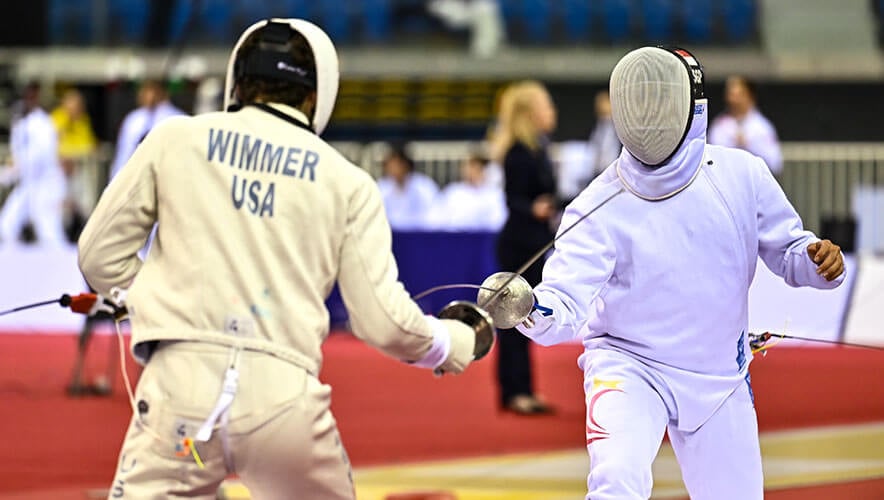
Born out of military dueling, fencing as an organized sport began to emerge in the 1890s and is likely best known for its presence in the modern Summer Olympic Games.
At the 2024 Paris Olympics, fencers in saber, foil, and epee competed in the historic Grand Palais—producing some of the most iconic imagery of the picturesque games amid fierce competition. Sixteen fencers from the United States participated in those games, part of the team nominated by USA Fencing.
Putting together the teams that represent the United States at the Olympics and the Paralympics is just one part of USA Fencing’s responsibilities. As the national governing body for the sport of fencing in the United States, USA Fencing sends 144 national teams to competitions around the world throughout the year, organizes fencing competitions in the United States, and oversees a youth sport initiative to encourage children to get started in the sport, says Phil Andrews, CEO of USA Fencing.
“A large part of what we do is bring people into the sport—let people know about our sport and so forth,” he adds. “We do the governing, we do the servicing, and we do the marketing. It’s very cool.”
Key to the organization’s work is ensuring that competitors meet the age eligibility requirements for their category. For instance, veteran athletes must be 40 years of age or older, while juniors must be 18 to 20 years of age, and cadets must be 17 and under. These age requirements help ensure an equal field of play—critical for maintaining the integrity of the sport, Andrews says.
“Whenever you have a real way to win—whether that’s in business, in sports, or in security—you’re going to have ways that either bad actors or nonmalicious, accidental bad actors will try to manipulate the system,” he explains.
In the past, USA Fencing used a manual process to verify competitors’ ages. Athletes registering with USA Fencing for competition would upload proof of identity documents—such as a driver’s license or birth certificate—through a registration portal. A USA Fencing staff member would then review the uploaded document and determine whether the athlete could proceed with registration in his or her respective class. The process was time-consuming and overwhelming during busy competition periods, when staffers might be reviewing thousands of uploads. It was also prone to human error.
“Humans are very, very good and exceptionally gifted at a number of things, but fatigue is a real thing,” Andrews adds.
So, in 2025, USA Fencing began exploring alternatives that would make it easier for athletes to verify their age and for staff to adjudicate. The organization connected with Jumio, an identity verification platform with a strong reputation for its services in the financial and technology sectors. The two started exploring how the vendor could streamline USA Fencing’s processes, and Andrews says the organization decided to go with Jumio’s solution because of its functionality and the company’s attention to the needs of the fencing community.
“There seemed to be a genuine care about the sport, a genuine care about keeping the field of play clean, which is not the usual use for identity verification or this type of security product,” Andrews says. “That care about the community, that care about sport integrity, that care about how their own business was perceived to some extent really resonated with me. We are a very fast-growing but quite niche sport. So that care means a lot to us.”
Jumio provides a variety of identity verification methods for end users, including facial recognition. But USA Fencing decided that its document verification process was the right fit for its needs to verify age while protecting minors and teenagers who might be registering using its systems. It worked with Jumio to design a fully automated registration process that is integrated into USA Fencing’s event registration system, says Reinhard Hochreiser, senior vice president of product and technology at Jumio.
Now when athletes register via a mobile device, they are guided through an enrollment process that instructs them to open their camera and then place an identity document within view. Adults might be asked to provide a government ID—such as a driver’s license, a passport, or a national ID card—while children are asked to provide identity documentation—like a birth certificate. The system will take an image of the document, evaluate it, and then provide a yes (the documents match the age the athlete claims to be), no (the documents do not match the claimed age), or maybe.
If an athlete is flagged as a no or maybe, Jumio alerts USA Fencing about what happened and why the system believes the individual’s documents are not authentic. USA Fencing can also access the Jumio portal to view the details associated with every athlete who has attempted the registration process.
Humans are very, very good and exceptionally gifted at a number of things, but fatigue is a real thing.
How does Jumio determine if documents are inauthentic? It uses more than 50 artificial intelligence (AI) models that the company has trained using machine learning to analyze specific features of identity-related documents, Hochreiser says.
Take a driver’s license from California, for instance. Jumio’s solution will analyze the license to decide whether it is genuine. The solution will look at the barcode on the back of the license that contains information about the individual whose ID it is. Jumio’s platform will then decrypt that barcode data and compare it to the date of birth on the front of the driver’s license. The system can also assess the driver’s license photo and make an age estimate based on the image, which Hochreiser explains can be used as a risk signal.
“It’s not a decision criterion because your face photo might be a couple of years old,” he adds. “It’s really more about comparing various data points with each other to ensure it’s not manipulated and not doctored.”
The platform has been trained on real data streams from around the world. This feature is helpful since USA Fencing has many older athletes and coaches who were born outside of the United States—such as in China, France, Romania, or Russia—and whose identity documents are not in English.
Jumio’s models are also trained using generative AI. Hochreiser explains that Jumio is using these generative AI models to create artificial data to train its models on so they can more accurately identify deepfakes. If Jumio’s systems detected that an identity document was not authentic or was a deepfake, it would share with USA Fencing that suspicious activity was detected and provide the reasoning for that suspicion. USA Fencing can then make the determination of whether the athlete should be allowed to continue to register.
“USA Fencing will see that [Jumio] has detected signals of a deepfake or we’ve detected signals of age manipulation, and it’s then on USA Fencing to decide what’s going to happen,” Hochreiser says.
As part of its privacy protections, Jumio’s solution asks for consent before athletes share their identity documents and also shares what will happen with the data that has been collected as part of the process. Hochreiser says that when the data leaves the athlete’s device, it is encrypted. Jumio then encrypts the data again after receiving it to protect it in storage, with a retention period set by the client that the data is being stored for—including the option for immediate deletion.
USA Fencing tested the Jumio solution during the first quarter of 2026. Andrews says it went well and allowed the organization to iron out the process for how to handle instances where an athlete’s documents are flagged or he or she experiences a problem during registration.
For example, many Asian American athletes commonly go by one name—such as Anna or Chris—but have a different name on their passport. USA Fencing had to create a process to handle those instances without wrongfully penalizing a potential participant. It also outlined a formal process addressing when human intervention is needed during registration and how to handle requests from registrants for an additional review or to discuss an issue.
“That’s part of our customer service. This is designed to improve service, not take away service,” Andrews adds of the new process.
USA Fencing formally rolled the solution out on 1 March for new athlete applicants before a youth fencing event in Cleveland, Ohio. Andrews says that it performed “exceptionally well,” approving 340 applicants immediately and denying just a few people—less than 2 percent of the total. USA Fencing then worked with those individuals to manually resolve their verification issue and will be tracking those instances to learn from.
“Those who have gone through the process are extremely satisfied, and we’ve observed folks coming through, taking a few minutes, and being able to go ahead and register for a tournament right away,” Andrews explains.
For more information on Jumio’s solutions, visit jumio.com.
Megan Gates is senior editor at Security Management. Connect with her at [email protected] or on LinkedIn.