Critical Infrastructure Sites Need to Be Prepared Against Unjammable Fiber-Optic Drone Threats
Insider and external state enemies know that one of the fastest ways to damage a nation’s economy and natural flow, cripple public morale, erode government trust, delay emergency response activities, and sow terror is to disrupt that nation’s critical infrastructure. This MO is nothing new.
Hundreds of critical infrastructure sites, including power substations, airports, water treatment facilities, and communication networks, around the world are regularly hit with cyber intrusions from either hostile foreign state actors or internal insurrectionist/terrorist organizations. Peaceful nations see fewer physical attacks a year while conflict-ridden nations see more. Ukraine’s power grid has been targeted more than a thousand times by Russian drones and missiles, and the resulting damage has severely affected Ukraine’s national stability and defense capabilities.
Attacks against critical infrastructure sites have come to be expected. But even as there are weekly reports of detectable drones violating the airspace around European airports, military sites, and other locations, a much higher-level, harder to detect, and harder-to-stop drone threat is already built, functional, in use, and practically in the hands of every Internet-savvy malicious actor across the globe: fiber-optic drones.
What is a Fiber-Optic Drone?
Fiber-optic drones use a thin, lightweight, fiber optic cable that unwinds from a spool as the vessel flies to maintain communication with the operator. All of the drone’s flight information is passed through that cable. The design makes these drones impossible to detect using radio frequency sniffers and other traditional drone detection methods, allowing the drone to make a stealthy approach and arrive close to targets before being observed.
Fiber-optic drones are also uniquely maneuverable, able to fly beyond visual line of sight from their operators—sometimes as far as 20 kilometers, even below the tree line. And these drones can carry significant amounts of explosives while flying. These features combine to make fiber-optic drones highly stealthy and extremely dangerous airborne threats.
Thank goodness it’s hard to get your hands on one, right? Wrong.
You can take a commercial, off-the-shelf DJI drone and buy all the fiber-optic parts you need on Alibaba.com for less than $150. DIY fiber optic drones are a very real, near-to-hand possibility for criminals.
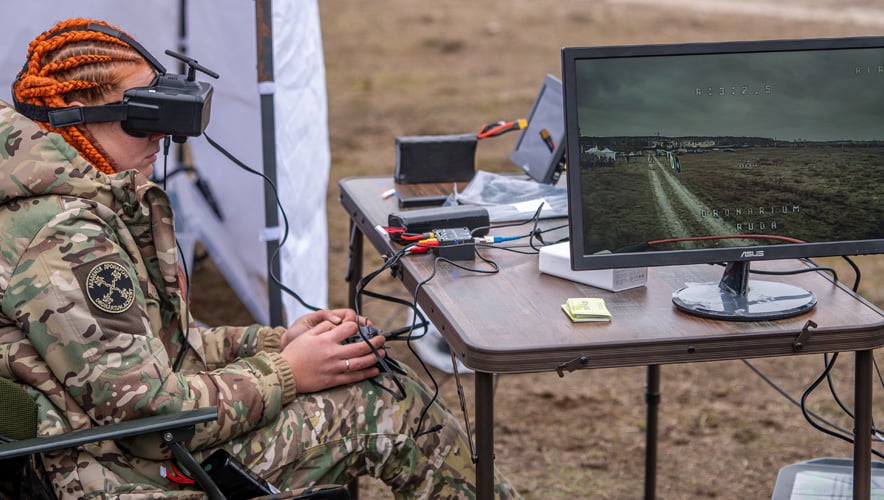
KYIV OBLAST, Ukraine - 29 January 2025: A Ukrainian soldier, wearing a virtual reality headset, operates a fiber-optic drone during a test flight. (Photo by Dan Bashakov, Global Images Ukraine, Getty)
Evidence of their destructive capacity is plentiful. Fiber-optic drones are racking up hundreds of casualties and millions of dollars in property damage across the Ukraine-Russia conflict. Both sides are using them daily to attack enemy positions and vehicles with startling efficiency. Where normal drones would lose radio signal in cluttered environments, fiber optic drones can weave their way through forests, around buildings, down hallways, and virtually anywhere their frame can fit through to deliver a deadly explosive payload.
News of these drones and what they can do is already all over the Internet. Hostile state actors and domestic violent extremists (DVEs) are always looking for an edge, a new way to achieve their aims—and the destructive capacity of fiber optic drones is within easy reach.
How Can You Detect Fiber-Optic Drones?
Currently, the two best bets for detecting fiber-optic and other stealth drones are acoustic sensors and radar. These technologies stand a chance because neither of them rely on the radio broadcasts of the drone but rather on the drone’s physical presence.
Acoustic sensors pick up the noise that drones make, usually from the drones’ rotors. The downside is that acoustic sensors struggle in noisy environments or in adverse weather conditions. They can still be useful in quiet environments, though.
Radars detect the actual physical presence of the drone units in the airspace. Not just any radar can do the job though. Drones are often small, so they often have a much smaller cross section than people, boats, vehicles, and airplanes—the kind of targets usually detected and tracked by long-distance radar. As a result, large, traditional radar systems struggle to detect drones, especially small drones that fly low to take advantage of ground clutter. Fiber-optic drones in particular excel at flying low and weaving their way around these objects.
Compact surveillance radars, which are smaller, shorter-range radar systems, have proven more effective at detecting stealth drones. Built to focus on smaller ranges and detect smaller targets, compact radar systems track ground and airborne threats up to 2,000 meters away. Because they detect motion through radio waves and non-visible light, radars identify threats reliably through darkness, fog, snow, rain, and other environmental obscurants. Some radar systems even come with artificial intelligence classification models that allow them to reliably classify target types at a distance, distinguishing sparrows from fiber optic drones and flocks of geese from swarms of drones. This greatly reduces false and nuisance alarms while maintaining site security.
How to Respond When a Drone’s Detected
Shoot it down, laser it down, send another drone to crash into it before it reaches its target, duck and cover—it all depends on what your legal authority to intercept the drone is and your capability. Whatever you do, it will need to be done fast, especially if the drone in question is on an attack mission and not a reconnaissance mission.
Much of the current obstacles for protecting critical infrastructure sites against fiber optic drones lie in the legal prohibitions against drone mitigation in many nations. In the United States, for example, security forces are prohibited from taking direct mitigation action against drones, that is jamming them or shooting them down, under the Aircraft Sabotage Act.
It is reasonable to prohibit shooting down or jamming drones in most situations. A downed drone could easily hurt someone as it falls. And it’s true that interfering with a drone’s radio communications could have negative impacts on other aircraft and radio devices in the area. But if any locations should be granted special permissions for drone mitigation, it should be those facilities that keep the lights on, the water running, and our nations secure. It is urgent that drone mitigation permissions be granted to critical infrastructure facilities.
Looking Forward: The Threat and How We Prepare for It
Laws are slow to change. But the better prepared critical infrastructure sites are to detect and document the first threats, the sooner compelling evidence can be presented to lawmakers to drive legislative change. And the sooner laws change, the sooner full protections for critical infrastructure sites can be implemented across the country.
Fortunately, early adopters have already gotten started. Many critical infrastructure providers across the United States, especially energy companies, have already invested in radar-based drone detection systems to protect their most sensitive locations. Protecting key power grid locations is of special concern because experts have warned that if enough key substations were taken offline, the result could be catastrophic, cascading power outages across the nation’s aging power grid. Many other critical infrastructure sectors depend on the power grid, and few, if any, communities and government installations are prepared to survive or withstand prolonged blackouts.
If we are fortunate, the fiber-optic and other stealth drone threat will develop gradually, allowing for the example of early adopters of bringing the needed laws and other defenses into place quickly enough to protect from disaster. If the threat lands quickly and strikes early with coordinated attacks against multiple key locations, the consequences may be far reaching in their damage to civilian life and national security.
Logan Harris is the founder, CEO, and president of Spotter Global. Harris is an experienced entrepreneur with a deep technical background in radio frequency and digital signal processing. He founded Spotter in 2009 and created the first compact surveillance radar for warfighters and critical infrastructure. Harris holds a master’s and bachelor’s degree in Electrical Engineering from Brigham Young University.