New Research Probes Current State of Worker Stress and Mental Health
The National Alliance on Mental Illness (NAMI) released findings from its annual survey of U.S. worker attitudes on mental health earlier this month. Spoiler: the state of the world and workplace pressures have created a stressed workforce, and the last place people want to talk about it is with their organization’s leaders.
The survey reached 2,153 adults who work at companies in the United States with at least 100 employees. The survey was fielded from 27 January to 2 February by polling company Ipsos.
Top-Level Finding: Workers feel stressors from a variety of sources, which has negatively impacted their mental health.
• Nearly a third (30 percent) of workers reported being very stressed about the state of the world in the past six months, and another 41 percent reported being somewhat stressed.
• While 82 percent reported that their mental health is either very good or somewhat good right now, 54 percent are either very concerned or somewhat concerned about their stress levels.
• More than half of workers (53 percent) report that at some point in the last year, they felt burned out because of their job.
• 38 percent said that at some point their mental health had suffered because of demands at work, and 39 percent said they had felt so overwhelmed it made it hard to do their job.
• A quarter of people (26 percent) said they considered quitting because of their work’s impact on their mental health, and at least* 6 percent actually had followed through and quit because of it. (*The survey only included current workers, so people who had quit and not found another job would not be represented.)
• Workers who are caregivers to children or parents experience additional effects. Workers in the sandwich generation—providing care to both children and parents—are much more likely to have considered quitting work because of mental health concerns (37 percent compared to 26 percent overall) or actually quit (16 percent compared to 6 percent).
Top-Level Finding: Many workers feel a stigma about discussing their mental health, and worker perceptions of their leaders are particularly dim.
• On the positive side, an overwhelming majority of people reported they would feel comfortable discussing mental health issues with a colleague they considered a friend (83 percent), that number drops to less than two-thirds of people who are comfortable having such conversations with their team members (61 percent) or their manager (57 percent). The numbers nosedive if the conversations are with human resources personnel (39 percent) or the organization’s senior leaders (30 percent).
• To the more generic question, “How comfortable do you feel sharing about mental health at work?”, only 61 percent reported being very comfortable or somewhat comfortable. For those that said they would be uncomfortable, “stigma or judgment around mental health” was the most frequent reason, cited by 41 percent; another 33 percent said they did not want to “seem weak.”
• More than three-quarters of workers (78 percent) said they think their manager or supervisor cares about them. However, only half (51 percent) said the company’s senior leadership cared about them.
Top-Level Finding: This is the third year of the NAMI survey. There have not been any dramatic shifts in the numbers, with many of the findings staying the same or within a percent or two from year to year. However, while the movement has been small, some areas are trending in the wrong direction.
• When workers were asked to rate the current state of their mental health, the number saying it was very good or somewhat good declined from 86 percent in 2024 to 85 percent in 2025 and 82 percent in 2026. Looking at only those who rated it very good, the decline is more pronounced, falling from 38 percent in 2024 to 31 percent in 2026.
• Workers who reported that they are concerned about their own mental health has increased from 35 percent in 2024 to 38 percent in 2025 and 43 percent in 2026. The survey found a similar trend with worker concern about stress levels, going from 48 percent in 2024 to 54 percent in 2026.
• While diversity, equity, and inclusion (DEI) initiatives have come under fire in U.S. workplaces, the survey did not find an increase in discrimination in the workforce. The percent of workers who said they felt discriminated against or looked down upon at work for their race, ethnicity, or country of origin has remained a constant 16 percent from 2024 to 2026. Discrimination based on gender identity was reported by 7 percent each year from 2024 through 2026; and for sexual orientation, it was 4 percent in 2024 and 5 percent in both 2025 and 2026.
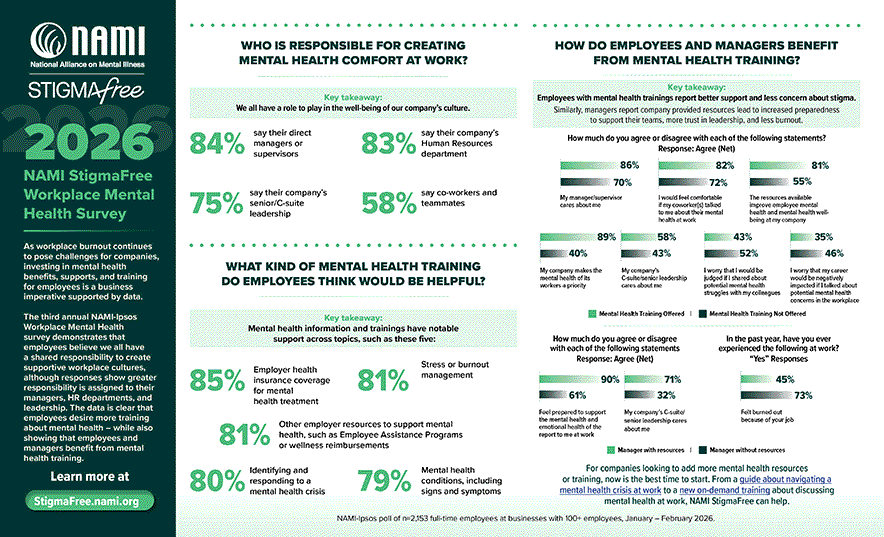
Source: National Alliance on Mental Illness
Six strategies to combat burnout from security staff.
Security staff often operate in jobs that are ripe for burnout. Some jobs require high stress confrontations while others can be monotonous monitoring of alerts. However, the stakes of security personnel during their job well are incredibly high. In a January Security Management article, ASIS members Eric Davoine, CPP, and Gigi Agassini, CPP, shared insight on fighting security personnel burnout.
1. Creating a work culture where security teams feel valued and heard is fundamental. This can be achieved through open communication, where staff can voice their concerns freely. Transparency helps identify issues early, allowing for timely interventions.
2. Promoting a balance between work and personal life is essential. Providing flexible schedules, part-time work options, or the ability to work remotely for administrative tasks can help employees better manage their personal responsibilities. Implementing policies that discourage after-hours communication further reduces stress and promotes a healthier work-life dynamic.
3. Investing in the growth and development of security personnel keeps them engaged. Ongoing security awareness training, certifications, and career advancement opportunities help staff stay up to date with current challenges, reducing the stress associated with feeling unprepared. Encouraging employees to learn new skills or engage in different aspects of security work can enhance their capabilities and job satisfaction.
4. Effective management strategies are crucial. Managers should be trained to recognize signs of burnout and provide immediate support, offering resources like counseling or stress management training. Programs that include meditation, relaxation exercises, and resilience training have been shown to reduce burnout symptoms.
5. Leveraging technology. Technology can play a pivotal role in alleviating the burden of repetitive tasks, particularly in security operations where efficiency and accuracy are paramount. Tools like phishing simulators and automated security systems can streamline processes, reducing the need for manual intervention in routine tasks. Similarly, automated security systems can monitor networks, flag anomalies, and even neutralize low-level threats without human intervention.
6. Prioritizing mental health resources. Resources are a vital component of fostering a supportive workplace environment, especially in high-stress fields like security. Offering accessible and confidential counseling services, organizing stress management workshops, and implementing mental health days not only demonstrate an organization’s commitment to employee well-being but create a culture where mental health is valued and normalized.
Stress-related mental injury is an emerging factor in workplace safety.
A Reuters commentary noted that “31 states, including New York, Florida, and Connecticut, have passed or are considering legislation that provides coverage for workplace trauma and stress-related conditions, identifying them as injuries that are compensable under workers compensation schemes. While the majority of the legislation focuses on supporting first responders and healthcare workers, there are also states, such as New York, that are pushing for more expansive laws to protect workers across all industries.”
In California, which the article noted is often a bellwether in employment law trends, worker compensation claims for anxiety, post-traumatic stress disorders, and depression have increased by 25 percent since 2022.
“One issue that lawmakers, insurers, and employers will have to confront is defining the parameters around what constitutes a compensable mental health injury,” the commentary said. “While certain trauma injuries may clearly warrant inclusion, others may fall into a more ambiguous category. For example, the legislation in New York recently passed leaves the term ‘extraordinary work stress’ undefined, which leaves the door open for various interpretations. It will also make it difficult to distinguish what stress is caused by work, as opposed to other non-work-related challenges.”
ASIS has covered mental health in security sector with many resources through the years.
The six strategies from Davoine and Agassini were from an article that was part of a package of eight Security Management articles focused on mental health and burnout published in January. Other articles covered resilience leaders; how multiple stressors, or the polycrisis, affects security professionals; and how long hours of video surveillance review affects the brain.
In addition, ASIS Connects has the Mental Health and Wellness Working Group, “an open community for all ASIS members interested in having an open dialogue and building a library of shared resources aimed at helping security professionals support their team’s mental health and wellness.”
The founder of the working group, Mike Hurst, CPP, CPOI, authored a blog post on the topic for the ASIS Blog in 2023. He offered these tips on recognizing potential signs of mental illness:
• A change in behavior. Is someone who was previously outgoing and friendly now withdrawn and irritable?
• Do they appear anxious or worried?
• Are they acting aggressively?
• Are they having mood swings?
• Is someone who is normally punctual and well presented, suddenly regularly late and disheveled?
• Has their interaction with colleagues changed?
• Increase in alcohol consumption or use of illegal substances can also be a sign of self-medication to deal with mental health problems.
• Being less productive at work.
• Confusion.
• Inability to complete tasks.
If you have concerns, he noted, it’s important not to try to diagnose or treat the person. Your best recourse is likely to involve human resources or management.