Organizations, Travelers Are Stuck Between Evacuation Orders and Limited Routes in Middle East
The U.S. State Department urged citizens on Monday in 14 Middle Eastern countries to “depart now” in the wake of widespread missile strikes related to U.S. and Israeli attacks on Iran and Iranian counterstrikes.
U.S. Assistant Secretary Bureau of Consular Affairs Mora Namdar advised Americans in Bahrain, Egypt, Iran, Iraq, Israel, Jordan, Kuwait, Lebanon, Oman, the Palestinian territory, Qatar, Saudi Arabia, Syria, the United Arab Emirates, and Yemen to depart using any available transportation.
Despite that guidance, many U.S. tourists, business travelers, and other citizens are stuck. There are few flights out of the region and no clear instructions on how to exit safely.
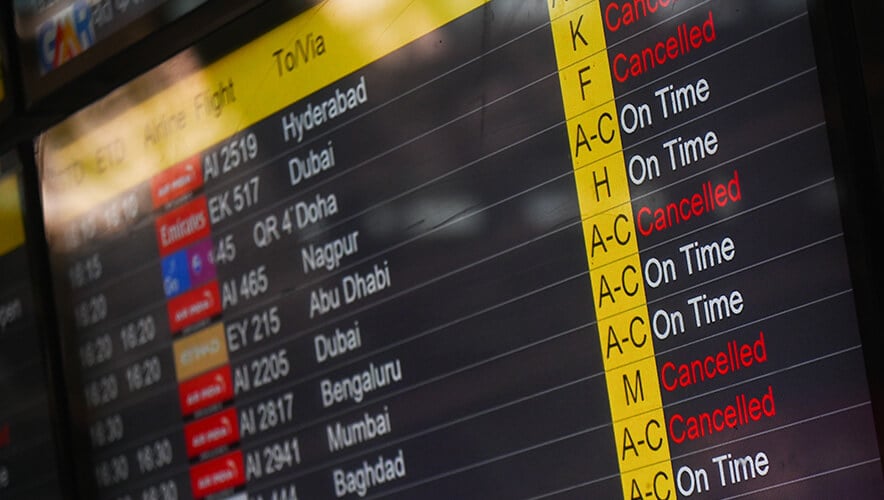
In the days after the war began on 28 February, nearly 20,000 flights to and from the Middle East were canceled. Major Gulf hubs, including the world’s busiest international airport in Dubai, were closed for days. Dubai Airports resumed small number of flights on 2 March but nowhere near its usual capacity.
The travel disruption has been described as the biggest since the COVID-19 pandemic.
Airlines are also scrambling to reroute flights around the conflict zone, which has become a gaping hole in the sky for global air travel, CNN reported. Because of the changes, aircraft are displaced, crews are stranded, fuel costs and use have surged, and delays and disruptions abound. The disruption is particularly problematic because many long-haul flights from Asia to Europe route through or have layovers in the Gulf, causing additional delays and cancelations.
“Effectively, within the Middle East, an eight-hour flying distance covers two-thirds of the world population,” international aviation and tourism consultant Anita Mendiratta told Al Jazeera. “When that corridor is blocked, it forces aviation to either move far north, which is going into potentially other conflict airspace, such as Russia, such as Pakistan, or fly south. That puts huge pressure on the airlines.”
The U.S. State Department said that more than 9,000 Americans have already returned from the Middle East and that it is assisting 3,000 Americans who reached out for assistance to book commercially available flights out, The New York Times reported. The department added that it is securing military and charter planes to pick up American citizens who want to evacuate, but travelers say that help has not yet manifested.
In response to the war in Iran and the surrounding countries, British and French governments have arranged charter flights to evacuate vulnerable nationals from the Middle East; the first of those flights are departing today. Tens of thousands of British and French citizens have registered their interest in being helped to leave the region as a result of the conflict.
Elsewhere, some wealthy travelers are paying up to 200,000 euros ($232,000) for luxury charter flights to Europe from smaller airports that have not been targeted by Iranian drone and missile strikes, Reuters reported.
But that option is not available to most travelers, many of whom are confused by the government guidance and the lack of routes to follow that guidance, says Don Aviv, CPP, PCI, PSP, CEO at global business intelligence and security consulting firm Interfor. It has about 3,000 clients—both individual and institutions, such as family offices, high-net-worth individuals, and international universities—currently located in the Gulf region.
“On the U.S. side, the U.S. State Department has had very confusing notifications thus far,” Aviv says.
An Overseas Security Advisory Council (OSAC, part of the U.S. State Department) meeting with private-sector stakeholders two days ago said that there were no plans to mandate widespread evacuations and that sheltering-in-place was the best course of action. But hours later in a post on X, Assistant Secretary Namdar told U.S. citizens in the region to evacuate using any commercial means available, Aviv says.
“There’s a lot of confusion; it’s led to panic on some levels,” he adds.
Getting out of the affected Gulf countries right now is also very complicated. There are few commercial routes open because of signal-jamming risks, as well as military requests to keep airspace clear. Maritime exit routes are particularly dangerous (if they are available at all) due to military strikes and closures in the Strait of Hormuz. People can try to take land transportation to less affected airports, such as those in Saudi Arabia or Egypt, but that could be an eight- to 12-hour drive on increasingly clogged roadways and hours-long waits at border checkpoints with no guarantee of a flight at the end of the journey, Aviv says.
“It is our belief that within the next 72 hours, the level of shutdowns when it comes to the skies will begin to diminish,” he says. “So, it is our belief that sheltering in place is the best route forward, for a variety of reasons, and then we shall readvise and reassess in 72 hours.”
The primary risk management challenge organizations and individuals are facing today in most Gulf states is confusion, Aviv says. Most individuals are not in direct harm’s way, and sheltering in place for a limited time is likely the best option until clearer intelligence and travel opportunities become available. But the government messaging, paired with a lack of options to follow it, has been tough to navigate.
“That’s been the complicating factor here,” he says. “Usually, we look to government to provide advice and guidance. And in this situation, there’s also liability concerns. So, if you’re a security director with operations in the region and you need to make a decision—do you shelter in place or evacuate—who do you listen to for advice? Do you listen to the U.S. authorities, the local authorities, or foreign authorities? I can’t remember a time like this in recent history where this kind of confusion has existed.”
Interfor is recommending that security directors speak to their external consultants, talk to other security directors, and get additional perspectives to inform decisions, rather than “waiting for drips and drabs from the U.S. government,” Aviv says.
When making decisions that run contrary to official government guidance, though, organizations should be careful to document their decision-making process to defend against potential duty of care or liability arguments.
“The question now is: How do you either go against the State Department’s notification or how do you try to follow them without a viable route?” he says.
Aviv adds that, “I would say, from a liability standpoint, this is a time of war, and in a time of war, decisions need to be made on the ground. So, document every decision you make, document how you reached that decision—who you spoke to, what information you were ingesting, and what information sources you were relying upon to make your decision. At the end of the day, there’s no right or wrong decision during a time of war, but it’s best effort here, and we have to move forward with our best efforts.”
For more lessons learned about mass evacuations, read this series from Security Management about the major evacuation efforts during the breakout of war in Ukraine, among other incidents.