Strait of Hormuz Closure: Impacts on Oil and Supply Chains
After the United States and Israel began major combat operations on 28 February, including strikes against Tehran and parts of Lebanon, Iran announced the closure of the Strait of Hormuz.
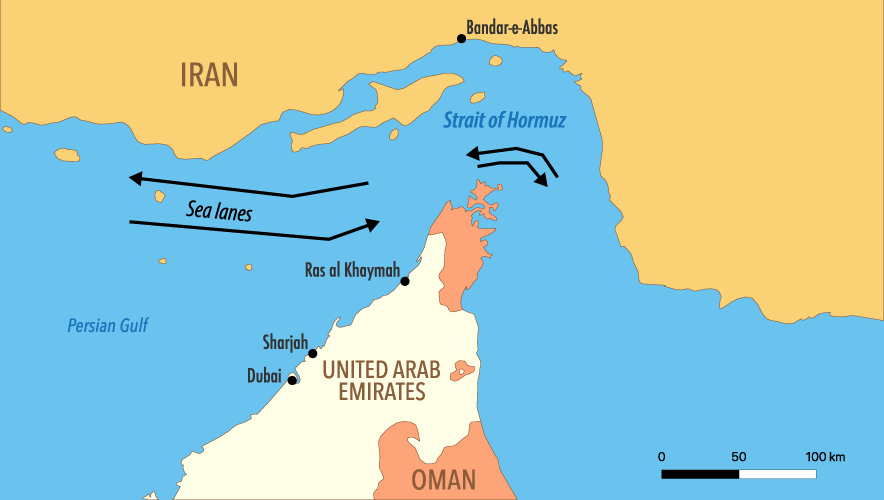
The strait runs between Iran and Oman, and about one-fifth of the world’s oil passing through it, mostly on its way to Asia, according to the Associated Press. Iran controls the fourth-largest proven oil reserves in the world, maintains the second-largest proven gas reserves, and is one of the largest crude exporters.
The strait, which connects the Persian Gulf to the Gulf of Oman, is roughly 20 miles at its widest point; however, the shipping lines running through it are only 2 miles wide. From the Gulf of Oman, ships exiting the strait can then cruise toward the rest of the world.
“The strait serves as a critical transit route—and potential chokepoint—for global crude, with about 13 million barrels per day moving through it in 2025, equal to approximately 31 percent of all seaborne oil flows, Kpler data showed,” CNBC reported.
Over the weekend, Iranian Revolutionary Guards warned that any ships attempting to use the strait would be targeted. Iran has since attacked several ships trying to sail through the strait.
“At least five tankers have been damaged, two personnel killed, and about 150 ships stranded around the strait,” Al Jazeera reported.
On 2 March, an official from the Revolutionary Guard announced that the strait had been shut down.
Alternatives to the strait are limited, making it an effective bottleneck for Opec oil deliveries to customers. “Any disruption to traffic through the Strait of Hormuz is highly disruptive to the oil trade,” the AP reported.
Flashpoint analysts said in commentary emailed to Security Management that the move is part of the Revolutionary Guard’s larger declaration of war on energy supplies throughout the Middle East, “an intent to inflict maximum global economic pain as a counter-pressure to military losses.”
Experts estimate that crude oil prices could jump to $100 per barrel due to the closure, especially if the conflict becomes prolonged (as of 3 March, crude oil was around $79 per barrel). If the military conflict continues, “we are looking at the worst-case scenarios for oil, including a major disruption of oil flows through the Middle East,” Vandana Hari, CEO of energy research firm Vanda Insights, told CNBC. This price increase would result in economic impacts on developed economies dealing with inflation and strains on costs of living.
Other energy impacts could include exacerbated natural gas prices in the European markets and a disruption to South Asia’s access to LNG supplies. An estimated 99 percent of Pakistan’s LNG imports come from Qatar and the UAE, which also provides 72 percent of Bangladesh’s LNG imports and 53 percent of India’s, CNBC reported.
Although China also relies on energy resources that depend on access to the strait—purchasing more than 80 percent of Iranian crude—data from vessel tracking firm Kpler indicates that the nation has enough crude oil and LNG stockpiled to provide some economic buffer.
In response to the closure, global carriers announced that they have suspended operations through the strait and to certain ports, including CMA-CGM, Hapag-Lloyd, Maersk, and MSC.
“In order to safeguard cargo and maintain continuity of service, we have implemented contingency measures across the affected routes, including alternative routings and operational adjustments. As such, it has been necessary to implement an emergency freight increase to cover these constraints and increased operating costs,” Maersk said in a press release.
Further straining costs for shippers was the announcement from multiple maritime insurers—including Gard and Skuld, NorthStandard, the London P&I Club, and the American Club—about the cancelation of war risk cover for ships traveling in the Gulf region, effective 5 March, according to The Guardian. War risk cover usually covers shipowners for any costs or damage due to war, terrorism, and piracy.