Legal Report: DHS Funding on the Line Amidst ICE Reform Effort
Megan Gates here with our monthly Legal Report column. The Security Management team has been following immigration enforcement actions in Minnesota closely, looking at how U.S. Department of Homeland Security (DHS) activity is affecting the security and safety of people and businesses in the community.
State and local officials in Minnesota have been leading efforts to stop DHS’s most aggressive tactics. But this week, Democratic leaders in the U.S. Congress are entering the fray by using DHS funding as leverage to push the department to reform.
And with that, we’ll dive into it.
- An ICE-y situation on Capitol Hill
- EU Commission misses AI deadline
- UK to give defense personnel drone takedown authority
- Shinzo Abe’s attacker sentenced to life in prison
- Australia enacts new gun restrictions after Bondi Beach
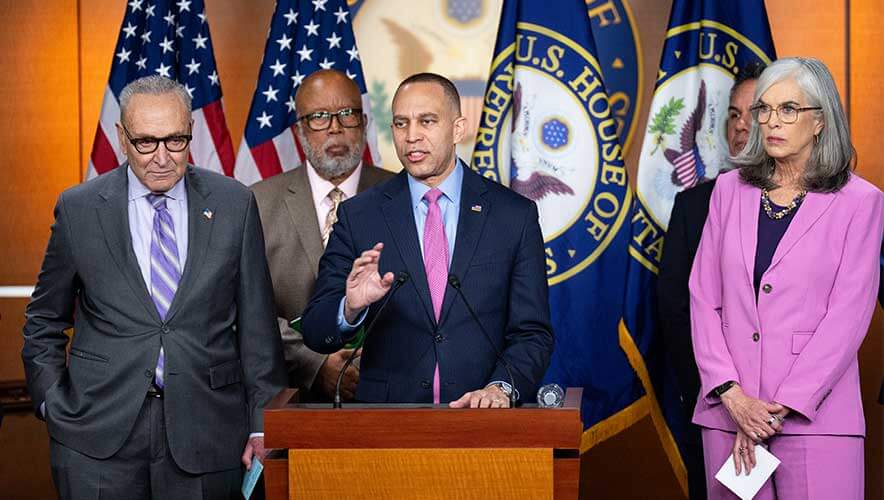
UNITED STATES - 4 FEBRUARY 2026: U.S. House Minority Leader Hakeem Jeffries (D-NY), speaks during the House and Senate Democrats' joint news conference on DHS funding negotiations in the U.S. Capitol on Wednesday, 4 February 2026. Jeffries is flanked from left by U.S. Senate Minority Leader Chuck Schumer, (D-NY), U.S. Representative Bennie Thompson (D-MS), House Democratic Caucus chair Pete Aguilar (D-CA), and House Minority Whip Katherine Clark (D-MA). (Bill Clark/CQ-Roll Call, Inc via Getty Images)
DHS Funding on the Line Amidst ICE Reform Effort
Homeland security is at a breaking point. Democratic members of the U.S. Congress are pledging to discontinue funding for DHS if Republicans fail to pass bipartisan legislation to reign in aggressive U.S. Immigrations and Customs Enforcement (ICE) activity.
“Taxpayer dollars should be used to make life more affordable for everyday Americans, not to brutalize or kill them,” said U.S. Senate Minority Leader Chuck Schumer (D-NY) in a press conference on 4 February. “ICE is completely and totally out of control. Immigration enforcement should be just. It should be fair. And it should be humane. That is not what is taking place right now.”
The timing. Schumer’s comments come after widespread criticism of the use-of-force and operational tactics that DHS agents—from both ICE and the U.S. Customs and Border Patrol (CBP)—have used to carry out immigration enforcement in Minnesota. During the last three months of Operation Metro Surge, ICE and CBP officers have arrested and detained children, entered public schools, used less-lethal ammunition on protesters, and shot and killed two U.S. citizens.
In a letter to U.S. Speaker of the House Mike Johnson (R-LA) and U.S. Senate Majority Leader John Thune (R-SD), U.S. House Minority Leader Hakeem Jeffries (D-NY) and Schumer provided 10 reform measures that Democrats want DHS to adopt:
- Targeted enforcement. Change policies to prevent DHS officers from entering private property without a judicial warrant, improvements to warrant procedures and standards, and requirements to verify that an individual is not a U.S. citizen before holding them in immigration detention.
- Ban masks. Prohibit ICE and immigration enforcement agents from wearing face coverings while on duty.
- Provide identification. Require DHS officers conducting immigration enforcement to display their agency, unique ID number, and last name. Officers must also be required to verbalize their ID number and last name, if asked.
- Protect sensitive locations. Prohibit DHS funds from being used to conduct immigration enforcement near sensitive locations, including medical facilities, schools, child-care facilities, churches, polling places, and courts.
- Discontinue racial profiling. Prevent DHS officers from conducting stops, questioning, and searches based on an individual’s presence at certain locations, their job, their spoken language and accent, or their race and ethnicity.
- Uphold use-of-force standards. Place into law a reasonable use of force policy, expand training, and require certification of officers. If an incident occurs, DHS must require the officer to be removed from the field until an investigation is conducted.
- Ensure state and local coordination and oversight. Preserve the ability of state and local jurisdictions to investigate and prosecute potential crimes and use of excessive force incidents. Require that evidence is preserved and shared with jurisdictions and require the consent of states and localities to conduct large-scale operations outside of targeted immigration enforcement.
- Build safeguards. Ensure that buildings where people are detained abide by the same basic detention standards that require immediate access to a person’s attorney to prevent citizen arrests or detention. Allow states to sue DHS for violations of these requirements and prohibit limitations on members of Congress visiting ICE facilities.
- Use body cameras for accountability. Require use of body-worn cameras when interacting with the public and mandate requirements for storage and access of their footage. Policies for these cameras should prohibit tracking, creating, or maintaining databases of individuals participating in First Amendment activities.
- End paramilitary policing. Regulate and standardize the type of uniforms and equipment DHS officers carry during enforcement operations to bring them in line with civil enforcement.
If Republicans fail to work with Democrats to pass these reforms, Democratic leaders have pledged to discontinue funding for DHS for the rest of the fiscal year—shutting down the department until a deal can be made.
“We are not going to fund a rogue department with its unchecked agents and officers,” Jeffries explained. “We are going to have accountability at DHS, or there will not be Democratic votes to fund a lawless agency.”
Lapse in funding ramifications. Congress has until 13 February to negotiate and pass the reforms before DHS’s funding runs out. Senate Majority Leader John Thune (R-TX) told Politico that meeting that timeline is close to impossible, and other Republican members of Congress have said they will not support requiring DHS reforms.
DHS is a massive department, which includes ICE, CBP, the Transportation Security Administration (TSA), the U.S. Coast Guard, the Federal Emergency Management Agency (FEMA), the Cybersecurity and Infrastructure Security Agency (CISA), and the U.S. Secret Service.
If funding for the department lapses, ICE and CBP operations will continue—as well the critical law enforcement, security, and life-safety work that DHS agencies carry out. Personnel performing those duties, however, will not be paid until Congress reaches a funding agreement.
Battle in the courts. Meanwhile, Minnesota officials are turning to the judicial system to stop ICE and CBP activities. Duluth and Fridley Public School Districts—along with the union Education Minnesota—filed a lawsuit on 4 February to block DHS from conducting immigration enforcement activity on or near public schools in the state.
The plaintiffs argue that the federal activity has disrupted education, endangered students, and driven families from classrooms, undermining access to public education.
“Students can’t learn, and educators can’t teach, when there are armed, masked federal agents stationed within view of classroom windows, sometimes for days on end,” said Monica Byron, president of Education Minnesota, in a press release. “ICE and Border Patrol need to stay away from our schools so students can go there safely each day to learn without fear, and so that our members can focus on teaching instead of constantly reacting to the shocking and unconstitutional actions of federal agents.”
The suit joins a state of Minnesota lawsuit that claims Operation Metro Surge violates the 10th Amendment of the U.S. Constitution by challenging its right to have sanctuary cities, or policies that limit cooperation with federal immigration enforcement. Minnesota had requested a temporary restraining order to halt the operation until the suit makes its way through the court system. U.S. District Judge Katherine Menendez did not issue that restraining order, though, instead ruling on 31 January that immigration enforcement can continue despite evidence that DHS agents have engaged in racial profiling, excessive use of force, and other harm.
“However, those are not the only harms to be considered,” Menendez wrote. “The Eighth Circuit has recently reiterated that entry of an injunction barring the federal government from enforcing federal law imposes significant harm on the government.”
The administration’s reaction. After DHS officers shot and killed U.S. citizen Alex Pretti in Minneapolis last month, the Trump administration heeded some calls to change the department’s tactics.
U.S. President Donald Trump sent his border tsar, Tom Homan, to Minnesota to oversee Operation Metro Surge, removing CBP’s Greg Bovino from the helm. Homan later pledged to withdraw 700 immigration agents from the state, and DHS Secretary Kristi Noem announced a plan to provide agents with body cameras to increase transparency.
Despite those promises, though, more than 2,000 DHS agents will remain in Minnesota—a force that vastly outnumbers the local law enforcement presence of approximately 600 sworn officers—and there has been no discussion on changing tactics or opening independent investigations into its use of force.
Other News to Note
EU Commission misses AI mark. EU Commissioners failed to produce guidance for high-risk artificial intelligence (AI) operators by the 2 February EU AI Act deadline. The commission said it would publish a final draft of the guidelines for feedback by the end of February. But the delay means that enforcers and businesses both will be hard-pressed to implement the AI Act’s mandates for high-risk systems before they enter into enforcement on 2 August 2027.
Trump attacker sentenced. U.S. federal judge Aileen Cannon sentenced Ryan Routh, 49, to life in prison for attempting to assassinate then-former U.S. President Donald Trump. Routh was convicted of attempted assassination of a major presidential candidate, assault of a federal law enforcement officer, and multiple firearms offenses for attempting to kill Trump at his Florida golf course in September 2024. Trump was not injured in the incident and was taken to safety by U.S. Secret Service agents as shots were fired.
UK to add drone defeat authority. UK legislators are considering legislation to grant defense personnel new powers to take down drones that threaten Ministry of Defense sites. The Armed Forces Bill would allow defense personnel to destroy aerial, land, and maritime drones that pose a threat. The Ministry of Defense requested the authority be added after tracking more than 250 drone incidents near UK military sites in 2025, double the number of incidents in 2024.
Job applicants push back on AI. A group of job applicants filed a class action lawsuit to hold AI employment screening tools subject to the Fair Credit Reporting Act requirements credit agencies must meet. The applicants are suing Eightfold AI, claiming that the company’s screening tool used by major employers can become an algorithmic gatekeeper that prevents them from advancing in the hiring process.
Speed Reads
Court Cases
- Executive protection. A Japanese court sentenced Tetsuya Yamagami, 45, to life in prison for assassinating former Japanese Prime Minister Shinzo Abe in July 2022. Yamagami had confessed to killing Abe because he wanted to expose politicians’ ties to the Unification Church, which he blamed for his mother’s neglect of him as a child.
- Corporate liability. A U.S. federal jury found Walmart negligent for selling a shotgun to former employee Jacob Mace, 23, who then used the gun to die by suicide. Mace’s family sued Walmart after his death, claiming that store managers knew he was suicidal and did not take action to prevent him from buying a firearm. The jury ordered Walmart to pay $10.5 million in damages.
- Emergency entry powers. The U.S. Supreme Court ruled that law enforcement officials can enter a person’s home without a warrant if they have an “objectively reasonable basis for believing” that someone inside needs emergency assistance. The unanimous Court decision stemmed from a lawsuit filed by a homeowner who was disrupted in attempting to take his own life when local law enforcement entered his home after being tipped off by his ex-girlfriend.
- Espionage. A U.S. federal judge sentenced Jinchao Wei, 25, to more than 16 years in prison for selling technical and operating manuals for ships to a Chinese intelligence officer. Wei, a former U.S. Navy sailor, provided the sensitive military information after being recruited by the intelligence officer over social media.
Legislation
- Masking. The U.S. state of Maryland’s Senate passed legislation that bans law enforcement officers from wearing masks while working. The bill tasks the Maryland Police Training and Standards Commission with creating a uniform policy prohibiting law enforcement—including federal agents—from wearing facial coverings in the normal course of their work, with exceptions for undercover officers, life-safety equipment, and harmful environmental conditions.
- Gun restrictions. Australia enacted new laws to create a national gun buyback program, limit firearm imports, and tighten background checks. The country is implementing the gun restrictions following a mass shooting at Bondi Beach in December 2025 that killed 15 people at a Hannukah celebration.
- Misconduct liability. Californians are collecting signatures for a ballot initiative that would make ride-hailing companies, like Uber and Lyft, responsible for sexual misconduct and assault against drivers and passengers. If more than 546,651 registered voters sign the petition before 1 July 2026, the state will add the measure to ballots for the general election in November 2026.
Thanks for reading! We’ll be back with more legal analysis in March.
What security-related regulatory developments are you following? Please email your thoughts to [email protected]
Megan Gates is senior editor at Security Management. Connect with her via email or on LinkedIn.