Perceived Political Violence Risks Push Factions Toward Preemptive Retaliation, Researchers Warn
Is America at a turning point or a flashpoint when it comes to political violence?
Political scientists seem at odds when evaluating the current situation following the murder of right-wing activist Charlie Kirk, seeing the attack as another nudge toward an era of violent, tit-for-tat political strife or as another in a long line of lone actor, individualized violence.
“We are now at a watershed moment in the United States,” said University of Chicago Political Science Professor Robert Pape in a call with reporters on 11 September. Pape noted that incidents of political violence—including the assassination of Kirk—are no longer unpredictable events.
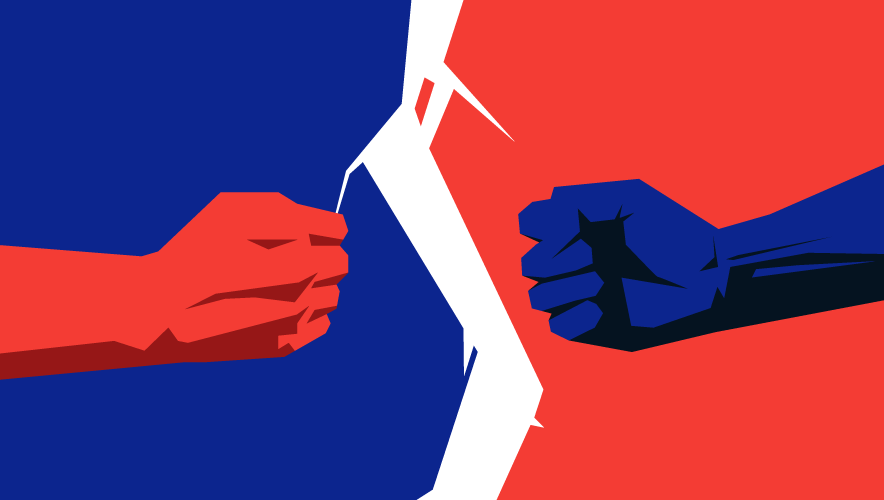
Pape explained that America is in a rising era of violent populism—not civil war, but definitely not politics as normal—and that further political violence from factions on both the right and the left of the political divide is likely if public officials do not take swift action to de-escalate partisan tensions.
Political violence is now at its highest level in the United States since the 1970s. In the first half of 2025, there were roughly 150 recorded politically motivated attacks—almost double from the same period in 2024. Threat actors have crossed the political spectrum, including right-wing extremists, left-wing militants, and unaffiliated actors, according to the Toda Peace Institute.
But unlike in the 1960s and 1970s, when political polarization focused on specific issues like civil rights or the Vietnam War, the current environment is more nebulous, without a clear goal that both sides could work toward. This leaves parties in an ideological quagmire, with tensions instead bubbling over into hostility rather than being channeled into productive action.
As part of his work directing the Chicago Project on Security and Threats, Pape measures Americans’ levels of support for political violence around a variety of issues. The more public support there is for political violence, the more common it is, he warned.
In May 2025, a Chicago Project on Security and Threats benchmarking survey found that about 40 percent of Democrats supported the use of force to remove U.S. President Donald Trump from the presidency, and about 25 percent of Republicans supported the use of the military to stop protests against Trump’s agenda. The numbers more than doubled since Fall 2024, Pape said.
On a positive note, 70 percent of Americans continue to abhor political violence in any of the situations presented, Pape’s research found, but the fringes present legitimate and ongoing risks.
Pape said he was most concerned about the spiral dynamics of violent populism, with fear, anger, and fundamental misperceptions of the other side driving each faction to retaliate or escalate situations.
Political assassinations also come in waves, said University of Massachusetts Lowell Scholar and Professor in Security Studies Arie Perlinger in an interview with PBS Newshour.
“We see that not only in the United States but other countries,” Perlinger said. “I’ve looked at political assassinations in many democracies, and one of the things I see in a fairly consistent manner is that political assassinations create a process of escalation that encourages others on the extreme political spectrum to feel the need to retaliate. And that is my main concern. That this process creates legitimization and acceptance, that it provides the sense that this is an acceptable form of political action. This will not end here.”
In analysis published by POLITICO, Sean Westwood, director of the Polarization Research Lab and an associate professor at Dartmouth College, wrote that a “mass movement of political violence is not happening.”
During the past three years, Westwood has tracked public support for political violence and found that less than 2 percent of Americans believe political murder is acceptable.
“The core problem is not a widespread desire for violence, but a profound misperception of the other side,” Westwood explained. “My data also show that Americans estimate nearly a third of their political opponents support partisan murder. This belief that one is facing a vast, murderous faction—rather than a few isolated extremists—creates a phantom enemy that makes the country feel far more dangerous than it actually is.”
The Polarization Research Lab found that 57 percent of the 1,000 Americans surveyed last week are strongly polarized, but only 3 percent support partisan violence. However, individuals think their political opponents are far more likely to support partisan violence.
The survey asked if participants would support a person’s actions if he were convicted of assault for throwing rocks at peaceful protesters from another political party. Fewer than 4 percent of either Democrats or Republicans supported the person’s actions, but 44 percent of each party said they think members of the other party would support those actions.
A similar divide appeared in a scenario where a fictional figure was arrested for killing a prominent member of the other party. Far more people believed the other party would accept that action than they actually would (less than 2 percent would support that individual's action, but more than a third believed the other party would support).
Meanwhile, Clionadh Raleigh, CEO of Armed Conflict Location and Event Data (ACLED), wrote in POLITICO that the assassination of a high-profile political individual, like Kirk, is a continuation of a trend of lone-actor violence instead of the emergence of organized political or partisan conflict.
“The U.S. has a concentration of serious violence in individual attacks without a partisan motivation or trend,” Raleigh added. “The perpetrators and victims of school shootings, racially motivated assaults, and targeted killings of political leaders, corporate executives, and public officials are not partisan or even coherently political. Because the murders are not motivated by a shared political agenda, they are a manifestation of the U.S.’s unique vulnerability to individualized violence in a polarized, heavily armed society.”
Raleigh noted that the current challenge is “preventing sporadic, individualized violence from becoming normalized as the price of political life.”
Political scientists also warned against escalating, incendiary rhetoric from political leaders and online communities.
“The rhetoric justifying these actions is destructive to our democracy,” wrote Dalya Berkowitz from the Carnegie Endowment for International Peace in POLITICO. “Research on political leaders’ incendiary rhetoric suggests it may direct violence against targeted groups. And social media posts glorifying these attacks threaten to normalize them. This kind of rhetoric helps violent people justify their actions.”
Online rhetoric in the wake of Kirk’s death has stirred up fears of widespread extremist radicalization, as well as doxxing and other targeted actions. Far-right extremist and white nationalist groups have started using Kirk’s death as a recruitment tool to push his supporters to take a more extreme worldview, WIRED reported.
“This latest instance of political violence is definitely acting as a clarion call for them to step up and try and get back to their pre-[6 January Capitol riot] levels,” Luke Baumgartner, a research fellow at George Washington University’s Program on Extremism, told WIRED. “The biggest danger that we'll likely see is not necessarily the ‘normies’ looking to join their ranks, but those that are already on the cusp, finally having their raison d'être to move from merely online chatter to IRL action against their enemies, both real and perceived.”
In tracking extremist online social media, Perlinger told PBS that “what we see right now is a strong sense that this assassination is being celebrated by parts of the left. And that has created an escalation of language from those in the extreme right social media ecosystem. There is much more willingness to discuss issues of retaliation, an actual civil war.”
Conservative activists online are retaliating against online accounts that they believe celebrated Kirk’s death in some way. They shared screenshots of offending posts and, when possible, contacted the individuals’ employers to demand disciplinary action. A website called Expose Charlie’s Murderers was launched to collect social media posts and the names, locations, and employment of people deemed to have been “celebrating” Kirk’s death, NPR reported. Some of the people featured on the site have lost their jobs. Others have received death and rape threats.
In a press conference on 12 September after a suspect in Kirk’s killing was arrested, Utah Governor Spencer Cox called for restraint and forgiveness, rather than retribution.
“We can return violence with fire and violence. We can return hate with hate. And that's the problem with political violence, is it metastasizes, because we can always point the finger at the other side, and at some point we have to find an off-ramp, or it's going to get much, much worse. These are choices that we can make,” he said.