Charlie Kirk Assassination Emphasizes Danger of Roiling Political Anger
Read our update on this story, including information about the arrest of a suspect, here.
Conservative commentator Charlie Kirk was murdered in a sniper-style shooting while taking part in an event on the campus of Utah Valley University in Oren, Utah, on 10 September.
Authorities had not arrested a suspected assassin at the time this article was published, but the FBI had shared a photo of a person of interest and asked for the public to help identify the individual.
The murder is a part of a rising tide of political violence in the United States. In the last 14 months, Democratic Minnesota lawmaker Melissa Hortman and her husband were shot and killed at their home and Minnesota State Senator John Hoffman and his wife were nonfatally wounded on the same night; a man set fire to the home of Democratic Pennsylvania Governor Josh Shapiro; and there were two attempts on U.S. President Donald Trump’s life when he was the Republican nominee last year, including the long-range attack in Butler, Pennsylvania, when a bullet grazed Trump at a campaign rally.
These events are a continuation of recent political violence, which include such high-profile attacks as the 2022 break-in and hammer attack on the husband of U.S. Representative Nancy Pelosi (D-CA), a shooter that critically wounded U.S. Representative Steve Scalise (R-LA) while practicing for the annual congressional baseball game in 2017, and the violent swarms of people who breached and temporarily occupied the U.S. Capitol at the end of President Trump’s first term in 2021.
“You look at security threats over the years, over the decades, and there’s cycles. We’re seeing a re-emergence of the '60s and '70s where people who had been passive in the past are now becoming more aggressive, committing violent acts because of the polarizing nature of these conversations,” says Caleb Gilbert, president of White Glove Protection Group and vice chair of the ASIS Executive Protection Community Steering Committee, in an interview with Security Management on the Utah shooting. “I think every single organization hosting controversial figures should take this as an opportunity to reassess the risks [they are] facing.”
A report from The New York Times examined the growing appetite for political violence in the United States.
“We’re basically a tinderbox of a country,” University of Chicago political science professor Robert Pape told the Times. Pape released a research report with the Anti-Defamation League in 2023 on the subject of political violence and researches it frequently. “We are seeing more radicalized politics and more support for violence than at any point since we’ve been doing these studies in the past four years.”
Video of the Utah Valley University (UVU) incident shows the likely shooter atop the university’s Losee Center building, approximately 140 yards from the position in the courtyard where Kirk was speaking under a tent. Kirk was at the university for the first stop of a national campus tour with his organization, Turning Point USA.
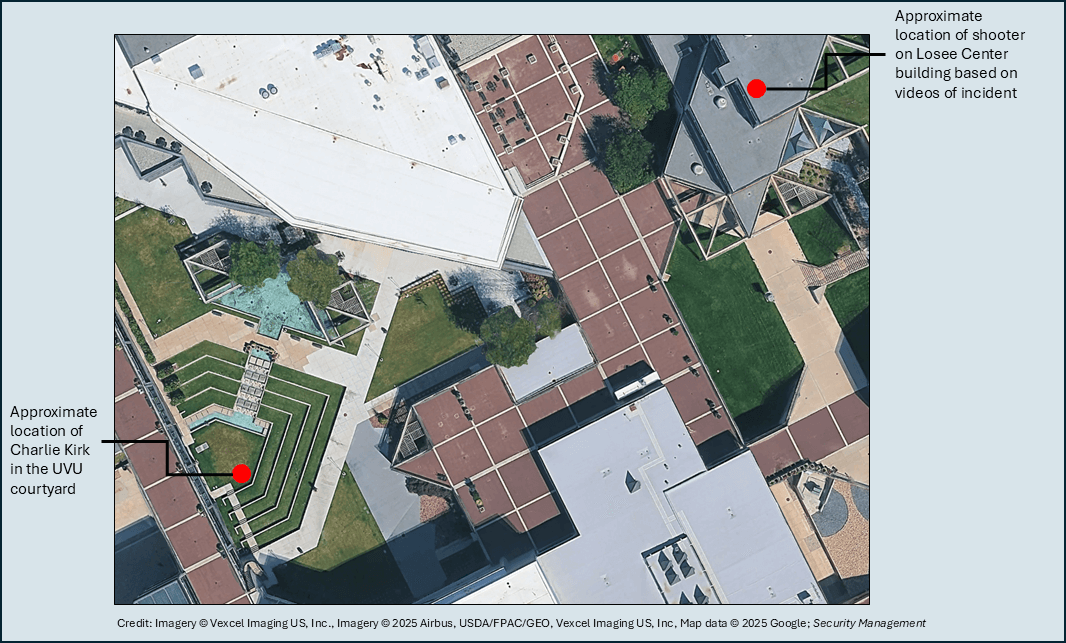
The shooter fired a single shot, and graphic footage of the incident shows the moment Kirk was hit and the panic that ensued from the crowd of approximately 3,000 people in attendance.
U.S. President Trump expressed sadness at the loss of Kirk, who was a key supporter of the president, and later his comments took an angry tone.
“For years, those on the radical left have compared wonderful Americans like Charlie to Nazis and the world’s worst mass murderers and criminals,” Trump said from the Oval Office. “This kind of rhetoric is directly responsible for the terrorism that we’re seeing in our country today.”
Other reactions took a more conciliatory tone. U.S. Speaker of the House Mike Johnson (R-LA) said, “That's what's so important for us to remember. We shouldn't regard one another as enemies. We're fellow Americans, and we should have vigorous debate, but it cannot lead to political violence. It's just too much.”
Former U.S. Representative Gabbie Giffords (D-AZ), who was critically wounded when shot in the head at political event in 2011, wrote on X (formerly Twitter) that, “Democratic societies will always have political disagreements, but we must never allow America to become a country that confronts those disagreements with violence.”
Prior to the shooting, The Associated Press (AP) reported that an online petition signed by nearly 1,000 people called for the university to prevent Kirk from holding an event on campus.
“The university issued a statement last week citing First Amendment rights,” the AP reported, “and affirming its ‘commitment to free speech, intellectual inquiry, and constructive dialogue.’”
Scott Stewart, vice president of protective intelligence at TorchStone Global, says in an email to Security Management that he is a “a huge proponent of protective intelligence driven security operations, and that approach is doubly important when a controversial individual is involved.”
“This approach not only includes solid advance work, but also an event threat assessment that can help the executive protection team understand the potential threats and institute appropriate security measures to mitigate them,” Stewart continues. “Liaison between all of the parties responsible is also critical, host organization, executive protection team, law enforcement, etc.”
Gilbert adds that even with a sizeable security team, if a bad actor has intent, gains the means, and has proximity to his or her target, bad things can still happen.
“That’s why it is so important to implement the protective intelligence alongside the physical executive protection efforts to make sure that you are scaling up your EP teams to the risks as they are being identified and that the process is dynamic,” he explains.
Gilbert says his threat management teams have a specific grid they use to take in all the known threat intelligence data for a given situation, which then dictates the protective measures needed.
“The process of identifying risk is very systematic,” he says. “You see where you are at on the spectrum of risk and you take the steps needed to scale up or scale back protection as needed.”
The fact that this was an outdoor event is notable in terms of risk. “I would imagine you’re going to see a lot less outdoor events for the foreseeable future,” Gilbert says.
Stewart has a forthcoming book, The Protective Intelligence Advantage, co-authored with Fred Burton that addresses this very situation through the lens of the Butler, Pennsylvania, assassination attempt on U.S. President Trump.
Stewart provided an excerpt to Security Management of the following:
We have learned over the years that there is brilliance in simplicity, and that simple tactics can be used to take advantage of protection failures that occur for a myriad of reasons, to include human error, denial, complacency, fatigue, missed signals, breakdowns in physical security plans and protocols, and failure to think outside the box... As protectors, we need to do better. As we look toward the future, we must never overlook or forget time-tested, simple tactics. But that will not be easy.
As the July 2024 attack against then-presidential candidate Donald Trump in Butler, Pennsylvania, reminded the world, the sniper threat remains a current and persistent concern for protection teams of U.S. government officials, and we would also argue, other prominent individuals. We think it is important to point out, however, that the gunman in this case was less than 140 yards from where President Trump was standing,[1] and was using an AR-15 with only a 16-inch barrel and chambered in 5.56mm. Despite the news reports all clamoring about the ”sniper attack,” the shooter was not a trained sniper, and the weapon he used was not a legitimate sniper rifle.
We have not yet seen legitimate sniper attacks against prominent people, but we believe it is only a matter of time. As protectors know, the resources to counter this threat, like counter sniper teams and heavy armored vehicle, are simply not there in the private sector and likely never will be. Therefore, innovative solutions need to be considered, to include moving advertised, public events indoors.
In addition, Security Management reached out to Melinda Heikkinen, associate vice president/chief, Saint Louis University Department of Public Safety, to ask how universities typically prepare for on-campus engagements. Here is that interview, slightly edited for clarity.
Security Management (SM). Campuses frequently host personalities that are controversial to some people. How would university security typically prepare for such events?
Heikkinen. For events involving potentially controversial speakers, universities generally begin with a comprehensive threat assessment. This often includes coordination with local, state, and federal partners—such as municipal law enforcement, the FBI, or [U.S. Department of Homeland Security]—to gather intelligence on possible threats/risks. Preparation is shaped by the institution’s type (public, private, or faith-based), its available security resources (sworn police, armed or unarmed security teams), and existing policies. Consideration is also given to the expectations of event organizers and the broader campus community. All of these factors inform the development of a tailored security plan.
SM. Assuming the personalities have their own security, how does your interaction with them usually go?
Heikkinen. Coordination with personal protection details is essential, as those teams are focused solely on protecting their principal. University security and law enforcement partners work to ensure that all parties are aligned on responsibilities, communication, and response protocols. Effective coordination helps avoid confusion and ensures a unified approach if the protection detail needs to act.
SM. How do you assess threats in such cases? How do you tell when a threat is credible versus, say, just trying to disrupt or prevent the event?
Heikkinen. Assessing threats requires gathering and evaluating information from multiple sources. Campus security typically partners with local, state, and federal law enforcement intelligence units, as well as university stakeholders such as student affairs staff, event organizers, and representatives of both sponsoring and opposing groups. Input from these channels helps determine whether threats are credible and informs the appropriate level of security planning.