
New Research Provides Benchmarks in Executive Protection
On the heels of releasing its Executive Protection Standard, ASIS published a research study benchmarking executive protection (EP) practices. The Executive Threat Environment: Benchmarking Research on Risk-Based Approaches to Executive Protection, sponsored by Everbridge, surveyed 824 security professionals in July. The extensive report covers everything from EP procedures to the relative importance of different threats in executive travel planning to the types of training offered to both EP professionals as well as the executives themselves.
The following are four results from the survey.
Executive Protection in Practice
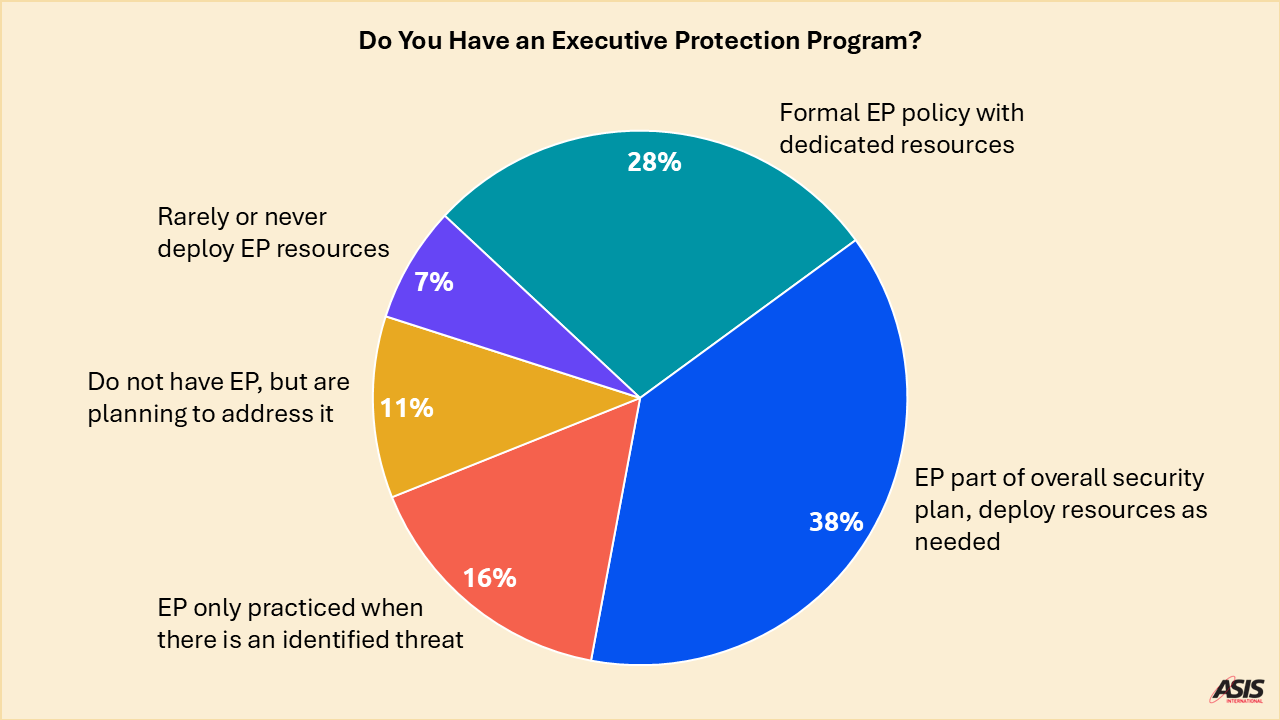
Only 28 percent of security professionals said they have a formal EP policy with dedicated resources, although another 38 percent said EP is addressed as part of a wider security plan and resources are deployed as needed. Seven percent reported that executive protection is not a consideration at their organizations, and the rest reported that EP is either ramping up or measures are put in place only when there is an identified threat. (Note: Since the survey was intended to study EP practices, the 7 percent that reported never deploying EP measures did not participate in the rest of the survey and are not included in any other statistics.)
The human resources deployed for executive protection are a mix of in-house security personnel and outsourced staffing. Overall, 44 percent of organizations said they use in-house security staff exclusively, 8 percent fully outsource their EP staff, and 29 percent said they use both in-house and outsourced staff (leaving 20 percent that reported having no dedicated EP staff).
Finally, 22 percent of organizations generally protect one or two executives; 21 percent protect three to five; 12 percent protect 6 to 10; 15 percent protect more than 10; and 30 percent reported that the number of executives protected varies based on need. As would be expected, larger organizations tend to protect more executives. That pattern holds for the other statistics presented in this section: Larger organizations are more likely to have a formal EP policy with dedicated resources and are more likely to have EP professionals on staff.
Executive Protection Gets More Attention
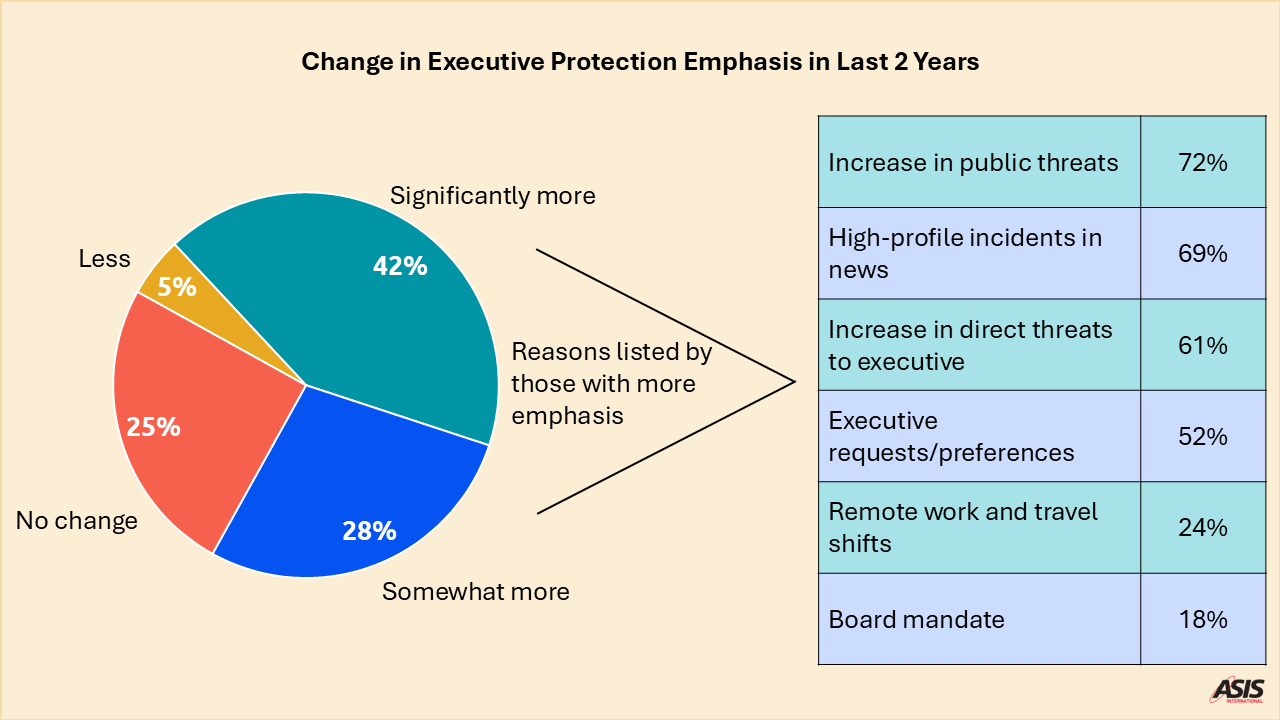
Seven in 10 security professionals said there is either significantly or somewhat more emphasis on EP at their organizations compared to two years ago. The survey was fielded before the Charlie Kirk assassination, but plenty of other high-profile incidents, especially the murder of UnitedHealthcare CEO Brian Thompson, contributed to the increased attention on executive protection.
In fact, at 69 percent, “high-profile incidents in the news” was the second-highest rated reason security professionals gave for the increased EP emphasis. Leading the way was in increase in public threats against executives, cited by 72 percent of security professionals.
Executive Travel Security
The types of travel threats security professionals reported as most important were (percent is the number that rated it highly important vs. somewhat important or not important):
- Terrorism: 78 percent
- Political instability or war: 75 percent
- History of kidnapping or other directed violence: 71 percent
- Civil or labor unrest: 66 percent
Security professionals assigned relatively less importance to threats related to weather, infrastructure, cultural differences.
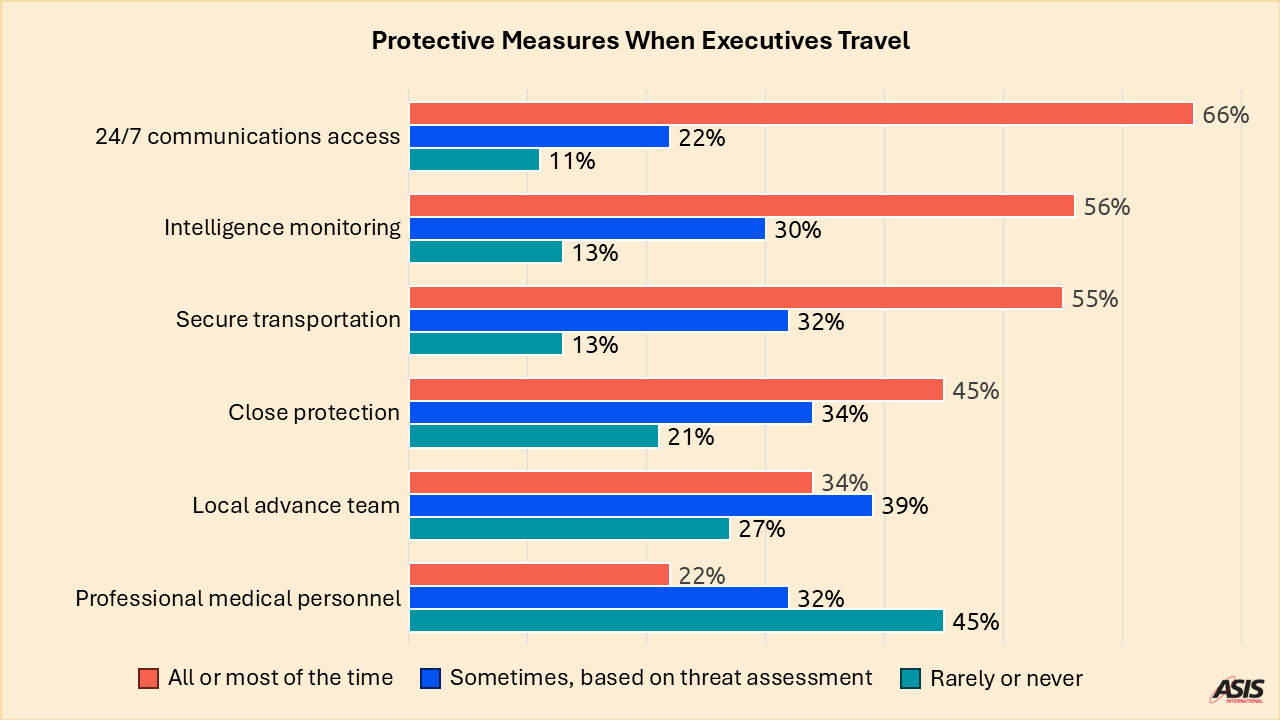
The measures security takes when executives travel are in the bar chart above. Having 24/7 communications leads the way, followed by intelligence monitoring, and providing secure transportation. Fewer organizations provide close protection services or send or employ local advance teams, and far fewer provide professional medical personnel.
Executive Protection Obstacles
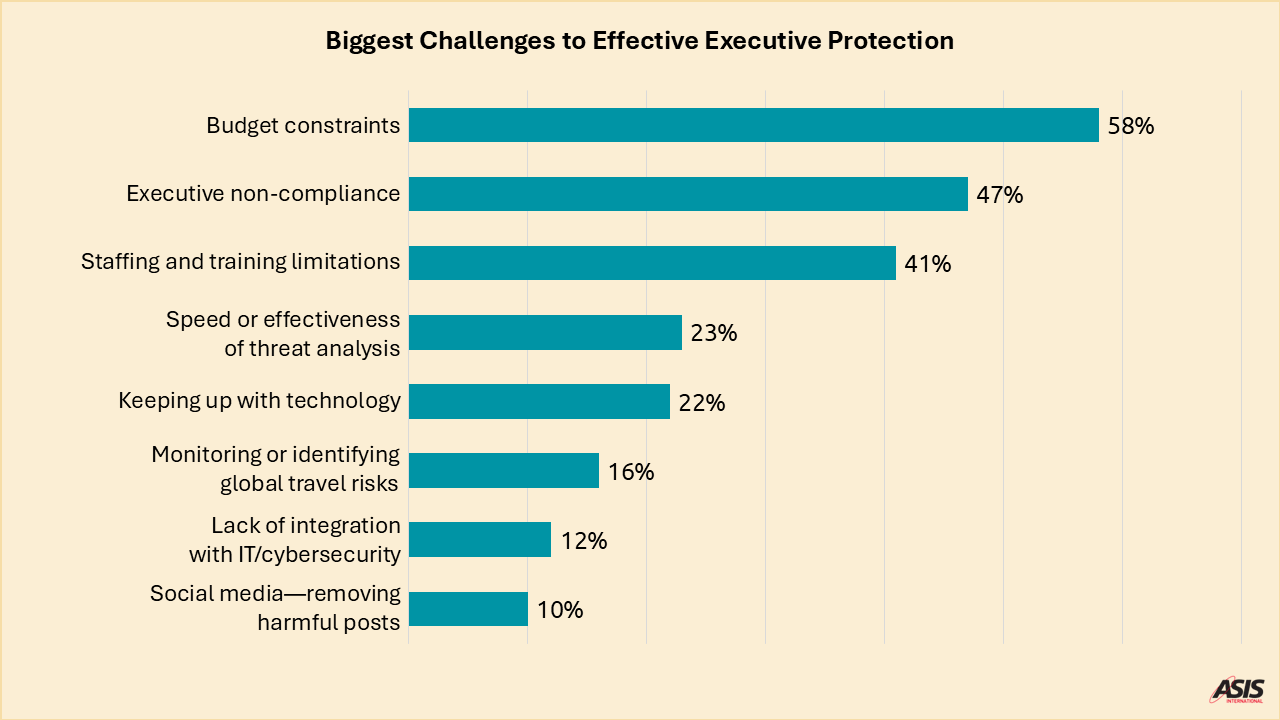
As the report said, the biggest impediment to effective executive protection are executives themselves. The top obstacle selected by security professionals was “budget constraints,” which means EP is not valued highly enough to put the needed resources into it. Since top executives generally decide what to fund, that means they do not value EP.
The second most-cited reason was more straightforwardly an indictment of top executives: “executive non-compliance,” which, again, shows a lack of value that top executives assign to EP.
However, the research suggests that security leaders may contribute to the low EP value. The survey provided more than 20 EP capabilities, asking security professionals to rate their importance. At least a couple of these capabilities would be used to help show the value of EP, specifically “automated after-action reports, data repository, and analytics” and “data logging and exportable analytics for EP ROI calculation.” Both of these capabilities fell into the bottom five of importance in the ratings. Furthermore, more than half of security professionals reported they do not track EP incidents or establish EP key performance indicators to measure.
The study findings will be the topic of discussion at the upcoming ASIS webinar: Building a Resilient Executive Protection Security Posture on 9 October.