Active Assailants: Midtown Manhattan Shooter and Other Incidents
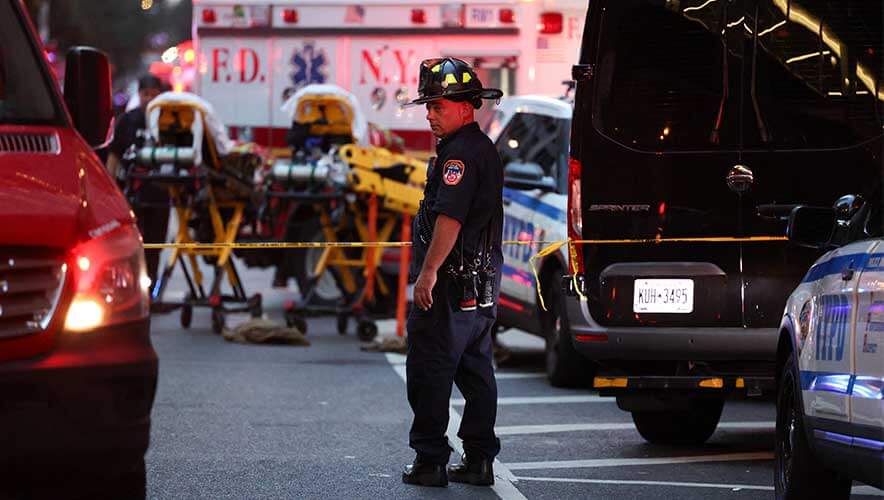
During the early evening of 18 July, a 27-year-old man from Las Vegas, Nevada, strode into the lobby of 345 Park Avenue in Manhattan. Employees in the New York City skyscraper were still leaving for the day. But then the man, identified as authorities as Shane Tamura, lifted his assault-style rifle and opened fire.
In the lobby, the shooter killed an off-duty New York City police officer, Didarul Islam, and two other people. Islam was in uniform providing security services for the building at the time. The attacker then took an elevator up to the 33rd floor and killed another person before turning the gun on himself and ending his own life.
Two days before the shooting, Tamura had gotten into his car in Nevada and started driving to New York. Tamura, who had a valid concealed firearms permit issued by the Las Vegas Police Department, is believed to have been targeting the National Football League (NFL). Police searched Tamura and his car after the shooting, finding another firearm, ammunition, prescribed medication, and a note.
In the note, the shooter mentioned the NFL and claimed to be suffering from chronic traumatic encephalopathy (CTE) due to playing football. Along with accusing the organization of covering up the dangers to players posed by the game, Tamura asked that his brain be examined.
The NFL is one of the high-end tenants with an office in the building, although none of the people killed worked for the organization. Other tenants include investment firm Blackstone Group and financial advisory firm KPMG. Tamura killed his last victim in the office of the Rudin Management company firm, which owns the building.
Because of the tenants, the site is one of the more secure private buildings in the city, typically supported by three to four armed officers, according to Don Aviv, CPP, PSP, PCI. Aviv is the CEO for Interfor International, with an office four blocks from the shooting. Blackstone is a client of Interfor.
The fact that there were not more fatalities is “a small miracle,” Aviv says. Despite that the majority of the deaths occurred in the lobby, the death toll could have been higher since the shooter was able to access the floors above. “The one vulnerability of that building is that the elevators are not locked down,” Aviv adds.
Some employees were able to safely flee the building, while others found ways to barricade themselves in rooms, using tables, couches, and other office furniture.
“Some of the clients in the building did exactly what proper training has taught them: Run, hide, fight,” Aviv says.
Aviv adds that organizations should use this moment to refresh their active assailant training and emergency protocols to ensure that everyone knows what do in response to a similar incident.
The barricades indicate, from an outside perspective, “that those people were prepared, that they were trained and acted quickly,” says Joseph Ranucci, CPP, security manager for the Almac Group.
Ranucci, who specializes in workplace safety, points out that despite the higher level of security posted in the building, lives were still lost.
“There’s nothing that’s ever going to be 100 percent secure,” Ranucci says, advocating that organizations should make active shooter or attacker drills as common place as a fire drill. In an emergency, he adds, “it’s about practice over panic.”
Another proactive measure to consider is an active threat monitoring program, which, according to Aviv, could potentially mitigate or even stop an incident. “More often than not, a lot of assailants use social media beforehand,” which can provide the opportunity for an early warning, he adds.
Other Notable Attacks
El Empalme, Ecuador. Southwest of the capital city of Quito, a gunman opened fire during the evening of 27 July, killing 17 people at a bar, including a 12-year-old boy. Authorities are suggesting that the shooting may have been linked to drug trafficking.
London, England. Two men were stabbed and killed in central London, near Tower Bridge, on 28 July. A third man is being treated for nonlethal injuries in a knife attack, and police have detained a suspect as part of the investigation into the incident. Tower Bridge is a popular tourist attraction, and violence in that area is usually rare.
Bangkok, Thailand. A mass shooting at a food market in the capital city of Thailand on 28 July left five people dead. Four of the victims were security guards, and the fifth victim worked at the Or Tor Kor food market. Two more vendors were injured and the suspected shooter apparently killed himself, according to authorities.
Traverse City, Michigan, USA. A 42-year-old man stabbed 11 people with a folding knife in a Walmart supermarket on 27 July. The suspect, Bradford James Gille, was taken into custody and is expected to be charged with terrorism and assault with intent to murder. The five men and six women stabbed are all expected to survive. Authorities have not revealed a motive for the attack.
Reno, Nevada, USA. A shooting outside of the largest casino in the city on 28 July left three people dead and three more wounded before police shot and arrested the alleged gunman.
Kyiv, Ukraine. Russian bombs and missiles targeted a Ukrainian prison and medical facility during the evening of 28 July, killing at least 27 people in civilian areas.