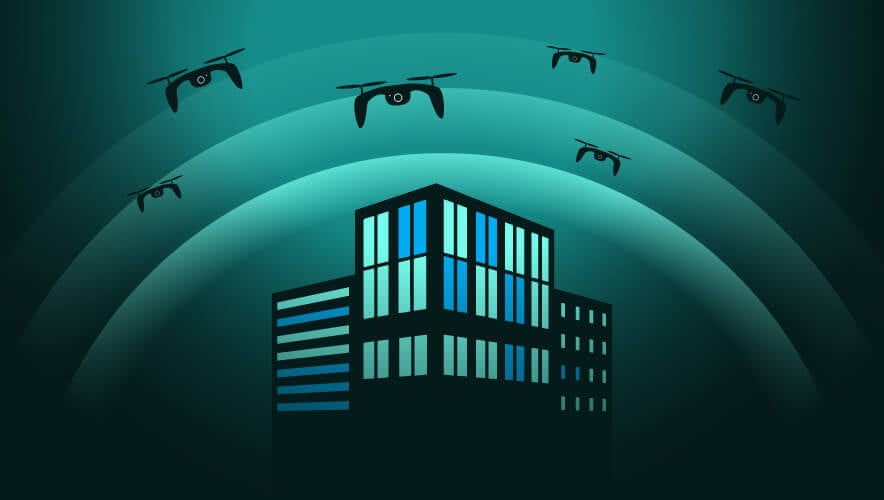
The need for counter-drone technologies has been thrown into sharp relief by the FIFA World Cup. During the course of the tournament, U.S. agencies seized more than 600 drones near stadiums and fan zones, with the FBI saying that drones had been seized from restricted airspace across all 11 U.S. host cities. 130 were confiscated in Miami alone.
The scale of the threat means it is not enough for systems to perform well in demonstrations; they have to deliver in the real world. Knowing a technology works is not enough. Operational validation is required to prove a system will continue to work when conditions become unpredictable.
Rather than the controlled environment of a demonstration, the real world is complex and unpredictable. Everything from weather to environmental clutter to false alarms makes the job of security systems much more complex, and failures creep in, creating a disconnect between the performance operators might have been promised in the demonstration, and the day-to-day reality at the site.
Part of this is attributable to the technologies at play. Traditional perimeter intrusion detection systems (PIDS) have limitations, and these come to the fore in complex operational environments. Accurately distinguishing threatening drones from benign objects such as birds and airborne debris remains a challenge for individual sensor technologies, including cameras and radio frequency (RF) systems, which can be vulnerable to false positives and misclassification, eroding confidence in the systems, and potentially delaying response to real threats
Beyond the Demo: Why Trusted Radar Data Drives Operational Integrity
Radar is a key enabler for bridging the gap between technology performance and operational performance, particularly in multi-sensor set-ups. Radar is not intended to replace RF detection or electro-optical sensors. Instead, it provides the persistent, high-confidence tracking data that enables the broader counter-drone system to operate more effectively. Radar excels in complex, outdoor and high-interference environments, and can detect drones even where visual contrast is poor or in conditions such as fog and low light.
Radar track data can be rapidly integrated into common Command-and-Control (C2) platforms, providing automated alerts and high-fidelity information such as range, elevation and velocity. This trusted data helps reduce false alarms, maintain track continuity and enables operators to determine more quickly whether an object is a credible threat or simply routine airborne activity.
The latest radar systems use advanced machine learning models to classify objects at the furthest range possible and then refine that classification as targets move closer. This offers early, high-confidence identification of drones. High-confidence classification at the sensor level provides trusted data for downstream systems, improving automation, accelerating operator decision-making and strengthening overall mission effectiveness outside the testing laboratory.
By detecting targets early and classifying them, radar reduces ambiguity and enables adjacent systems to perform faster. In turn, real-time data allows operators to make informed decision quickly – critical when operational safety is in the breach.
The Time to Act is Now, Not After a Drone Enters Your Airspace
Drone activity is on the rise. Risk is growing. Security teams require the tools to protect sites from disruption or subterfuge by drone. With drones a serious and real threat to critical infrastructure sites and entertainment venues, one factor is increasingly clear: successful protection depends on systems that perform reliably in the real world—not just during controlled demonstrations.
Security leaders should evaluate demonstrations as operational validation exercises—not technology showcases. Demonstrations should reflect the environmental conditions, sensor integration and operational complexity the system will face after deployment. The key to systems that deliver in both demonstrations and real-world operations is twofold:
- Validate the complete system — Multiple sensors, software and Command-and-Control operating together as an integrated solution.
- Test under realistic operating conditions — Including representative weather, lighting, environmental clutter, communications challenges and realistic threat behavior.
Equally important, reducing false alarms helps preserve operator trust. When personnel are confident in the alerts they receive, they can respond faster and with greater certainty when a genuine threat emerges.
Adopting Counter-Drone Systems Built for the Real-World
Procurement decisions should be based not only on sensor specifications, but also on demonstrated operational performance, interoperability, classification confidence and testing under representative site conditions.
A multi-layered approach - with radar, radio frequency (RF) detection and optical sensors provide the most comprehensive solution to detect and confirm drone threats.
As drones become an increasingly accessible tool for malicious actors, security leaders can no longer rely on technology that performs only under ideal demonstration conditions. By choosing interoperable, multi-layered systems that have been validated under real-world operating conditions, organizations can better prepare for both today's threats and tomorrow's.
By Curtis Walters, Vice President, Sales-Critical Infrastructure & Commercial Security at Echodyne
Sponsored Content by Echodyne