How Security Consultants View the State of Corporate Executive Protection
In most ASIS Security Issues Research projects, the survey asks participants if they are security consultants or industry suppliers. These people are then given the option of answering an alternate set of questions. In the executive protection (EP) survey, which was sponsored by Everbridge, more than 100 participants opted to answer the consultant-focused questions. While that’s not enough for rigorous statistical analysis, it is a big enough sample to begin to draw some conclusions.
In this article, we’ll compare how consultants and security professionals answered the same or similar questions and gain additional insights.
Demographics of the Participating Consultants
First, we asked what products or services they provided to organizations, and they could choose all that applied. Three services were offered by more than 50 percent of the consultants in the study, beginning with consulting on travel risk, which topped the list at 60 percent. Providing in-person travel advance intelligence planning or personnel and intelligence gathering technology or analysis were each provided by 55 percent of respondents.
|
Do you offer these executive protection tools or services? |
|
|
Consulting on travel risk |
60 percent |
|
Intelligence gathering technology or analysis |
55 percent |
|
Provide in-person travel advance intelligence/planning personnel |
55 percent |
|
Provide contracted close protection professionals or drivers |
46 percent |
|
Training executive protection professionals |
42 percent |
|
Communication technology |
26 percent |
|
Travel insurance or emergency services related to travel |
12 percent |
|
Other product or service directly related to executive protection |
42 percent |
Exactly half of the consultants surveyed serviced North America. Nearly a quarter provided services in Asia (26 percent), followed by Central America, South America, and the Caribbean (23 percent), Africa (23 percent), and Europe (20 percent). Rounding out the geography: 17 percent provided services to the Middle East, and 8 percent serviced Oceania. The numbers add up to more than 100 percent because companies could serve more than a single region.
More than half had fewer than 100 employees (53 percent). Twenty percent had between 100 and 1,000 employees; 14 percent had 1,000 to 10,000 employees; and the rest had more.
Executive Protection Tools and Tactics
In general, consultants said every tool and tactic asked about in the survey was important. Examining executive protection tools first, consultants were asked to rank if the tool was “never or hardly ever useful,” which was given a weight of one; “can be useful in isolated situations,” weighted a two; “generally a tool that is necessary,” weighted a three; or “indispensable tool,” weighted a four.
A weighted average analysis puts the tools in an order—threat monitoring platforms topped the list with a 3.27; tools detecting personal device tampering, with a 2.89, was last. However, the difference between tools at the top and tools at the bottom is explained by more consultants choosing indispensable versus just generally necessary. Fully 70 percent of consultants said the lowest-rated tool—tools detecting personal device tampering—was at least generally necessary.
The table below lists the tools in order and shows the number of organizations that have existing executive protection programs who report using the tool in their programs.
|
Tool |
Consultant importance rating (weighted average on scale of 4) |
Percent of organizations that deploy the tool in executive protection program |
|
Threat-monitoring platform |
3.27 |
64 percent* |
|
GPS tracking |
3.19 |
56 percent |
|
Travel risk management platform |
3.15 |
68 percent |
|
Mobile panic/emergency apps |
3.11 |
57 percent |
|
Surveillance (CCTV, drones) |
2.93 |
67 percent |
|
Tools for technical surveillance countermeasures (TCAM) (i.e., bug sweeps) |
2.9 |
39 percent |
|
Tools detecting personal device tampering |
2.89 |
41 percent ** |
*Security professionals were asked if they used “threat intelligence feeds.”
**Security professionals were asked if they used “cybersecurity tools.”
Just like with tools, consultants rated every type of intelligence gathering tactic as important. The following table lists the tools in order and shows the number of organizations that use the intelligence method in their EP programs.
|
Intelligence method |
Consultant importance rating (weighted average on scale of 4) |
Percent of organizations that use the method in executive protection program |
|
Open-source intelligence (OSINT) |
3.52 |
82 percent |
|
Background checks on identified potential threats or for scheduled meetings if not previously known |
3.43 |
58 percent* |
|
Human intelligence |
3.41 |
67 percent |
|
Travel, crime, or violence reports from governmental authorities |
3.38 |
68 percent |
|
Internal incident reports |
3.36 |
62 percent |
|
Social media monitoring |
3.34 |
79 percent |
|
Physical surveillance |
3.32 |
65 percent |
*Security professionals were asked if they used “background checks.”
Difficulty of Executive Protection Tasks
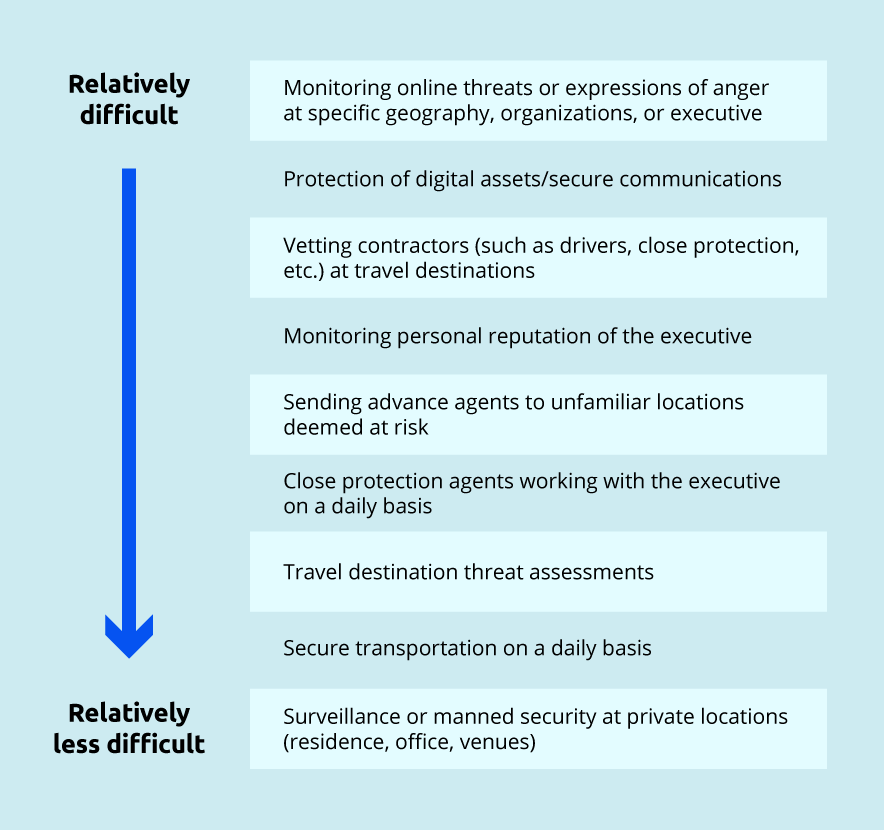
The consultants were asked how difficult it was for EP professionals to execute tasks effectively. “Monitoring online threats or expressions of anger at specific geography, organization, or executive” was rated most difficult, and “surveillance or manned security at private locations (such as residence, office, or venues)” was rated as least difficult.
Travel Threats
The consultants were asked to rate how well companies identify and prepare for different travel-related threats. Consultants gave somewhat middling grades to organizations, with most giving organizations a rating of two, three, or four on a five-point scale where five was the best. Consultants thought organizations were best able to identify and prepare for potential weather-related issues, with 47 percent giving four or five ratings in this category.
Consultants thought organizations did a much worse job of identifying and preparing executives for cultural differences—the number of four and five ratings fell to 27 percent.
The table below shows the weighted averages in each threat area, followed by the percentage of security professionals who said the threat was highly important (as opposed to “somewhat important” or “not very important”) factor in their executive travel threat assessment process.
|
Travel threat |
Consultant assessment of organizational preparedness for threat (weighted average 1 = worst; 5 = best ) |
Percent of security professionals rating threat as highly important in executive travel threat assessments |
|
Potential for weather-related issues |
3.38 |
35 percent |
|
Kidnapping or personal violence threats |
3.36 |
72 percent* |
|
Terrorism threat |
3.33 |
79 percent |
|
Infrastructure (telecommunications, energy, or other) |
3.29 |
37 percent |
|
Political instability or war |
3.27 |
76 percent |
|
Civil or labor unrest |
3.20 |
66 percent |
|
Cultural differences |
2.84 |
30 percent |
* Security professionals were asked about the “history of kidnapping or other directed violence.”
Advice from Consultants
The consultants were asked a pair of open-ended questions. To see selected advice on how to overcome the objections from executives who would refuse EP measures, see “The Main Impediment to Executive Protection? The Executives Themselves.”
The survey also asked what misunderstandings corporate security leaders had about EP. As with any open-ended survey question, responses ranged from insightful to nonsensical to unexpected or unusual.
One comment compared executive protection to the Japanese concept of omotenashi—the act of selfless hospitality that focuses on anticipating and meeting guests’ needs before they are even asked, and no task is menial if it contributes to the positive experience of the guest.
Another emphasized the need for “hard skills” including “shooting, fighting, and driving,” noting that executive protection professionals should train these skills “on at least a weekly basis.”
One consultant appeared to directly address security leaders who use outsourced protective details with advice worthy of consideration:
“One of the key misunderstandings corporate security leaders often have about executive protection is underestimating how different the reality on the ground can be compared to what was initially briefed or planned. Being in the field directly with the client presents dynamic challenges and changing circumstances that can’t always be anticipated from a distance.
“Unfortunately, GSOCs or command centers sometimes apply unnecessary pressure on field agents to follow rigid protocols, even when those protocols may not align with the evolving situation,” the consultant continued. “It’s important to understand that you can’t always please both sides at once—the client’s immediate needs and corporate procedures may not always align perfectly in real-time.
“As long as the close protection officers have undergone proper training and demonstrated sound judgment, they should be trusted to make critical decisions and adapt as needed. Ultimately, the field team must be empowered to ‘run the show’ to ensure both safety and client satisfaction.”
Most of the comments, however, tended to fall into two related categories: Those that addressed the misperception that an executive protection program is limited to close protective services and those that tied executive protection into an organization’s risk management approach.
Following are two examples of consultant advice in each of these categories.
Executive protection is not a synonym for close protection.
“Many corporate security leaders misunderstand executive protection as solely a physical security or bodyguard function,” one consultant said. “They often overlook the broader, integrated nature of executive protection, which includes cybersecurity, travel risk, digital reputation monitoring, and secure communications. There’s also a tendency to underestimate the importance of proactive intelligence (OSINT, HUMINT), as well as the need for tailored protection plans based on executive roles, exposure, and digital footprints.”
Another commented that, “Corporate security leaders often oversimplify executive protection, viewing it as optional, merely physical, or a matter of cultural prestige. However, in today’s risk landscape, executive protection must be intelligence-led, holistic, discreet, and integrated across both digital and physical dimensions. By addressing these misconceptions, organizations can effectively safeguard their leadership, reputation, and strategic operations with minimal intrusion and maximum impact.
Executive protection is an organizational risk management function.
“Many corporate security leaders mistakenly believe that executive protection is only about physical bodyguards and travel logistics,” one consultant said in the survey. “They often overlook the strategic role of threat intelligence, cybersecurity, secure communications, and digital footprint management. Additionally, there is a tendency to treat executive protection as a reactive function rather than a proactive, risk-based discipline that integrates IT, travel, and behavioral threat analysis.”
Another consultant noted, “Many corporate security leaders see executive protection as just bodyguards and travel logistics, rather than a strategic, intelligence-driven risk mitigation tool. They often overlook its integration with cyber, reputational, and operational security. Effective executive protection is proactive, discreet, and aligned with both the executive’s role and the organization’s broader risk posture.”
Read the full report, The Executive Threat Environment: Benchmarking Research on Risk-Based Approaches to Executive Protection, online.
Scott Briscoe is the content development director at ASIS International. He led the Executive Protection Research Project.