Historic Category 5 Hurricane Melissa Making Landfall in Jamaica
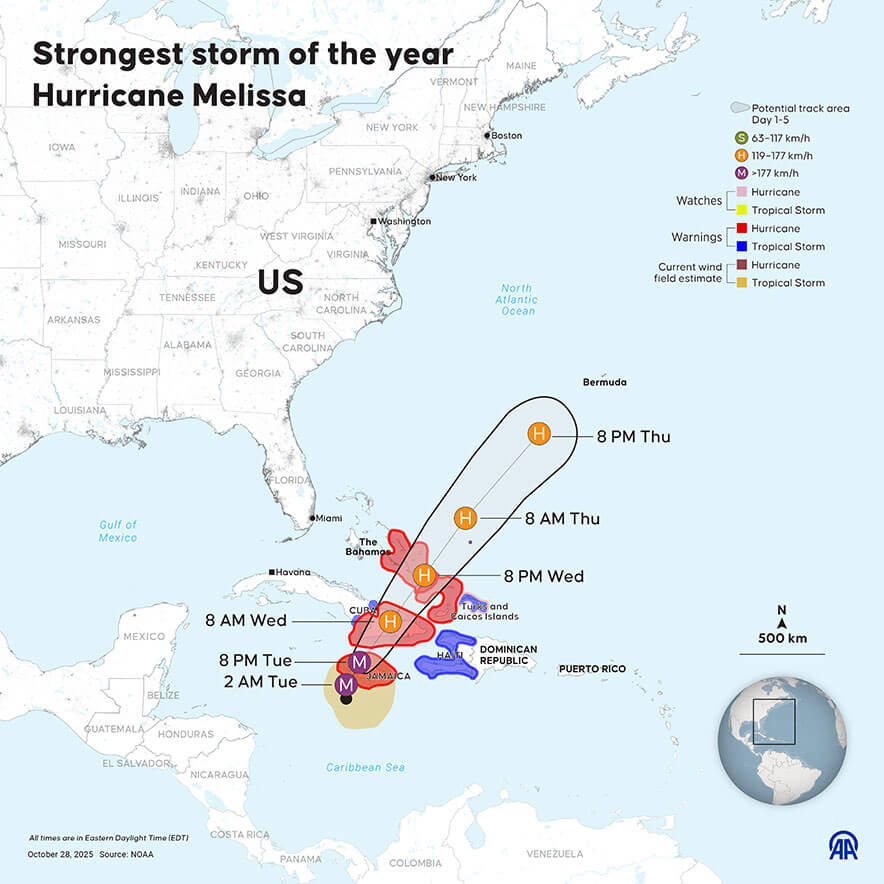
Hurricane Melissa, one of the strongest Atlantic hurricanes in recorded history, started making landfall onto Jamaica on 28 October. The island nation has been preparing for the expected devastation and threat to lives that the storm promises to bring.
Clocking in at 185 mph, the Category 5 storm is second only to 1980’s Hurricane Allen (190 mph) and tied with four other storms in terms of wind speed.
The National Hurricane Center (NHC) reported that Melissa also has a pressure at its center of 892 millibars (mb). “This places it tied with the Labor Day storm in 1935 for the third most intense Atlantic Basin hurricane of all time based on pressure,” The Weather Channel said.
Even before landfall, Melissa has already been deemed responsible for at least six deaths: three in Haiti and three in Jamaica, which occurred while preparing for the storm.
The storm is expected to make landfall on Tuesday and is threatening to demolish the nation’s infrastructure and isolate communities throughout. CNN described Melissa as a “a storm so powerful it will reshape Jamaica for years to come and could trigger a humanitarian disaster.”
Melissa’s eyewall—the zone containing the storm’s strongest winds—began moving into Jamaica on Tuesday morning, marking the beginning of the landfall process. A hurricane officially makes landfall once at least half of the storm’s center—or “eye”—crosses over onto land. The storm also features hurricane-force winds even 30 miles away from the eye of the storm, according to The Weather Channel.
Along with catastrophic winds, experts are anticipating that the storm will deliver flash-flooding, storm surge, and landslides. Melissa is drawing historic strength from warmer-than-usual water temperatures in the Caribbean.
The NHC has forecast that the storm will deliver at least 20 to 30 inches of rainfall in Jamaica. The significant rainfall makes flash flooding and landslides more likely, especially in areas with mountainous or even hilly terrain, such as the Blue Mountain range in Jamaica.
“Hurricane Melissa’s rain-soaked crawl toward Jamaica on Tuesday drew fears from forecasters that its sluggish pace could produce a worst-case scenario,” The New York Times reported, referencing the storm’s movement towards Jamaica at only 7 mph.
Although mandatory evacuation orders were issued prior to Tuesday, officials said that not enough residents in low-lying areas complied with the orders, according to the Times. Authorities are anticipating that the storm will displace roughly 50,000 people.
In an interview with CNN, Robert H.P. Hill, CEO of planning and regulation administration Kingston and St. Andrew Municipal Corporation, said that while all precautions are being taken to keep citizens safe and with enough supplies in certified shelters, floods will be one of the biggest threats to the nation. While teams are prepared to clean drains and waterways to minimize flooding, Melissa is expected to deliver a significant amount of rainfall, Hill added.
The NHC is also predicting likely storm surge along Jamaica’s south coast, with peak heights reaching to 13 feet above ground level near where the storm is expected to make landfall.
On Tuesday morning, Jamaica was already experiencing several power outages. Roughly 240,000 people, or around 35 percent of Jamaica Public Service customers lost power due to hurricane conditions even before Melissa’s landfall, according to the BBC. While most hospitals still have power, some in the areas of Manchester and St. Elizabeth are already relying on generators.
After Jamaica, the hurricane is on course to hit eastern Cuba and the southeast Bahamas, according to The Weather Channel, maintaining its ferocity as a major hurricane.
Melissa is not the only storm promising destruction at the moment. Authorities in India shut down schools and evacuated tens of thousands of people from low-lying coastal areas in response to Cyclone Montha, which also began to make landfall on 28 October.
For information on flood preparedness, check out Security Management's recent content, including "Fast Facts: The Cost of Multi-Hazard Disasters" and "How to Manage Water Emergencies."