Tens of Thousands Flee Thailand-Cambodia Border as Fighting Intensifies in the Region
Cambodia and Thailand agreed to a ceasefire on Monday morning that will begin at midnight after five days of deadly border clashes.
Thai Acting Prime Minister Pumtham Wechayachai met with Cambodian Prime Minister Hun Manet in Malaysia with Prime Minister Anwar Ibrahim. Anwar read out a joint statement after the meeting on 28 July to reach a “common understanding to take steps to return to normalcy after what he called frank discussions,” according to the Associated Press (AP).
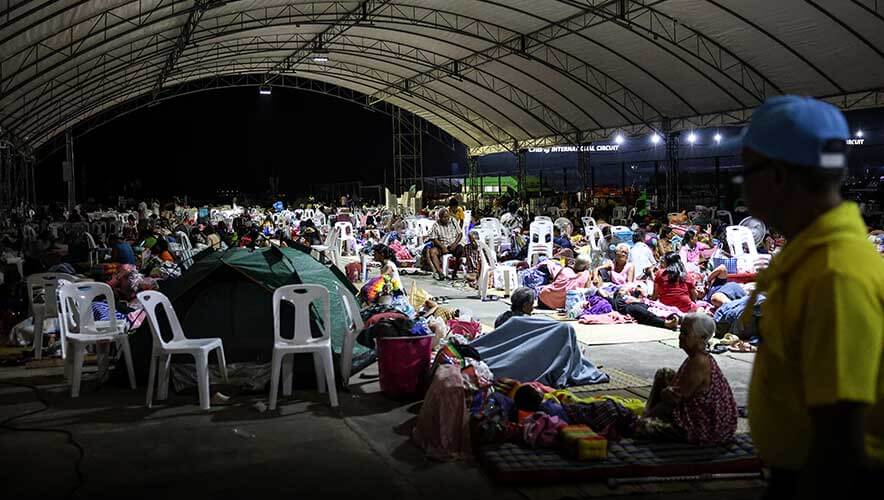
Tens of thousands of people fled their homes near the Thailand and Cambodia border as fighting between the two nations intensified Friday morning.
The New York Times reported that more than 131,000 people in Thailand have evacuated the area as of 8:47 a.m. ET on 25 July. Earlier reporting from the AP said that at least 4,000 people have fled villages near the border in Cambodia. Fifteen people, including 14 civilians, have been killed in the conflict so far.
Tensions were already high along the border of Thailand and Cambodia, but fighting broke out on Wednesday after a landmine exploded along the border and wounded five Thai solders. The two nations had a planned ceasefire agreement set for midnight on Thursday, but the Times reported that Cambodian Prime Minister Manet said Thailand had reversed its position.
“The Thai military reported clashes early Friday in multiple areas, including along the border at Chong Bok and Phu Makhuea in Thailand’s Ubon Ratchathani province, at Phanom Dong Rak in Surin province, and near the ancient Ta Muen Thom temple,” the AP reported.
Thailand’s acting Prime Minister Wechayachai said that the clashes could “move towards war” since heavy weapons are already being used and the fighting has spread to 12 locations along the border, the BBC reported.
“Thailand also accused Cambodia of firing into civilian areas and evacuated all villages deemed to be within the radius of its rockets,” according to the BBC. “Cambodia, for its part, accused Thailand of using cluster munitions. Cluster munitions are banned in much of the world because of their indiscriminate effect on civilian populations. Thailand has not responded to the allegations.”
Early Friday morning the Thai government shut down border crossings in both Chanthaburi and Trat provinces—including land and maritime routes, the U.S. Embassy and Consulate in Thailand said in a press release. The Thai Ministry of Public Health also fully or partially closed 11 hospitals in the border region, and the Thai Ministry of Education temporarily closed 751 schools across six provinces.
Cambodia and Thailand share a nearly 500-mile border that has been contested for almost 100 years, most recently with clashes in 2008 and 2011. The border region is a thick jungle that contains many culturally significant temples that have become a source of conflict for the two countries.
“Prasat Ta Muen Thom was constructed in the 12th century with laterite—a reddish porous stone—and comprises a wide set of archaeological sites nearby,” according to the Times. “The temple, accessible from both sides, is in a poorly demarcated part of the border and stands as an important religious and cultural site for both Cambodians and the Thai. Troops from both countries constantly patrol the temple’s area, leading to frequent skirmishes.”
The temple was closed briefly in February 2025 after Cambodians sang a nationalist song near the site. Cambodian Senate President and former Prime Minister Hun Sen alleged that a Thai military commander created the current conflict by closing the temple on Wednesday and opening fire on Cambodian troops the next day.
That was just one element in the current conflict, however, which began intensifying several months ago. On 28 May, Thai and Cambodian troops fired briefly at each other in a disputed border area. The Thai army said that Cambodian soldiers entered the area and then, due to a misunderstanding, opened fire on the Thai solders, who retaliated. A Cambodian soldier was killed in the interaction, which lasted about 10 minutes, according to the AP.
“But what makes the current flare-up most bamboozling is that it pits two of Southeast Asia’s most formidable and, until recently, closely aligned families against each other,” Time magazine reports. “When border tensions first flared up [on 28 May], Thailand’s then-Prime Minister, Paegongtarn Shinawatra, called up Cambodia’s 72-year-old former strongman Hun Sen—Hun Manet’s father—to soothe tensions. However, Hun Sen leaked their June 15 phone call, during which Paetongtarn adopted a subservient tone and criticized one of her own generals, leading to her suspension by Thailand’s constitutional court pending an ethics investigation after 10,000 people took to the street demanding her resignation.”
Amidst this backdrop, Thai police recently began investigating Cambodian business figures allegedly connected to gambling and scam centers, and billions of dollars in trade between the two countries has been disrupted.
“But rather than back off, Cambodia’s Hun Sen seems to have jumped at the opportunity to ramp up rhetoric against Thailand and the Shinawatra family in particular,” the BBC reports. “He claims to be in possession of secret documents that would incriminate Thaksin—documents he claims could even prove that he insulted the monarchy, an offense which comes with a hefty prison sentence in Thailand.”
The Thai government responded to these claims by expelling Cambodia’s ambassador on Wednesday and recalling its own envoy.
The UN Security Council held an emergency meeting Friday afternoon to discuss the conflict. Other countries, including China and the United States, expressed concerns about the conflict’s potential escalation. Malaysia, which chairs the 10-member Association of Southeast Asian Nations, had offered to facilitate dialogue between Cambodia and Thailand.
Editor's Note: This article was updated at 1:00 p.m. ET on 28 July 2025 to include new information about the ceasefire agreement.