What You Need to Know About Trump Federalizing DC’s Police Force
U.S. President Donald Trump announced on Monday that he is federalizing the local law enforcement of Washington, District of Columbia (DC), and will authorize deploying National Guard troops and FBI agents to crack down on crime in the district.
In an executive order, Trump claimed that crime is “out of control in the District of Columbia,” and declared that the city was in a state of emergency. Trump tasked U.S. Attorney General Pam Bondi with overseeing the federalization effort.
Bondi met with DC Mayor Muriel Bowser on Tuesday to discuss the federalization of DC's Metropolitan Police Department (MPD). Trump’s executive order states that Bowser “shall provide such services of the Metropolitan Police force as the Attorney General may deem necessary and appropriate.”
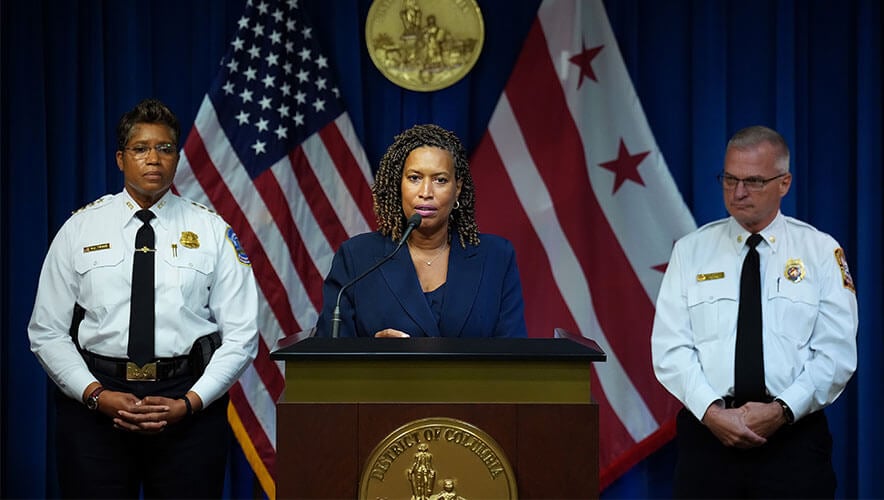
Trump named Terry Cole, head of the U.S. Drug Enforcement Administration, to lead MPD during the federalization period. But details about what control of the MPD will look like remain unclear. Bowser said during a press conference “that Chief of Police Pamela Smith would still run the department and report to Bowser up through the deputy mayor,” according to CNN. Smith said she would be meeting with federal liaisons for the first time after Trump’s announcement to work on an operational plan and that residents should expect to see an “enhanced presence” of federal law enforcement in the city, according to The Hill.
The weekend before the announcement, Trump ordered federal law enforcement officers to start supporting the MPD in certain areas throughout the city, “including as many as 130 FBI agents to patrol with DC police as part of the increased federal presence,” according to CNN.
For local security professionals, the order has a mixed response.
“It’s probably not going to impact our business operations immediately,” says Scot Rittenberg, PCI, managing director for a DC-based security consultancy.
Depending on how long federal law enforcement holds the reins, Rittenberg says he expects that opportunities to work with law enforcement to support coordination and improve logistics between agencies will arise. As for his firm’s private clients in Washington, he adds that he does not expect there to be an impact beyond updating risk assessments and reviewing and updating safety procedures.
Organizations based in Washington are contending with supporting staff and determining how to interact with an increased presence of federal law enforcement, who might not have the same training and community awareness as local police.
“Our staff is very concerned,” says Doug Beaver, CPP, director of security for the National Museum of Women in the Arts in downtown Washington, D.C.
Beaver is currently developing training and protocols for staff in response to concerns about the announcement, as well as about reports of Immigration and Customs Enforcement (ICE) raids in the DC area.
“I have contacted other DMV cultural institutions for their input regarding this and plan on integrating ‘best practices’ gathered from these institutions into a resource for distribution,” he says in an email to Security Management, using a common nickname for the DC, Maryland, and Virginia area.
Wait, Is This Déjà Vu?
This is the first time that Trump has federalized DC's police department. But it is not the first time the president has authorized the deployment of the National Guard in DC.
During his first presidential term in 2020, Trump sent the National Guard into Washington in response to protests after the killing of George Floyd. Traditionally, the authority to deploy a National Guard belongs to governors of U.S. States. Because DC is not a U.S. state, the authority to deploy the National Guard rests with the president.
More recently, Trump deployed roughly 4,000 National Guard troops and U.S. Marines to Los Angeles, California, in response to protests against his administation's deportation tactics. Officials in California claim that the additional presence of military personnel didn’t help—it only aggravated tensions between civilians and law enforcement.
California Governor Gavin Newsom filed a lawsuit over Trump's decision to deploy the National Guard, which went to trial yesterday. The three-day trial could determine the extent to which presidents can use the nation’s military to police citizens within the nation’s borders, according to Bloomberg Law. (Newsom v Trump, U.S. District Court for the Northern District of California, No. 25-cv-04870, 2025)
Who Will Be Targeted?
Violent crime in Washington is at a 30 year low, according to a press release issued earlier this year by the U.S. Department of Justice.
Despite this fact, Trump declared a crime emergency and has federalized the MPD for 30 days to maintain law and order, protect federal buildings and other federal property, and ensure conditions are met to allow the functioning of the federal government. Approximately 800 National Guard troops will be deployed in admininstrative and logistical roles, as well as providing a physical presence, to support law enforcement officers during the federalization period.
“Trump’s primary targets are those he describes as criminals—in this case often teenagers, many of them Black,” NPR reported.
Trump also placed an emphasis on ousting unhoused people from the city, although he did not specify where they would be moved to.
“George Morgan, 65, who lives in the tent camp near the Lincoln Memorial, said he is disappointed by Trump's rhetoric and believes the U.S. should use more of its wealth to help people who need housing and health care,” NPR reported.
The impact of the federalization of MPD on its community could have long-lasting effects, according to Tahir Duckett, executive director of the Center for Innovations in Community Safety and an adjunct professor at Georgetown Law.
“It’s going to break down community trust, which any police officer will tell you, that the only way you actually solve murders [or] armed robberies, is when you have really deep trust,” Duckett told The Hill.
And military experts say that this operation and similar ones are likely to have a negative impact on troops, too. Members of the California National Guard told The New York Times that the deployment to Los Angeles had “eroded” morale and Guard officials are worried that the DC operations will impact re-enlistment.
“For the military as a whole, the cost could come in recruiting and retention, military experts say, as few join the military to police the Washington metro area,” The Times reported.
Is This Legal?
Yes. Although the president cannot usually seize control of DC without congressional approval, Trump is using part of the Home Rule Act to temporarily control DC's police force.
The Home Rule Act, signed in 1973, allows DC residents to elect a mayor and city council, creating an autonomous local government. Section 740 of the law allows a president to temporarily oversee the city’s police department if the president “determines that special conditions of an emergency nature exist,” according to the law.
Trump’s decision is the first time that Section 740 has been used to federalize the city’s police, according to CNN.
Congress can vote to end the emergency designation early, but Republicans hold the majority in both legislative chambers so support for such an effort is unlikely.
How Bad is Crime in DC?
Trump began threatening a federal takeover of DC after a former U.S. Department of Government Efficiency employee was attacked during a carjacking in the district on Sunday, 3 August. Two people were arrested in connection with the incident, which allegedly perpetrated by a large group of minors.
Overall, though, total violent crime in 2024 was 35 percent less compared to 2023, according to MPD records. Homicides decreased by 32 percent, robberies decreased 39 percent, armed carjackings decreased 53 percent, and assaults with a dangerous weapon decreased 27 percent, according to the U.S. Department of Justice.
The preliminary year-to-date data comparing 2025 and 2024 shows a similar trend with further declines, with an overall drop in violent crimes of 26 percent. As of 12 August 2025, homicides have decreased 11 percent, robberies decreased 28 percent, and assaults with a dangerous weapon decreased 20 percent.
Critics of the statistics, including the president, point to allegations that law enforcement officials have manipulated the data to make it seem that crime is decreasing in DC.
DC Mayor Bowser supported the published data and insists that crime has truly decreased in the city. In a press conference on Monday, Bowser said that crime in DC is down not just from the post-pandemic spike in 2023 but from 2019 levels prior to the pandemic.
What Do the Locals Think?
Democratic legislators in the area are unhappy, to say the least.
In a statement, Delegate Eleanor Holmes Norton (D-DC), a nonvoting congressional delegate to the U.S. House of Representatives, added that the executive order “is counterproductive, potentially dangerous, and an egregious assault on DC home rule.”
Both U.S. Representatives Glenn Ivey (D-MD) and Jamie Raskin (D-MD), who represent Maryland suburbs surrounding DC, claimed that this is the president’s latest attempt to distract from other issues, such as the Epstein files, which have soured much of his MAGA base against Trump.
President Trump stood by during the Jan. 6 riots, and now that a former staffer is assaulted, he scrambles to deploy the National Guard and tries to federalize local police?
— Rep. Glenn Ivey (@RepGlennIvey) August 11, 2025
Read my statement below: pic.twitter.com/cVjfM0AYyq
In an interview with Axios, Raskin said that the president “continues to search for distractions and provocations to divert attention from his outrageous refusal to release the Epstein files.”
“Suspicious minds might wonder if this is just kind of a first step towards a move on other parts of the government in DC,” Ivey added.
Raskin also told Axios that he plans to introduce a resolution to end the emergency later this week.