Bremmer: A Power Vacuum in Global Leadership Leaves Room for Giant Geopolitical Shifts
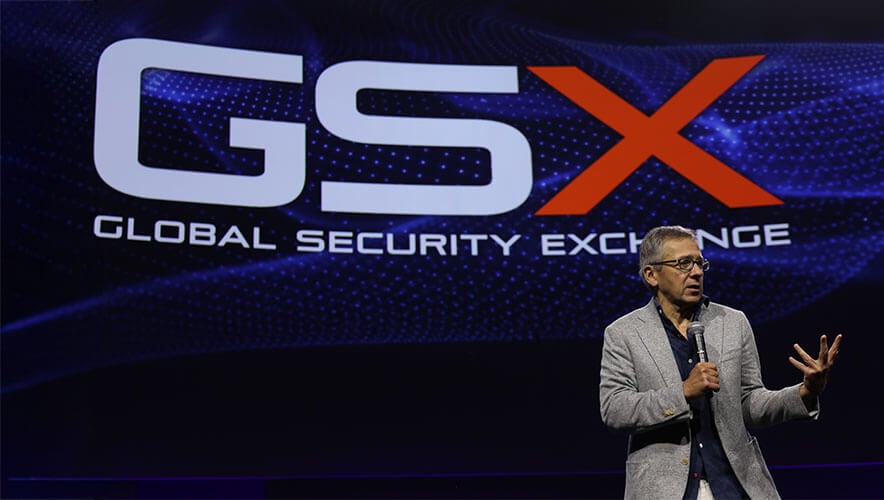
For much of modern history, the United States has provided leadership on a global stage, promoting free trade and the benefits of democracy as well as leading in security. But that interest in asymmetric leadership—and the demands upon the position—have recently waned, with the United States indicating less enthusiasm in the role, observed Ian Bremmer, president and founder of the Eurasia Group and a 2025 keynote speaker at GSX 2025 in New Orleans, Louisiana.
“But the United States is not declining,” Bremmer noted during the 29 September general session, sponsored by Axon. Instead, “America’s allies have gotten much weaker.” Bremmer pointed to Australia, Canada, Japan, South Korea, and the United Kingdom as traditional U.S. allies who find themselves grappling with increasing geopolitical uncertainty while being less able to depend on the United States. If this trend continues, Bremmer sees China stepping in to fill that space on a global stage, presenting itself as a more reliable dance partner.
Bremmer’s speech presented an analysis of the larger current conflicts and arrangements that will likely continue to impact the larger world and relationships between nations, while acknowledging that they were not the only issues at hand. “It is just a lot right now,” Bremmer said.
China and the United States
In recent weeks, the relationship between the United States and China has largely stabilized.
When U.S. President Donald Trump announced tariffs on Chinese goods, it was with the expectation that China would capitulate to U.S. demands to avoid the tariffs. Instead, China held out and managed to find an Achilles’ heel: in April 2025, China announced export restrictions on critical minerals—rare earth elements that are used in the automotive, defense, and energy industries.
“If you think the Americans are vulnerable to a Taiwan disruption on semiconductors, you’ve seen nothing until you look at how vulnerable American production is on Chinese-controlled critical minerals, reprocessing, and supply chain,” Bremmer said.
The following month, officials from the two countries came to an agreement, with the U.S. backing down from the tariffs while China gave U.S. companies that depend on its critical minerals a pass. Since then, there is an overall interest in stabilizing relationships between the two nations.
It’s just a lot right now.
One of the key levers between the two is the social media platform TikTok, which the Trump administration has long voiced an interest in. Technology company Oracle, whose founder Larry Ellison is considered a potential Trump ally, is expected to be one of the new U.S. owners.
Trump’s interest in the application superseded fentanyl and critical minerals, according to Bremmer. “Trump really wants ownership of TikTok because control of those algorithms by people who are politically supportive of him” will translate into allowing Trump to consolidate power in the United States, Bremmer said.
Meanwhile, China is willing to provide Trump with this gift, but with the expectation that in turn the United States will oppose Taiwanese independence from China.
If both of those things happen, Bremmer said that the upside would be decreased confrontation and a stabilization of economic trade between the two nations. But enough with “the good news,” Bremmer added, and onto the bad.
Russia and Ukraine
While the war between Russia and Ukraine continues, other leaders have been eyeing new ways to force Russia to return to negotiation talks as Putin has been largely unimpacted by other nations’ previous reactions to the war. One tactic has been to increase pressure on Russia’s pocketbook as Western nations announce sanctions and boycotts of Russian oil and energy supplies. Even Trump has asked other countries, like India, to cut off their use of these supplies.
According to Bremmer, it’s likely that the economic squeeze on Russia will become serious. While that might provide the leverage that Ukraine and its allies want for bringing Putin back to the table, it could backfire, resulting in increased military strikes against Ukraine.
Russia also recently escalated tensions among NATO allies, sending 21 drones into Poland. “The Russians clearly understood what they were doing. It was a test to see how the West responded,” Bremmer said. He acknowledged that the test was cautious, aiming to avoid a direct war with NATO nations.
The Middle East
Like Putin, Benjamin Netanyahu has felt few of the consequences for his actions in the conflict with Hamas and Hezbollah, with Gaza as the battleground. While Israel opposes a two-state solution in Palestine, the United Arab Emirates recently announced that if Israel decisively moved against this option (for example, by annexing the Palestinian territory), it would exit the Abraham Accords.
This puts Israel in a difficult situation, Bremmer noted, because while its citizens largely oppose a two-state solution, they do not want to become globally isolated and seen as a modern-day apartheid South Africa.
Sara Mosqueda is the editor-in-chief of the GSX Daily, which is published by Security Management, and associate editor for Security Management. Connect with her at [email protected] or on LinkedIn.