Overlapping Factors Lead to Overcrowding, Safety Condition Challenges in European Prisons
Despite a lower imprisonment rate than other regions of the world, the European Union is tracking a familiar problem for those in correctional security: overcrowding.
Prison administrators across Europe noted an uptick in their populations during and immediately after the COVID-19 pandemic that placed strain on their infrastructure and staff.
The European Organization of Prison and Correctional Services (EuroPris) report, From Challenges to Solutions: Mapping European Strategies on Prison Overcrowding, looked at data from 33 national and regional prison administrations representing about 80 percent of its members. It identified overcrowding as one of the most persistent and systemic challenges facing European prison administrations.
Between 2020 and 2025, 24 of the 33 total administrations reported increasing prison populations. Numbers rose sharply in Croatia (up 31 percent), France (up 15 percent), Ireland (up 27 percent), Northern Ireland (up 43 percent), and Sweden (up 55 percent). Some administrators reported occupancy rates above 120 percent at their facilities. In extreme cases in Croatia, some administrators reported occupancy rates of 190 percent.
Administrators noted concentrated pressure on overcrowding in pretrial detention facilities, women’s prisons, high-security units, and mental health facilities, where lack of specialist staff and increasing psychiatric needs are creating bottlenecks.
EuroPris stressed in its analysis, though, that overcrowding is a problem that’s created when multiple factors come together: sentencing frameworks that rely on custodial penalties, limited investment in noncustodial sanctions and community-based support, aging or inadequate infrastructure, fragmented governance, and broader social and political dynamics that favor punitive responses over preventive or rehabilitative approaches.
However, overcrowding is not simply a problem of insufficient space for incarcerated individuals.
“Beyond these dimensions, overcrowding directly affects safety and humane conditions for both staff and prisoners,” EuroPris assessed. “It heightens tension and violence, increases risks to physical and mental health, and places pressure on compliance with international standards, including the Nelson Mandela Rules, the Bangkok Rules, and the European Prison Rules.”
Research from the United Nations published in 2025, for instance, found that the death rate for all causes in prison—natural causes, accidental, suicide, and intentional homicide—was highest in European countries with data. The UN logged 453 deaths per 100,000 inmates in European prisons in 2023, compared to 354 in Asia and 247 in the Americas. Africa had a rate of only 164 per 100,000 inmates, but only five African countries shared data with the UN for its analysis.
European prison administrators who reported less than 100 percent occupancy at their facilities still said they had challenges with limited access to healthcare, education, reintegration activities, and mental health support. The unavailability of these services also led to staff fatigue and safety concerns.
The lack of these services can also pose challenges for prisons in meeting their goals of rehabilitation to prevent recidivism. The UN research identified several factors that are linked to positive rehabilitation outcomes, including strong program delivery, appropriate staff training, alignment with individual needs, and implementation within structured settings like therapeutic communities.
These programs are also more effective “when paired with broader organizational features—such as institutional culture, leadership approaches, and staff-prisoner dynamics—which can influence how well rehabilitation efforts are carried out in practice,” the UN wrote.
Mitigation Measures
Prison administrators have a variety of operational tools to address a rise in their inmate populations. But they are meant only to be temporary to safeguard order and safety.
“Administrations also noted that these measures often entail a deterioration in operational conditions and can undermine safety, rehabilitation, decency, and order, particularly when they persist beyond the period for which they were intended,” the report said.
Emergency practices. Some of the most common emergency practices administrators reported were having inmates share cells, initiating intrasystem transfers, temporarily increasing operational capacity, engaging in an emergency release of an inmate, or repurposing communal areas—like classrooms and gyms. Some administrators also said they postponed maintenance work to retain usable space or took the unusual step of initiating a cross-border transfer of inmates.
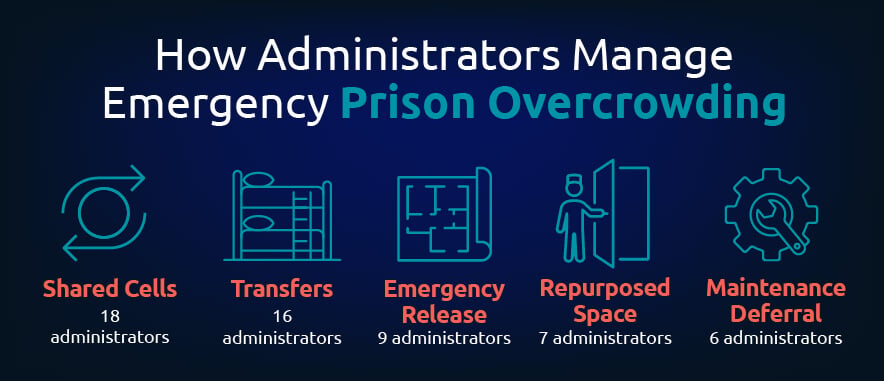
For example, in Denmark, administrators reported converting gyms and classrooms into temporary accommodation for inmates during high points of capacity strain. In the Czech Republic, administrators reduced the space that inmates are allowed to have—from 4 square meters to 3 square meters.
Using these emergency practices can relieve strain on the facility. But repeatedly relying on them risks normalizing overcrowding, EuroPris said.
“Several administrators noted that persistent overcrowding erodes staff well-being, restricts activity programs, and shifts perceptions of what is considered ‘acceptable’ capacity,” the report said.
Medium-term measures. Prison administrators can use medium-term measures to stabilize their facilities beyond immediate crisis response practices. These medium-term measures typically focus on managing the inflow and outflow of inmates, using progressive sentence execution, early or temporary release, or targeted population management across the estate.
In Belgium, Poland, Sweden, and Scotland, the judicial system used electronic monitoring for individuals who were sentenced to shorter prison sentences—ranging from three years to six months. In Germany, officials created the “Sweating Instead of Sitting” program that requires individuals with unpaid fines to perform community service instead of completing a short sentence in prison.
Long-term measures. Several countries have plans in place to increase their prison infrastructure. Hungary is constructing the Csenger National Prison, which will house 1,500 inmates, while Croatia is building modular annexes alongside three new facilities to house 400 inmates each.
While improving infrastructure to manage larger prison populations is a supported response for overcrowding, EuroPris found that long-term sustainability requires new construction be balanced with staffing, activities, and reintegration services.
“The biggest cautionary lesson is that increasing bed numbers without expanding access to activities creates serious risks,” the report said. “Sweden advises other jurisdictions not to repeat this error—capacity growth must be balanced with access to activities that allow reintegration into society.”
For instance, The Netherlands provided digital tablets to five prisons to support education, communication, and digital inclusion. Meanwhile, Finland is using a Smart Prison model for secure laptops for education, healthcare, inmate sentence planning, and communication.
“These initiatives do not reduce overcrowding directly but help mitigate its effect and support reintegration,” EuroPris found.
In this spirit, several countries are also creating tools to predict their future capacity needs and support strategic planning to prevent overcrowding.
England, Estonia, Ireland, Slovakia, Sweden, and Wales are all using 10-year frameworks for capacity, staffing, and budget planning. Slovakia is mandating annual assessments of accommodations, reconstruction needs, and contributions to criminal policy to assess overcrowding risks. Switzerland is creating a national forecasting model for construction between 2035 and 2050 to create a common strategy and action plan for prison infrastructure.
There is no single solution to the overcrowding problem at European prisons. Instead, EuroPris assessed that “progress depends on combinations of measures applied in parallel.
“Infrastructure expansion alone is insufficient without proportional investment in staffing, activity spaces, and reintegration programs,” the report said. “Several administrations are adopting 10-year capacity and staffing forecasts to support anticipatory governance, while cultural and political factors—including public confidence in alternatives—remain critical to sustainable reform.”
Megan Gates is senior editor at Security Management. Connect with her at [email protected] or on LinkedIn.