
What You Should Know About Using Therapy Dogs for Incident Recovery
After a violent incident occurs in the workplace, some organizations are including therapy dogs in their post-incident response measures.
But what exactly is a therapy dog? And how can you determine if a therapy dog might be a good fit for your organization?
Security Management reached out to Mary R. Burch, Ph.D., American Kennel Club (AKC) family dog director to find out. Burch is one of less than 100 Certified Applied Animal Behaviorists working in the field today and has more than 25 years of experience working with dogs.
The following Q&A and has been lightly edited for clarity.
Security Management (SM). When and how did you know that you wanted your professional career to include working with dogs?
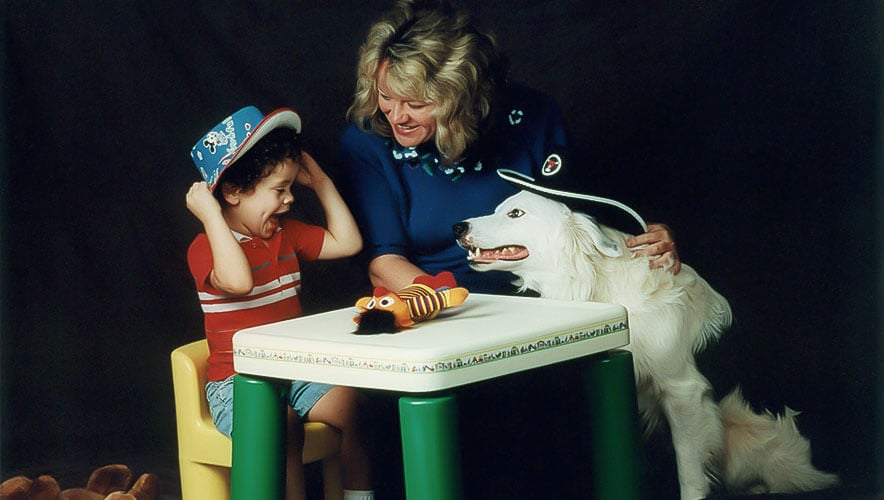
Mary Burch. My career in dogs started with a wonderful, mostly-white Border Collie named Laddie. When I got him as a four-month-old puppy, he had never been in a house or car, and he was a behavioral mess. He was afraid to walk down the street on a leash because there were mailboxes on posts, and he seemed certain that they would jump out and hurt him.
I went to AKC Obedience classes to survive, and I got hooked on training. Within two years, Laddie was a successful therapy dog and he had earned the AKC’s Utility Dog title in obedience.
SM. Sometimes people confuse therapy dogs with service dogs. What’s an easy way to understand the difference between the two?
Burch. To put it simply, therapy dogs are dogs who volunteer with their owners to provide comfort and help others. An example of a therapy dog is a dog who goes with its owner to volunteer in a school program where children are learning to read, or a dog who visits people who are elderly in a nursing home to bring them comfort.
Service dogs are dogs that are trained on specific tasks to help a person with a disability. An example is a guide dog for a person who is blind or a dog who helps a person with a physical disability.
SM. Are there any breeds of dogs that are preferred when training a therapy dog? What characteristics should therapy dog candidates have?
Burch. A common question about therapy dogs is “which breeds are best?” In fact, nearly all breeds can be good as therapy dogs if the individual dog is carefully matched with the setting and person.
For dogs who will visit multiple people in a day, a dog with an outgoing personality may be best. For a dog who is going to visit a person who is bed-ridden, a small, quiet dog may be the best choice. An extremely active dog may not be the best choice if the dog needs to work around a lot of medical equipment, but this dog may be perfect for a residential program for teenage boys who will be delighted to throw a ball for the dog.
SM. What characteristics do dog owners that want to train their dog to be a therapy dog need?
Burch. The dog owner needs to be committed to providing the dog with the necessary training to be a therapy dog. One would expect the dog owner to be consistent and persistent as a trainer. The owner should be getting training on dog obedience and therapy work from a qualified person. So many people want their dogs to be therapy dogs as a part of the image they have of their dog. It is important to note that the most important part of the therapy dog equation is the person who will be the recipient of the services.
Sometimes, people say to me, “Dr. Burch, my dog got certified as therapy dog!” I say, “That is wonderful. What kind of facility will you visit?” And they get this look like, “Facility???” as though I just dropped in from another planet. They never had any intention of doing therapy visits; they only wanted the certification for the dog. To do therapy work, both the dog owner and dog need to like and care about people.
SM. What does the training to become an AKC Therapy Dog entail?
Burch. Therapy dog training begins with basic good manners training—sit, down, come, stay, and the other basics. Some therapy dog organizations require the dog to pass the AKC’s Canine Good Citizen test before taking their organization’s therapy dog assessment. Therapy dog tests include therapy-specific skills such as: go say hello, leave it, behaving appropriately around healthcare equipment, and so on.
SM. Are there differences in training for dogs for trauma versus other needs?
Burch. In most cases, the dogs that work with people with trauma (such as PTSD) will be service dogs and not therapy dogs. Service dogs are trained to perform specific tasks related to the person’s disability. Some of this training is sophisticated and time-consuming.
Tasks service dogs perform for people with PTSD (many of these are ex-military) are interrupting nightmares or flashbacks, calming the person during a panic attack, interrupting anxious behaviors, and providing security in crowded situations.
Therapy dogs are increasingly paired with first responders and used in situations where there has been trauma for multiple people, such as when schoolchildren have been murdered or there have been shootings on college campuses.
Petting a dog releases endorphins in the brain, and this can be calming.
SM. When considering bringing in a therapy dog to your workplace after a traumatic incident, what are some initial questions you should ask?
Burch. Has the dog been trained to work in trauma situations, and is it confident in these situations? Do the people who have experienced the trauma and the workplace providers feel that therapy dogs are needed and would be beneficial? Is there a suitable place for the dogs and handlers to work, and is there a way to give the people who experienced trauma the choice to see a dog or not?
SM. When preparing to bring a therapy dog into your workplace, what are some best practices for setting up an environment that is conducive to that activity?
Burch. Make plans for anyone who has allergies or dog phobias, designate elevators for therapy dogs (so allergic people can choose another elevator), and plan for a bathroom area for dogs.
Designate a back-up handler for each dog so if the owner had to leave the dog, someone else would be in charge, and create policies/procedures about bringing dogs to work—bathing/grooming before visits, etc. Designate places for visits with the dog, unless they will be allowed to go from office to office.
SM. How should you communicate to employees about the therapy dog coming into their space?
Burch. You can start with an informative email and then follow-up with a meeting. Tell them the rules for the dog, make it clear people can opt out of visits, and provide the name of a contact person who can answer any questions. In the email, include background info and a photo of the dog or dogs.
SM. Should that communication be different if the visit will be primarily interacting with children, such as in a school or pediatric hospital setting?
Burch. In the case where children are involved, the information about the dog should go to the parents and they should sign a release. Be sure to tell them how children will be kept safe and how infection control is handled regarding the therapy dogs.
Megan Gates is senior editor at Security Management. Connect with her at [email protected] or on LinkedIn.