Critical Leadership Lessons from the FDNY’s Response to 9/11
Crises are catalysts for change; they can force people and organizations to reevaluate their priorities and their mission.
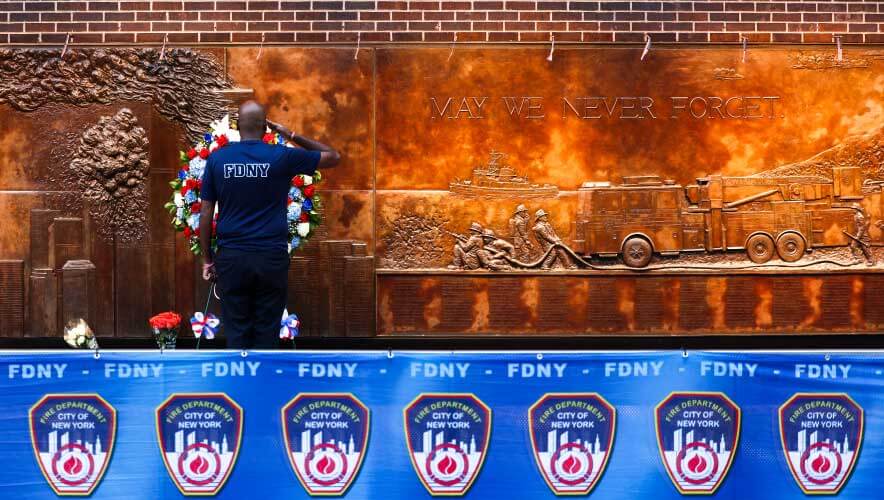
On 9/11, 343 members of the New York Fire Department (FDNY) were killed, including firefighters, paramedics, chaplains, and FDNY Chief William Feehan, who died when the South Tower of the World Trade Center fell on his command post.
After the terrorist attack, the FDNY underwent a major transformation, evolving from a world-class fire department to an all-emergencies function specializing in incident response.
In his new book, Greg Shea, senior fellow at the Wharton Center for Leadership and Change Management and senior fellow at the Penn Implementation Science Center, explores the pressures, revelations, and cultural needs that drove the FDNY to reinvent itself after tragedy.
Shea and his coauthors, Paul Brown and Andre Kotze, spent nine years interviewing first responders about 9/11 and about how the department changed afterward, for Rising From Ground Zero: 9/11 and the FDNY’s Path Through Crisis to Transformation. The experiences detailed in the book have notable lessons for corporate security professionals and leaders overall, including about humility, delegating leadership, and crafting an organizational mission that matches the moment.
In an interview with Security Management, Shea outlines some of the lessons and stories from Rising From Ground Zero and how they inform crisis leadership.
After both towers fell and the debris was six stories high on 9/11, the FDNY had already lost three of its six most senior people and 93 officers in total. It was a complete catastrophe, Shea says.
In that moment, two department officers were weighing who needed to lead the response. The most senior of the two had deep operational experience, but not as much as the lower-ranking officer.
“The more senior person—who believes he is now the ranking senior person in the FDNY—in the worst day in FDNY history, turns to the more junior person and says ‘It’s yours. What do you want me to do?’” Shea recalls.
The senior officer “knows that as good as he is—and he’s good—this guy’s better at this particular set of problems that are facing him right now,” Shea says. “He’s willing to take the subordinate role because he understands that this situation, this catastrophe that has to be worked through, will require operational and tactical skills. And as good as he is, he doesn’t think he’s as good as the other guy. That’s a leadership moment.”
The lesson for security and other business leaders here is threefold, Shea says.
First, leaders need to understand the external and internal situation—what you are working with, and what conditions are working for or against you. Second, leaders need to understand their role in the crisis response. Their job could be connecting the dots, leveraging relationships to get more resources or information, or guiding research. Finally, leaders need to know when to hand the job off to someone else who will handle the next stage better.
“Part of that is understanding yourself well enough to understand your skillset and your limits,” Shea says. “Understand what you can bring. Is this about the team? Is this something I can handle? Can I delegate this? Is this something that we actually have very little capacity to handle? If so, we’d better go find the expertise.”
In a security incident, this can play out clearly. A senior security executive who came up in the physical security space is now facing the fallout from a cyberattack on operational technology (OT) devices at a manufacturing plant. While the executive isn’t ignorant on cybersecurity or OT, she also realizes that it would be foolhardy to take the lead on cyber incident response when she has hired an extremely competent cybersecurity team, including someone with incident response expertise.
“They still have responsibility of command, but it would be much smarter for them to turn to somebody who may very well be 15 years younger than they are and say, ‘Tell me what you think I should do here.’ Now, you don’t have to do what they say, but most likely you’ll be better informed if you ask for that perspective,” Shea says.
“You put the right resources in play to handle the situation that you were in…You didn’t get caught up in your rank,” he continues. “You went to where the expertise was, and that’s what you leveraged. You used your rank to understand the situation, to identify what needed to be done, and to get the right resources deployed. In this case, they weren’t you.”
That doesn’t mean that individuals or departments not leading a crisis response can’t play an invaluable role. Looking back at 9/11, the FDNY learned critical incident management skills from an unexpected place: the U.S. Forest Service.
Early in the response to 9/11, New York officials and first responders rebuffed efforts from outside agencies to assist in incident management.
“This was hallowed ground for them,” Shea says of the FDNY and other NYC departments. “They’re going to run this, and they’re going to stiff-arm any people from the city, feds, or state who try to take it over from them.”
Officials from the Forest Service, which has a long history of managing wildfire response and other natural disasters, were on the scene within a day, watching operations and incident response. Eventually, they get a scant 5 minutes with the incident commander after a meeting.
“They meet with this guy, and the exchange quickly becomes, ‘What can you do for me?’ They say ‘What do you need?’” Shea adds.
The incident commander asked for radios—existing radios’ batteries were dead, systems were down, and transmitters were blown up. He asked for 250 to 300 radios as soon as he could get them.
The Forest Service returned the next day with 500 radios, a transmitter on top of the Empire State Building, and a second transmitter on top of a museum aircraft carrier in the Hudson River. The success of that first request led to more collaboration and additional resource sharing.
“The credit is to the FDNY for being opening to it,” Shea says. “To the people who were trying to reach them, it was ‘Let’s define what you need. I’m not going to tell you what you need.’”
In a crisis scenario, effective leaders spend a little time finding out what the responder needs that the leader can provide, rather than beating down the command room door with unwanted advice or offers that take up time.
“If you want to end up in a helping relationship, you’d better figure out what it is to help,” Shea adds. “Just saying ‘I’m here to help’ doesn’t help enough. I’ve got to be able to be specific enough in terms of the things that you need so you can see my value.”
Greg Shea, PhD, will be presenting more leadership and organizational culture lessons from the FDNY’s post-9/11 transformation during this year’s ASIS International CSO Secure Horizons event at GSX 2026, sponsored by Knightscope. For more information on this program, visit the website here.
Claire Meyer is editor-in-chief of Security Management. She has been reporting on the security industry since 2012. Connect with her on LinkedIn or via email at [email protected].