How the Port of Antwerp-Bruges Built a Resilient Innovation Hub
Once a 12th Century docking station on the Scheldt River in Antwerp, the Port of Antwerp-Bruges has evolved into a lifeline for Belgium and a critical supply chain between Europe and the world.
The 150-square kilometer port, the second largest in Europe, provides connections to more than 800 destinations, generates 72,600 direct jobs, and adds at least €21 billion in value to Belgium. Around 290 million tons of international maritime cargo pass through the port each year, which is also home to Europe’s largest integrated chemical cluster.
In 2016, Zara Hadid designed a new headquarters for the port to bring together its 500 staff that previously worked in separate buildings around Antwerp. The design placed a ship atop an existing firehouse.
It was the vision of the architect to combine the successful past—the lower part of the building—with an ambitious future that represents Antwerp’s iconic diamond and maritime industries, said Erwin Verstraelen, vice president of innovation at the Port of Antwerp-Bruges, in his opening keynote on Tuesday, 24 March, at ASIS Europe 2026: From Risk to Resilience.
“This is certainly in line with what we want to do. We understand the challenges of our time. We know that we face a lot of problems,” Verstraelen said. “But with a little bit of a different mindset, they can be opportunities.”
Verstraelen joined the port in 2017 as chief digital and innovation officer and quickly identified that to maintain the port’s business amidst a challenging threat landscape at the time, it needed to change its mindset to see those challenges as opportunities to become more resilient.
During his keynote, he shared how he helped build an environment to foster innovation that helped the port navigate tariff troubles, the COVID-19 pandemic, cyberattacks, and kinetic assaults while facilitating record levels of trade.
A key element of this journey has been embracing the mindset that the staff at the port are pioneers. The definition, for Verstraelen, is important. Pioneers are people who have “a long-term goal in mind, but understand that in between now and the goal, you will have setbacks, disappointments, failure, and a lot of free criticism,” he added. “But the pioneer has one key characteristic: it’s called tenacity. They endure. They don’t give up.”
Creating the Heart
Before embarking on this ambitious project, Verstraelen said the port needed to create a working environment that allowed innovation.
Internal stakeholders at the port would need to trust one another so they could share information between themselves in an open way. Doing so would create transparency, which would lead to better understanding between stakeholders of how the port is operating and what the business and security needs of the port are. Shared understanding, in turn, would help create a collaborative environment where innovation can happen.
The port’s CEO at the time helped foster this environment with Verstraelen by adopting what he calls a DELTA mindset, “dare to experiment, learn, and trigger others,” Verstraelen recalled. “The message was do something out of the ordinary, and if you fail, it won’t kill you.”
Verstraelen also understood that he needed to approach his work with the mindset that everything he would do would have an impact on the business.
With these key factors in mind and trusted working environment, the port decided to begin a digital transformation journey to become an innovation hub that would make it more resilient to its current challenges and more prepared to address the ones of the future.
Building the Nerve Endings
The human body’s central nervous system is a command center. It uses nerves to receive sensory information, passing it to the brain to process and then initiate a response.
Verstraelen and the port’s leadership decided that the port needed its own digital nervous system to facilitate a similar process using a variety of security technology.
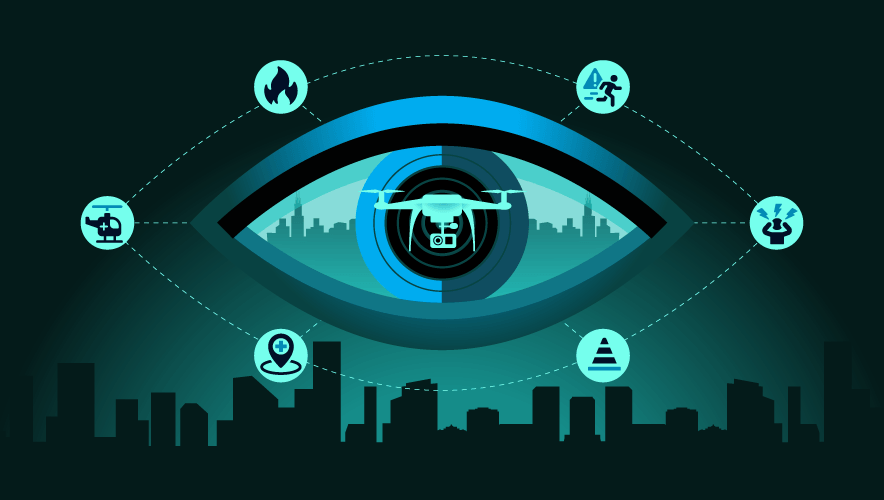
Drones. The first aspect of the system was to create a drone program that would allow pilots to remotely operate drones at a height farther than the human eye can see above the port.
There was just one problem. It was illegal at the time to fly a drone beyond a human operator’s line of sight and above the port itself. Despite this setback, Verstraelen’s team worked to address the legal issues. It now has the authority to act as its own geo zone manager, making risk assessments and allowing authorized drone flights above the port. In 2025 alone, the port deployed 14,000 authorized drone flights to provide data and move materials.
This system helped the security team meet its needs to improve situational awareness. It also created an ecosystem of drone operators that provides valuable services for business needs, Verstraelen said.
The port now uses drones to inspect infrastructure, conduct surveillance and monitoring, manage berthing, and detect oil spills and floating waste. The drones are also leveraged to support security practitioners when incidents or fires occur.
One example of this is how the port uses drones from ADLC—a drone logistics company that operates a carrier drone. These drones can carry up to 50 kilograms of chemical samples through the air to a laboratory for testing.
The drone flights allow the labs to test the samples sooner, which speeds up a required quality check procedure that must be completed before a ship in the port can unload its cargo. ADLC’s drones can also carry documents to large ships, significantly improving the traditional process, which used motorcycles, cars, or vans to move the documents from place to place.
Sensors. While drones were moving through the air, Verstraelen also knew that the port’s digital nervous system would need more sensors in key locations to feed it data on its water quality, the strength of its bollards, and even the integrity of its bridges.
It inventoried sources and water losses from its docks using the KULeuven water balance model, which allowed the port to calculate how climate change caused sea level rise and drier dock periods are impacting the port.
The port also uses a system of locks—an infrastructure component used to raise or lower ships between the Scheldt River and the inland dock system. The port needed a better understanding of how to optimize these locks, so it used a dock level management application to provide more insight into future rainfall and the tides on the river so operators could take action to keep the dock level at the correct mark.
The port then collaborated with partners to install smart sensors on the Antwerp docks to measure conductivity, salinity, and the temperature of dock water.
While many security practitioners are familiar with bollards used to prevent vehicular traffic, their first use was in the maritime sector. Ports and docks would install bollards, which crews would then tie their ships to to prevent the vessel from drifting away.
The Port of Antwerp-Bruges has a significant number of bollards, many of which are decades old. Verstraelen’s team developed a sensor that can be placed on these bollards to measure their strength, so it can identify when the bollard’s breaking point would be overstretched by a modern heavy ship.
The port also has many bridges across its infrastructure that were built in the 1960s—or even earlier. Some of these crossways have small cracks in them that the port needs to monitor to identify when they expand and require repairs. These cracks, however, are often in hard-to-reach locations for humans, so the port has developed sensors that provide remote monitoring capabilities.
Cameras. Along with installing sensors, the port also wanted to enhance how it used its video surveillance system to provide more actionable information.
It started with downloading software that would allow its camera system to use object detection for vehicle, train, and cargo container tracking.
The port then attempted to build its own models not available on the market to detect objects in its specific environment. It used thousands of images to do this over several weeks to get a model that was 95 percent accurate, Verstraelen says. Now, using artificial intelligence (AI), he adds that the port can do the same thing in about 5 minutes.
“That exponential technology growth creates capabilities that were unheard of four or five years ago, and with these kinds of capabilities we can do a lot,” Verstraelen said.
The port is also combining historical data with real-time tracking data from AIS that is issued for ships every 3 to 5 seconds to assess normal behavior for ships. Using this method, analysts can detect deviating sailing behavior like degasification—ventilating enclosed spaces to remove harmful gases—or removing liquid residual cargo from the tanks of tankers. Belgium has regulated the practice.
“We need to know when that happens because it often creates irritation and smell, and we need to understand where it’s coming from,” Verstraelen explained.
The port can also use tracking data to monitor ship activity in the port itself, such as understanding why a ship is stopping at multiple locations. That could be innocuous—like a container barge picking up empty containers—or an incident that the port needs to respond to.
Audio collection. In a port environment, much of the communication between ship-to-ship and ship-to-shore is done via people speaking on the radio. It’s a protocol driven procedure where one person makes a call, the recipient acknowledges the call and responds, and then the initiator of the call confirms.
“We asked ourselves the question, what would be the value if we could transform all that speech into text? Because once you have text, you can query it. You can also do sentiment analysis,” he explained.
Sentiment analysis could be helpful for monitoring when there is an emotional change in the tone someone uses in a radio communication, which typically indicates that an incident is occurring that the port should be aware of.
The port attempted to gather this data and analyze it in 2018, but it was difficult because even though many of the calls were in English, they were also in Dutch, French, and German, too. Verstraelen said the they had abandoned the idea until 2022, when OpenAI released ChatGPT to the public. The port used ChatGPT to analyze a sound file and found that it was 95 percent accurate, allowing it to move forward with the project.
“This speaks to the point that you should never underestimate the potential of technology that is evolving at an exponential rate, because the biggest mistake you can make is to say, ‘We tried it in the past and it didn’t work. We’re not going to try it again,’” Verstraelen said.
The Brain of the System
Once the digital nervous systems inputs were in place, the port needed a way to collect the data from them and analyze it. This challenge created an opportunity for the port to develop its digital twin, the Advanced Port Intelligence & Coordination Assistant known as APICA.
APICA is a 2D/3D interface that uses real-time data integration and monitoring, along with AI predictive capabilities to visualize systems and forecast scenarios.
The digital twin is “an assistant in the sense that it helps our people do their job better and to be more efficient and more effective in what they need to do,” Verstraelen said.
APICA can help provide predictive analysis that helps the port prepare to handle upcoming weather conditions and ship traffic to maintain operations. For instance, providing a reminder to port staff that with the expected incoming and outgoing ships, the weather forecast, and the wind speed and direction, that they will need to dispatch another tugboat in three hours to assist ships without causing a weather delay.
“That’s the kind of value you get out of a digital twin, because it is information that exists in multiple data sources and in multiple information platforms that you can bring together in context,” Verstraelen said.
Looking to the Future
Verstraelen transitioned into his current role in 2025 and the port continues to be a thriving center of innovation.
It’s currently working with Antwerp’s police and fire service, as well as the City of Antwerp, to build a private 5G network to increase the speed, reliability, and security of digital applications at the port.
It’s also adding to its camera network, placing 700 smart cameras at the Bruges portion of the port that will use AI to detect individuals and problems in its traffic network. Additionally, Bruge has added a Central Security Control room to alert operators when unauthorized visitors enter the port area, and Antwerp is studying how it can use smart fencing to keep intruders at bay.
Verstraelen said the port is looking at how it can continue to use and improve APICA as part of their continuous exploration of possibilities. The journey includes continuing to foster an environment where people who are enthusiastic about innovation and pioneering continue to be engaged. He mentioned that just last year, employees at the port created t-shirts with the slogan “No Guts, No Glory” printed on them.
People with this open mindset, who say sure, “this is a problem, but where is the opportunity? No guts, no glory,” are essential to building the solutions and systems that create a more resilient future, Verstraelen said.
“Stick out your neck. Ask your people to step out of the safe zone, and back them up,” he added.
For more on ASIS Europe 2026: From Risk to Resilience, check out the dedicated website here.
Megan Gates is senior editor at Security Management. Connect with her at [email protected] or on LinkedIn.