Mexico to Boost Security at Tourist Sites After Shooting
A man opened fire on tourists at the Teotihuacan pyramids in Mexico on 20 April, injuring 13 people and killing one. The shooter—identified as a 27-year-old Mexican man—later died of a self-inflicted gunshot wound.
The attack, considered an isolated incident, spurred action from Mexican government officials looking to reassure visitors ahead of the World Cup 2026, which will take place across Canada, Mexico, and the United States starting in June.
The Attack
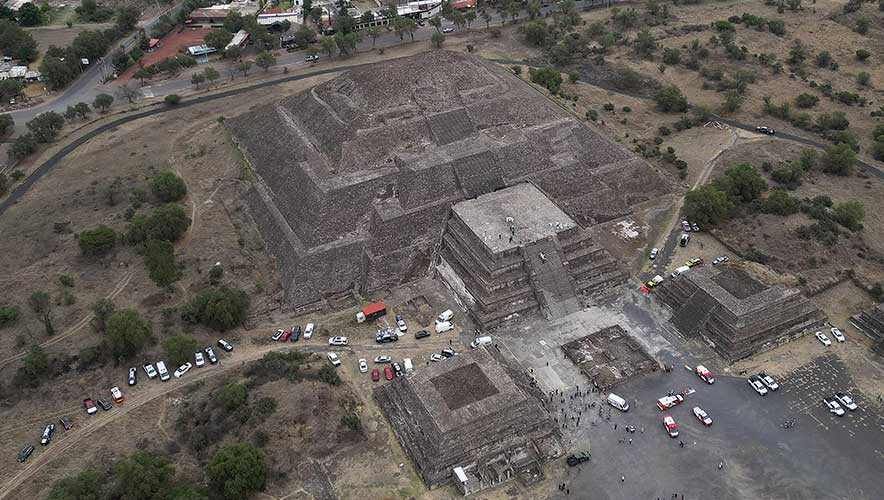
The suspected shooter positioned himself on top of one of the Teotihuacan pyramids, armed with a gun, knife, and ammunition, security officials said. Shortly after 11:30 a.m., he shot at tourists climbing the pyramids or standing atop them. He was on the same platform on top of the Pyramid of the Moon with roughly 60 tourists. Seven were wounded by gunshots, and others fell while trying to get away after the shooting started, the Associated Press (AP) reported.
Mexican National Guard members scaled the pyramid and wounded the attacker in the leg, after which the assailant shot and killed himself.
State officials said the perpetrator carried materials that were apparently related to the 1999 shooting at Columbine High School, including a photo modified by artificial intelligence to show the attacker alongside the Columbine shooters. His attack occurred on the 27th anniversary of the school massacre.
Authorities said that the gunman visited Teotihuacan several times before carrying out the attack, allegedly to scout out the area.
Security Improvements
The Teotihuacan pyramids are a UNESCO World Heritage Site and one of Mexico’s most important tourist destinations. The site drew more than 1.8 million international visitors in 2025, and Mexican authorities expect a wave of new tourists during the World Cup.
In past years, staff at the archaeological site carried out security scans before people entered the area, but those efforts have stopped, one local guide told the AP. The pyramids—part of an ancient city built by three different civilizations—are widely considered one of the safest major tourist attractions in Mexico.
In response to the attack, law enforcement will tighten security at archaeological sites and other top tourist locations in Mexico, Security Minister Omar García Harfuch told reporters. The government will increase National Guard presence, boost security checks, and improve surveillance systems. Teotihuacan is set to reopen today with reinforced security.
Mexican President Claudia Sheinbaum reiterated Mexico’s guarantees of safety during the World Cup, which will open on 11 June in Mexico City. Teotihuacan was slated to be a key site for visitors during the tournament, since it’s just an hour away from Mexico City. Local lawmakers were even pushing for the return of a nighttime interactive light show projected on the pyramids to make them more of a draw for World Cup visitors, the AP reported.
Sheinbaum acknowledged that the site lacked security filters to prevent the attack. She said the shooting was “an isolated incident” and the first of its kind at a public space in Mexico. Mass shootings in Mexico are rare, especially at tourist sites.
World Cup Outlook
Mexican officials are doubling down on security measures for the World Cup, deploying 100,000 security personnel across the country, especially in its tournament host cities—Mexico City, Guadalajara, and Monterrey. Officials said they would deploy more than 2,000 military vehicles, plus aircraft and drones, and establish security perimeters around stadiums and key airports.
Concerns about World Cup security previously arose after the capture and death of a the Jalisco New Generation Cartel (CJNG) in February and subsequent violent retaliation by cartel members. Following multiple briefings and security updates, FIFA President Gianni Infantino expressed his “full confidence” that Mexico will be able to cohost the games safely, the AP reported in March.
Third-party threat assessment tools—including the stadium overviews available for free through Base Operations—note that crime risk at the World Cup venue in Mexico City (Estadio Azteca) is high, although primarily for fraud, theft, or property crime instead of violence.
Threat severity at the stadiums in Guadalajara and Monterrey is lower, with vehicle theft and vandalism ranked as the top threat categories. Base Operations noted, however, that “CJNG maintains territorial control” in Guadalajara.
“While a ‘tacit truce’ regarding high-profile violence is expected during the tournament, the cartel exploits high-visibility events for illicit revenue (extortion, trafficking),” Base Operations said, adding that corporate security directors should remain alert and use armored vehicles for executive movements.