3 African Democracies Struggle with Unrest, Corruption
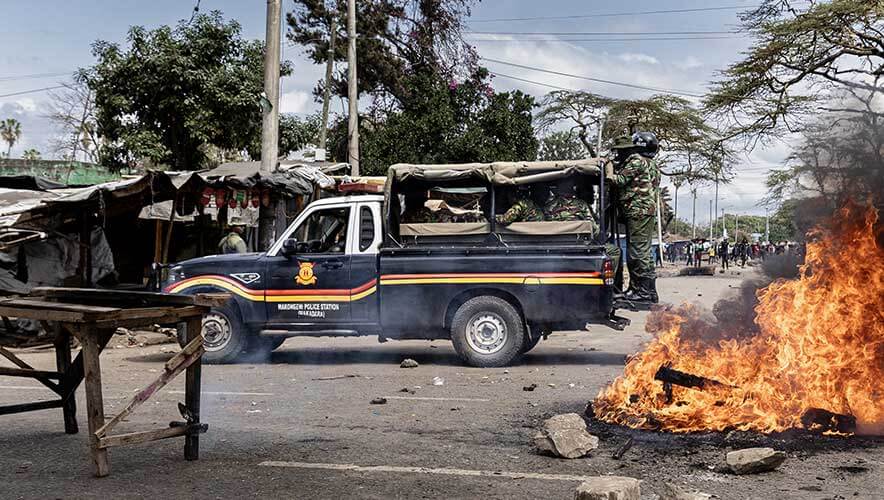
Kenya is one of several African democracies enduring turbulent times. On 7 July, roiling unrest came to a head with violent clashes between police and protestors. According to the Police Reforms Working Group, which is affiliated with Amnesty International Kenya, at least 38 people died in the clashes, more than 500 were injured, and well over 1,000 people were detained or arrested.
Young Kenyans are fueling the unrest and have said they will continue to protest until President William Ruto resigns. After the violence on 7 July, Ruto made the widely condemned statement that people who engage in looting during the unrest should be shot in their legs by authorities.
The protests were part of a long string of unrest that has stretched on for months. The 7 July protests occurred on Saba Saba Day, a celebration in Kenya marking 7 July 1990, when protests demanding free elections and an end to authoritarian practices eventually led to reforms in the country.
The New York Times published a timeline of the unrest that stretches back to 2023 and includes several different grievances. In 2023, protests broke out when food and fuel prices spiked to unattainable levels. In 2024, protesters stormed Kenya’s parliament building, setting parts of it on fire in reaction to a bill that would raise taxes on such necessities as bread, cars, and mobile money transfers. Following the widespread 2024 protests, many activists reported being kidnapped, interrogated, and tortured, which has led to continued unrest and deadly violence in late June and early July.
The youth-centered protests have fully employed digital tools for understanding and spreading information. Activists used social networks extensively to coordinate protests and expand their reach. They also used artificial intelligence (AI) to quickly produce easy-to-understand FAQ-style information sheets on things like the esoteric financial bill in 2024.
On 14 July, researchers from South Korea’s Hankuk University of Foreign Studies announced they would study the social, psychological, economic, and political issues affecting youth in Kenya. “The professors noted that the youth demographic is a challenge not only in Kenya but across the world, and the need to understand them is critical to inform appropriate policy interventions for their needs,” the announcement said.
South Africa
South African Minister of Police Senzo Mchunu and his deputy Shadrack Sibiya were placed on leave by President Cyril Ramaphosa based on allegations that they were working with organized crime gangs.
“The commission will investigate the role of current or former senior officials in certain institutions who may have aided or abetted the alleged criminal activity, failed to act on credible intelligence or internal warnings, or benefited financially or politically from a syndicate’s operations,” Ramaphosa said during a televised address Sunday.
At least one serious allegation against Mchunu and Sibiya came from a provincial police leader who said the pair had disbanded a task force that had been set up to investigate the assassinations of politicians because the task force was uncovering ties between corrupt politicians and police officials with businesspeople and leaders tied to a drug cartel.
“I welcome and respect the president's decision and pledge my commitment to the process,” Mchunu said in a statement. “Honor and integrity are the virtues I personally subscribe to and which we all need to make efforts to uphold.”
Nigeria
The African continent’s most populous country is another democracy under fire. With groups like Boko Haram and the Islamic State in West Africa Province wreaking havoc in the country, large swaths of Nigeria have been affected by terror and lawlessness.
“Since 2014 more than 1,600 children have been abducted or kidnapped, with at least 580 civilians, primarily women and girls, kidnapped across several states in 2024 alone,” the Global Centre for the Responsibility to Protect said. The group also reported that more than 2,266 people were killed by insurgents or bandits in the first six months of 2025, more than in all of 2024.
On 10 July, Amnesty International put out an urgent alert saying that gunmen and bandits had displaced as many as 500,000 people in the Benue state, which lies in central-eastern Nigeria.
“The Nigerian authorities have failed the people of Benue state again and again. Rampant attacks by gunmen have deprived thousands of people of their rights to life, physical integrity, liberty, freedom of movement and access to livelihoods. Survivors of these harrowing attacks face the fresh torment of being displaced in overcrowded, unhygienic camps where disease runs rampant and essentials such as food and clean water are scarce,” said Isa Sanusi, Director of Amnesty International Nigeria.
Included in the violence are incidents targeting Catholic priests. On 10 July, a Boko Haram faction attacked a seminary in Ivhainokpodi in Edo, Nigeria, abducting three people and killing a security guard at the facility. In June, Boko Haram had abducted Catholic Reverend Daniel Alphonsus Afina when he was traveling from Mubi to Maiduguri.
“For the past decade the Catholic Church in Nigeria has seen an alarming rise in the number of abductions targeting priests, seminarians, and other religious personnel,” a Vatican News article said. “In March 2025, Fides [News Agency] released a report indicating that between 2015 and 2025 a total of 145 priests were abducted of which 11 were killed.”