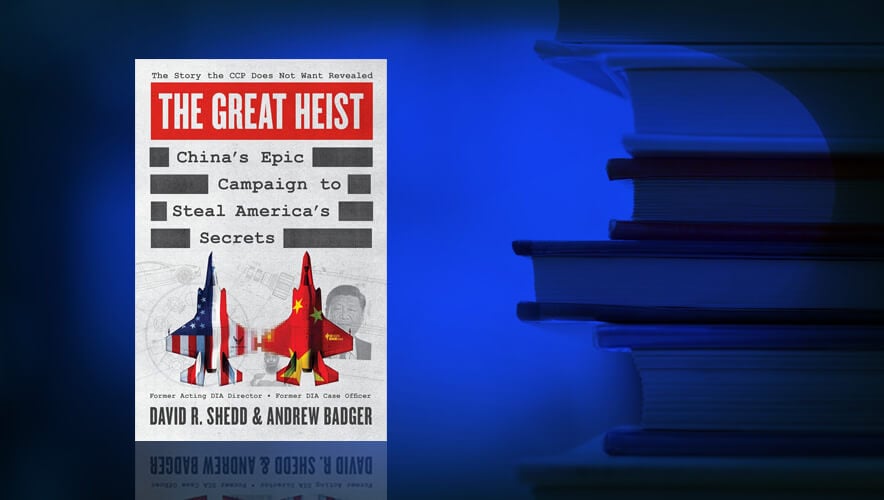
Book Review: The Great Heist: China’s Epic Campaign to Steal America’s Secrets
The Great Heist: China’s Epic Campaign to Steal America’s Secrets. By David R. Shedd and Andrew Badger. HarperCollins Publishers; 368 pages; $32.50.
The Great Heist: China’s Epic Campaign to Steal America’s Secrets by David R. Shedd and Andrew Badger is a forceful, highly readable examination of how the Chinese Communist Party has waged a decades‑long campaign to appropriate American intellectual property, data, and technological advantage. Drawing on their careers in U.S. intelligence, Shedd and Badger argue that China’s economic rise cannot be understood without recognizing the central role of state‑directed espionage and industrial theft.
The book’s core strength lies in its blend of case‑driven storytelling and strategic analysis. Shedd and Badger take the reader through operations targeting firms such as Boeing, Lockheed Martin, and major U.S. tech companies. They illustrate how a whole‑of‑society approach mobilizes intelligence officers, hackers, students, front companies, and joint ventures in a coordinated effort to capture Western innovation. These chapters read with the pace of a thriller yet are grounded in interviews with intelligence officers, corporate security teams, policymakers, and victims of espionage.
Equally compelling is the authors’ presentation of documented facts that makes a strong case that complacency enabled this “great heist.” They describe how cost pressures, market access dreams, and a bias toward free‑trade optimism led corporations and universities to overlook warning signs, underinvest in security, and sometimes downplay breaches. This critique extends to successive U.S. administrations, which the authors portray as slow to recognize that China’s strategy is systemic rather than episodic, treating each case as a discrete scandal instead of part of a larger campaign.
For national security professionals and corporate leaders, the book’s most practical contribution is its strategic playbook for response. Shedd and Badger outline measures to tighten counterintelligence, harden corporate defenses, and rethink the balance between openness and resilience in critical sectors. Some readers may find the tone distinctly alarmist, but even skeptics will have to grapple with the breadth of evidence and the sobering implications for supply chains, research partnerships, and technology export policy.
Overall, The Great Heist succeeds as both a wake‑up call and a policy argument. It is not neutral, and it does not try to be. Instead, it presses the reader to confront how far behind the curve the United States has been in defending its crown jewels of innovation. For anyone concerned with national security, economic competitiveness, or corporate risk, it is an urgent and unsettling read.
Sources cited in The Great Heist are credible within the U.S. national security and corporate security risk communities. For readers interested in national security and corporate risk, the sourcing is widely regarded as solid, strong on operational detail and practitioner insight, but leave it to the stakeholders and policy leaders to determine appropriate mitigation and risk tolerance needed to protect their economic interests. The book is best read as a well‑sourced, seasoned‑insider factual account of the current, past, and future landscape surrounding this issue.
Reviewer: Jerry Brennan is the co-founder and chief executive for the Security Management Resources (SMR) Group, whose exclusive focus is global recruitment of security, risk, and resiliency professionals. Prior to cofounding SMR in 1997, Brennan had a 26-year career in domestic and international enterprise risk and security executive leadership roles.
Book review © 2026, Jerry J. Brennan