Cognitive Warfare Is Exploiting Polarization, Both in Nations and Companies
When Russia’s Internet Research Agency ran its influence operations ahead of the 2016 U.S. presidential election, it didn’t just promote one candidate over another. It ran Black Lives Matter pages and Blue Lives Matter pages simultaneously. The strategic objective wasn’t electoral. It was epistemic—degrading Americans’ ability to trust each other, their institutions, and their shared sense of what’s true. By that measure, it was remarkably cost-effective.
This is cognitive warfare: the deliberate, state-directed exploitation of cognitive vulnerabilities to degrade a population’s capacity for rational, collective decision-making. It is not propaganda in a digital wrapper. Propaganda tries to change what people believe. Cognitive warfare is more ambitious—it aims to degrade how people think. And the primary attack surface isn’t a network or a facility. It’s polarization.
Understanding the Feedback Loop
The relationship between polarization and cognitive warfare is a feedback loop, and security leaders need to understand its mechanics. Preexisting social divisions—tribal identities, declining institutional trust, grievances that politics has failed to address—create structural fractures.
Adversary operations then exploit those fractures through four primary techniques: injecting divisive narratives into already heated debates, leveraging platform algorithms to amplify emotionally charged content, fabricating the appearance of grassroots support for extreme positions, and systematically delegitimizing the institutions that populations rely on for trustworthy information.
The result is deeper polarization, which makes the next round of operations cheaper and more effective. The loop feeds itself. And the vulnerability is nonlinear: Below a certain threshold of social trust, adversary interventions that would have bounced off a cohesive society instead produce cascading effects. Think of it as an immune system. A healthy society metabolizes disinformation; a polarized one amplifies it.
Three Adversaries, Three Strategies
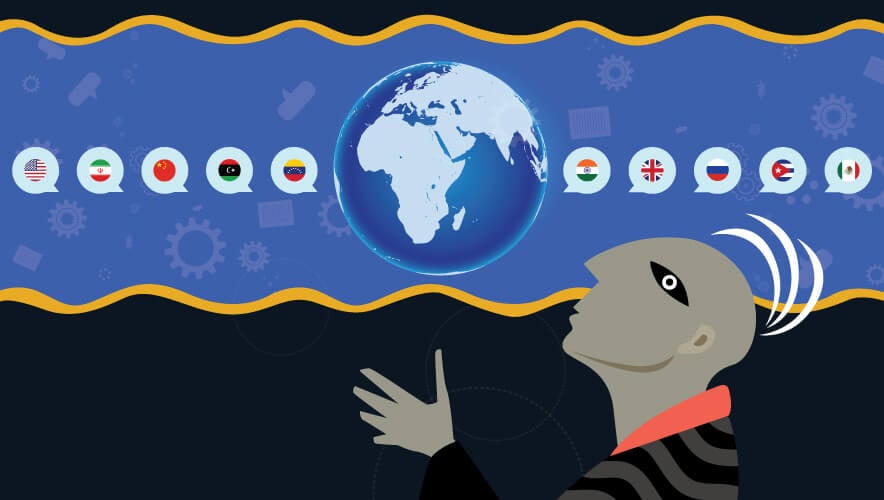
Cognitive warfare is not a monolith. Russia, China, and Iran each pursue distinct approaches shaped by their geopolitical positions, and the operational implications differ.
Russia is in the destabilization business. Operating from a position of declining conventional military advantage, Moscow uses cognitive operations as an asymmetric tool to weaken adversary alliances and paralyze decision-making. The playbook is persistent: Inject division, amplify grievances, erode trust. The 2024 Romanian presidential election—annulled after the constitutional court cited evidence of coordinated foreign interference via TikTok—illustrates how these operations can produce outsized effects in already polarized environments, though the precise causal weight relative to domestic factors remains contested.
China takes a constructive rather than destructive approach. Beijing’s “Three Warfares” doctrine—psychological, media, and legal warfare—represents a generational effort to reshape the international information environment in China’s favor. The targets extend well beyond Taiwan to include diaspora communities, Western academic institutions, and international organizations. For security leaders managing global operations, this means that brand narratives, supply chain relationships, and stakeholder perceptions in the Asia-Pacific region are all potential vectors.
A healthy society metabolizes disinformation; a polarized one amplifies it.
Iran’s approach has undergone a doctrinal shift that current events have made impossible to ignore. Campaigns that were once characterized as episodic and regionally bounded have evolved into operational, multidimensional information warfare integrated with kinetic action.
During the June 2025 Iran–Israel exchange and the broader conflict that started in February 2026, Iranian state media and affiliated networks deployed AI-generated deepfakes at industrial scale; the New York Times identified more than 110 distinct synthetic media items in the first two weeks of fighting alone. The fakes fabricated military victories, inflated adversary casualties, and constructed an alternative operational reality for both domestic and international audiences.
The pattern reflects a deliberate doctrine: Iran cannot match U.S. or Israeli conventional force, so information operations function as a force multiplier, aimed at fracturing Western public resolve and generating international pressure to negotiate on terms favorable to Tehran.
Two structural features of Iran’s approach carry direct implications for security leaders. First, Iranian information operations have increasingly fused with kinetic action, synchronized to missile launches to shape the narrative before independent verification is possible. Second, Iran’s Ministry of Intelligence and Security (MOIS) runs psychological operations directly targeting Western soil. For example, in March 2026, the U.S. Department of Justice seized four MOIS-controlled domains used to publish stolen personal data, issue death threats to Iranian dissidents and journalists in the United States, and solicit partners to commit acts of violence. Cognitive warfare, in the Iranian case, is not separate from covert action; it is the same instrument.
There is also a self-inflicted dimension worth noting. Years of systematic disinformation have produced what analysts are calling the “liar’s dividend:” Iran’s information architecture has so thoroughly contaminated the information space that its legitimate claims, genuine accounts of civilian casualties, and verifiable infrastructure damage are now widely disbelieved by international audiences. The regime’s cognitive operations have undermined its credibility precisely when it needs it most. For security leaders, that dynamic offers a pointed lesson about the long-term cost of institutional deception: Eroded credibility cannot be rebuilt on demand.
What all three share is that they exploit the same structural vulnerability: low institutional trust in target societies. Trust is the center of gravity.
Why It Matters at the Organizational Level
Cognitive warfare may seem like a geopolitical abstraction, but its effects cascade into every domain security professionals manage. Consider the operational implications.
Workforce vulnerability increases. Employees immersed in polarized information environments are more susceptible to social engineering, phishing, and insider threat recruitment. The same cognitive biases that Security Management has previously explored in risk decision-making—confirmation bias, tribal reasoning, emotional over analytical processing—are precisely the mechanisms adversary operations exploit. An employee who has been primed by months of polarizing content to distrust institutional authority is a softer target for social engineering than one who hasn’t been.
Reputational risk escalates. Organizations that depend on public trust—financial institutions, healthcare systems, utilities, government agencies—are vulnerable to targeted disinformation campaigns that no cybersecurity investment can prevent. Deepfake technology and generative AI are lowering the cost of producing credible, contextually adapted attacks on organizational credibility. A fabricated video of a CEO making inflammatory statements during a period of social unrest is no longer a theoretical scenario.
Alliance and supply chain exposure grows. For organizations operating internationally, cognitive warfare’s effects on partner nations’ governance capacity and alliance cohesion create material risks. Polarized publics become susceptible to narratives that frame international partnerships as serving foreign rather than national interests, undermining the political foundations of cross-border cooperation.
Building Resilience: A Four-Pillar Approach
The temptation is to focus on detection—identifying and flagging adversary operations. That matters, but it addresses only the supply side. The more consequential challenge is reducing the demand: the organizational and societal vulnerabilities that give cognitive operations their leverage. Effective counterstrategies require four pillars working together.
Invest in cognitive security. The Nordic and Baltic states offer the most developed models. Finland integrates media literacy across its education system and public institutions. Estonia has built rapid-response capabilities after years of Russian information operations. Sweden operates a dedicated psychological defense agency. Within organizations, this translates to embedding critical thinking and media literacy into security awareness programs—treating cognitive resilience as seriously as cybersecurity hygiene.
Deploy prebunking at scale. A growing body of research—including a 2025 meta-analysis covering more than 81,000 participants—shows that preemptive exposure to weakened forms of manipulation techniques builds measurable resistance to subsequent manipulation. Several governments are already integrating these “inoculation” approaches into public communication. For security leaders, the practical application is workforce training that teaches employees to recognize manipulation techniques before they encounter them, rather than relying solely on content-based fact-checking after the fact.
Strengthen institutional credibility. Trust is the strategic center of gravity. Organizations that have earned trust through transparency, accountability, and consistent behavior are harder to undermine. Those that haven’t are easy targets. Security leaders should advocate for organizational communication practices that build credibility reserves—because when a deepfake crisis hits, credibility is what determines whether stakeholders believe the organization’s denial.
Prepare for AI-enabled escalation. Generative AI is lowering the barriers to credible cognitive operations. Deepfakes will become harder to detect. Organizations need detection capabilities, response protocols, and crisis communication plans that account for sophisticated synthetic media. The World Economic Forum’s Global Risks Report 2025 ranked misinformation and disinformation as the top two-year global risk—a signal that the threat trajectory is accelerating.
An employee who has been primed by months of polarizing content to distrust institutional authority is a softer target for social engineering than one who hasn’t.
Five Steps for Security Leaders
First, add cognitive warfare to your threat assessment. It belongs in risk registers alongside cyberthreats and physical security risks—not siloed in a communications department.
Second, audit your organization’s trust posture. Where are the credibility gaps an adversary could exploit? What narratives about your organization already circulate in polarized online communities? Understand your exposure.
Third, extend security awareness training to include manipulation recognition. Programs like prebunking—teaching people how manipulation works before they encounter it—have stronger evidence behind them than post hoc fact-checking. Your workforce is the attack surface; train accordingly.
Fourth, develop synthetic media response protocols. Know who is authorized to confirm or deny organizational communications. Pre-position verification mechanisms. Run tabletop exercises for deepfake scenarios.
Fifth, collaborate across disciplines. Cognitive warfare doesn’t respect the boundaries between physical security, cybersecurity, communications, and human resources. The ASIS enterprise security risk management (ESRM) framework already emphasizes convergence. Cognitive threats are one more reason it matters. Security leaders who can coordinate across these functions will be better positioned to identify and respond to operations that exploit organizational seams.
Cognitive warfare is not a distant geopolitical abstraction. It is a present-tense operational risk that targets the cognitive infrastructure on which every other security function depends. The organizations best positioned to withstand it will not be those with the most sophisticated detection technology. They will be the organizations that invested in the institutional credibility, workforce resilience, and cross-functional coordination that make manipulation recognizable for what it is.
Dr. Paul Wood is the founder of Emerging Risks Global, a consultancy specializing in emerging security threats and strategic risk analysis. He advises government and private sector clients on cognitive security, hybrid threats, and resilience strategy. Contact him at [email protected].