How Misogyny Can Lead to Extremism
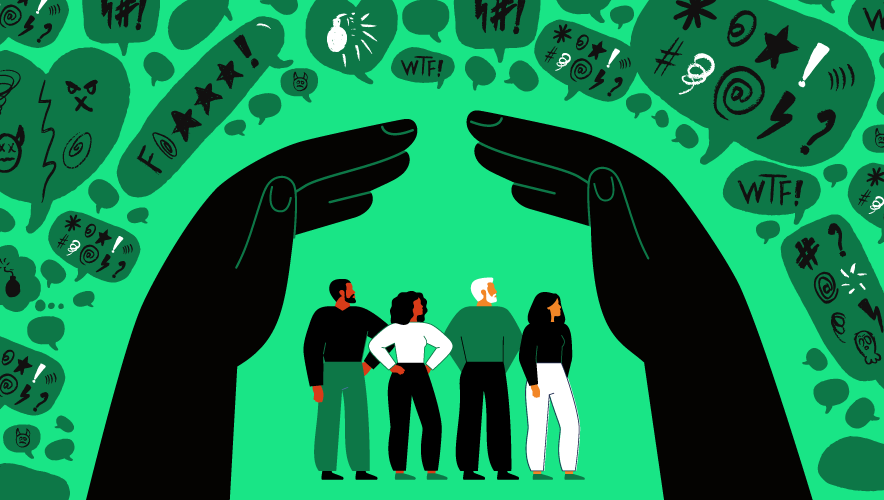
The manosphere: It’s alluring and insidious—and it’s an online money maker. The manosphere is a loose network of accounts, websites, influencers, and groups that promise solutions for the slew of problems facing modern men, such as fitness, dating, work, and a man’s role in society. Its adherents tout it as an antidote to feminism, a call for men to hold onto domination and supremacy over women.
The ideology of male supremacy is directly tied to violence, according to Pasha Dashtgard, director of interventions for American University’s Polarization and Extremism Research and Innovation Lab (PERIL). In fact, “these are sort of embedded aspects of male supremacist ideology that show up and manifest in violent mass shooting behaviors,” Dashtgard says.
The research reflects that observation. According to the Violence Prevention Project, between 1966 and 2021, 98 percent of all U.S. mass shootings were carried out by men. More recent data from the SUNY Rockefeller Institute of Government found that mass shooting events in 2025 did not result in a significant change in the data. While 55 percent of the shooters were white, 94.7 percent of mass shootings were carried out by a single male, 3.7 percent by a single female, 1 percent by a man and woman working together, and 0.6 percent by two or more males. So, in total, 96.3 percent of all U.S. mass shootings involved at least one man.
Misogyny manifests in other harmful ways, as well. Ideas of male supremacy can lead to sexual violence, intimate partner violence, and stalking, according to Amee Wurzburg, deputy director of PERIL’s Gendered Violence Portfolio.
“Misogyny is not new, but we’re seeing it be platformed in a new way. What used to be more niche extremist ideas and spaces on the Internet now suddenly became a lot more mainstream,” Wurzburg says.
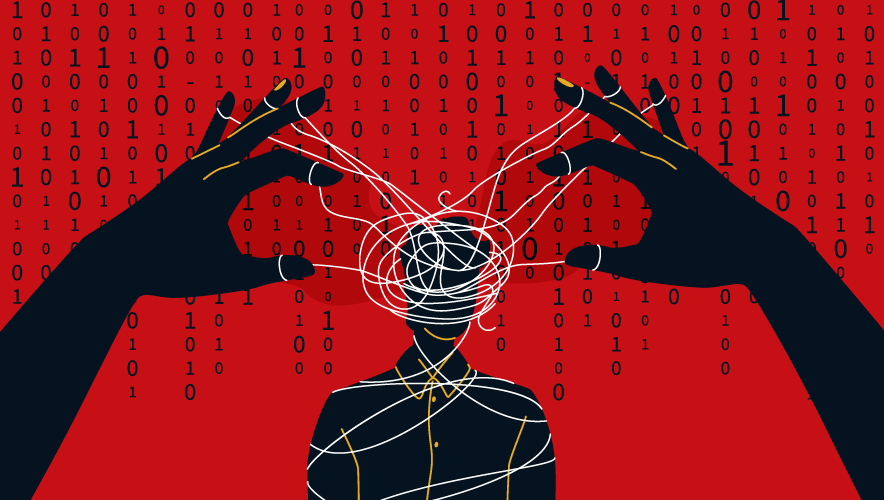
Extremists are taking advantage of this increasingly normalized ideology to recruit new followers. They use grievances tied to misogyny to lure people to their causes, with misogyny acting as an inroad to other forms of hate.
“It becomes very easy—especially due to the role of algorithms—for a young person to click on one thing and then they’re getting a little bit of anti-Semitism, a little bit of Islamophobia, and then all of a sudden it becomes all of these conspiracy myths,” Wurzburg says.
Dashtgard and Wurzburg say that there are a few characteristics that show misogyny has been more normalized in society today. First, the concept presents as a backlash to the rise of gender equality, with the majority group—in this case, straight men—feeling that this equality demands that men cede power to other groups instead of seeing equality as beneficial to all. Second, there’s an expectation that harassment of women and LGBTQI+ individuals is par for the course.
The negative impact of normalizing misogynistic behavior goes beyond harassment of non-male individuals—it also harms straight men. Wurzburg says when society excuses male behavior because men “just can’t help themselves,” it is limiting the capacity and growth potential of the men in question.
Getting a Head Start
Along with studying the root causes of extremism, PERIL also focuses on prevention, including teaching people about emotional regulation and how to spot propaganda designed to manipulate a person’s emotional state.
When it comes to emotional regulation, Dashtgard and Wurzburg say instructors and trusted adults responsible for children need to emphasize humanizing emotions for all genders while teaching that appropriate reactions to feelings such as anger should not be violent. While adolescent girls are more likely to internalize negative emotions and harm themselves, adolescent boys more often externalize their reactions and hurt those around them, according to Wurzburg.
“We need to be teaching young people early that emotions are normal and we’re all going to feel them, and that there are healthy and productive ways to manage them,” she says.
Emotional regulation is a crucial aspect of violence prevention because it can help someone pause before instantly responding to an event with violence, while also buffering against emotional manipulation.
While there are various learning methods for improving emotion regulation abilities, such as social learning with observational or instructed emotion regulation methods, the need for this regulation cannot be understated when it comes to combating misogyny.
Historically “boys are not really taught to process their emotions, they’re not taught to have emotions. They’re taught to suppress their emotions,” Dashtgard says. If a boy or man hasn’t been taught how to handle rejection or shame, his reactions can metastasize into a predilection to violence, he adds.
One of PERIL’s other areas of focus concerns online behavior. The lab’s Developing and Using Critical Comprehension (DUCC) curriculum offers resources and videos to help teachers educate kindergarten through fifth-grade students how to recognize beguiling, manipulative, and harmful online content. While the content was created with children in mind, it applies to all ages aiming to learn more about spotting manipulation online or through technology.
“You don’t convince people to reject propaganda by debunking the facts,” Dashtgard says. “Social psychology tells you that actually what happens if you try and present people with alternative facts is it just pushes people more to their own ideological side.”
It’s important to have the skills to spot emotional manipulation, especially as outrage is presently normalized, encouraged, and even monetized, according to Wurzburg.
“Not just young people—it’s really everyone, we all need those skills, but it’s much easier to develop those skills early,” she says. The earlier training can start, the better. Children, teenagers, and young adults are increasingly online and therefore are more likely to be exposed to harmful messaging.
Trusted networks, including and beyond primary caregivers—such as teachers, coaches, and family friends, have the ability to challenge gender norms that are imposed early on in children’s lives. These gender norms include things such as colors (pink vs. blue), toys (dolls vs. toy trucks), or activities (dance vs. sports) that are associated with specific genders.
“Challenging those kinds of norms early really does start to create a framework for greater equality,” Wurzburg says. “We know that more equitable gender norms actually create a safer and healthier society for all people. Improving gender equality actually improves not just women’s health, but men’s health as well.”
Sara Mosqueda is associate editor for Security Management. Connect with her on LinkedIn or send her an email at [email protected].