American University Improves Its Campus Dining Experience with Modern Access Control
In the heart of Washington, D.C., American University provides undergraduate, graduate, law, and online programs for roughly 13,000 students. An estimated 3,800 students live on campus, using amenities like the campus store, mail services, and dining facilities, which are managed by the school’s business services team.
The school’s Terrace Dining Room is the primary dining site for residential undergraduate students, faculty, and staff, as well as alumni and other visitors. In fact, Michael Scher, assistant vice president of business services, notes that anyone can use the all-you-can-eat dining hall if he or she pays the flat rate at the door. Although the hall seats up to 560 people, gaining entrance had become a problem that Scher and others wanted to resolve.
Cashiers in the dining hall had to switch back and forth between point-of-sale (POS) and meal plan modes to accommodate different customers—students, staff, and the public. The challenge with two separate POS systems for this space is that when switching occurred, it slowed down the process of entering the dining hall, resulting in long entrance lines and congestion for people trying to leave.
Although the facility had undergone minor facelifts in its time, they were limited to installing new flooring, wall treatments, or swapping out outdated equipment. The one thing that had not changed was the hall’s overall footprint.
“The space had been refreshed many times over the past about 40 years, but it hadn’t been really gut renovated, and it needed it,” Scher says.
In 2024, American University began a full renovation of the space. The university closed the hall in April and added a temporary dining site in another part of the building. Renovation crews stripped the interior to its framing, allowing workers to not only redo the electrical and plumbing, but also reconfigure the footprint, including expanding the front entrance and exit.
The increased space sparked conversations around maximizing efficiency and improving customer experience in the cashier line. “We have several hundred diners that eat with us at any given time. Some meal periods there can be 500 or nearly 600 people flowing through, if not more, turning over in an hour,” Scher says.
Instead of bringing on more full-time cashier staff, Scher and others considered technological solutions that could result in savings while improving the efficiency of the space. This meant additions like mobile ordering and pickup lockers as well as a new system for the entrance. The entrance’s new footprint was an opportunity to save on labor while making the guest experience more seamless.
The team wanted to avoid hard metal turnstiles. Instead, they wanted an access control solution that would blend with the overall experience—not an overt security function, according to Scher.
“We wanted to present a sense of sophisticated automation, ease of entry,” he says. The solution also needed to directly interact with the university’s campus card system, merging access control with payment.
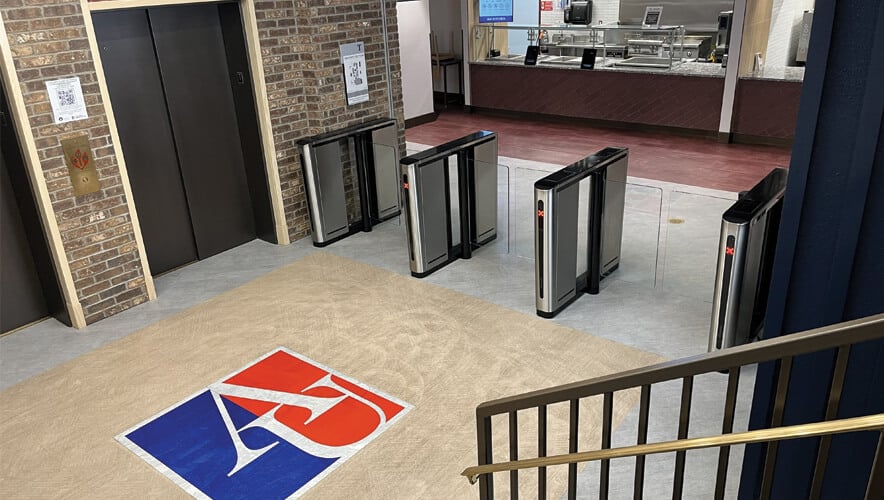
Students were used to modern amenities and the convenience of food delivery apps, like Uber Eats or DoorDash, and decisions makers included these considerations when determining what the new experience should be. “We knew from surveys what people wanted. They wanted more technology, they wanted ease of access,” Scher says. Boon Edam’s Lifeline Speedlane Compact Optical Turnstiles fit the bill.
The turnstiles were installed in July 2024 over the course of a week, keeping the overall project on schedule. Altogether, the school installed two compact turnstiles that operate solely as entrance lanes and another three as exit lanes.
With the new turnstiles, students with a meal plan now just needed to use their university ID—the AU One Card—to enter the dining hall. The turnstiles were integrated with the campus’s meal plan, which the One Cards are linked to. Students with an active meal plan tap their One Cards on the turnstile, which responds by allowing the glass barriers to unlock, so the student can swing through and walk towards his or her next meal.
We knew from surveys what people wanted. They wanted more technology, they wanted ease of access.
In August 2024, the hall had a soft reopening about a week before classes resumed, giving students, faculty, and staff a chance to test drive the turnstiles. Scher and his team also wanted feedback on the new setup, enticing participants with freebies and giveaways in exchange for comments and insight into the new process. The feedback was positive, “so we felt actually really confident that it was going to be a good guest experience for the students,” Scher says.
With the new set up, Scher says that there are no longer lines that snaked throughout the hall and stairwell.
While students swiped their One Card, those relying on cash or credit cards accessed a cashier. The same cashier could also assist with incidents such as a depleted meal plan preventing a student from being able to walk through the turnstile. More often than not, the cashier is someone students, staff, faculty, and alumni know as Ms. Berlin, who has worked in the dining hall for more than 40 years.
“She is an incredibly critical part of the guest experience,” Scher says. While Ms. Berlin is famous for her kind welcomes and friendly demeanor, Scher says that the new turnstiles allow her to freely engage with regulars and visitors, further improving the overall experience by providing guidance about any aspect of the dining experience.
“Before, we didn’t have the time to do that, even though we had two cashiers. It just was too many people coming in on a meal swipe. Now, all that is offloaded and automated,” Scher says. When someone experiences a problem with their card or has a question, the cashier can help. “Now the guest experience is what you want in any venue,” Scher says. “It’s somebody who’s interactive, can troubleshoot, help increase the satisfaction, get follow-up, and solicit feedback.”
That satisfaction is reflected in recent surveys about the dining hall between the start of their recent school years. The department found that overall guest satisfaction had increased by roughly 60 percent since the fall of 2023, according to Scher.
He adds that the turnstiles have improved insights into the kitchen’s operations. The units provide data about patterns in usage, including frequency and timing. This helps kitchen and other dining staff adjust the amount of food to order while decreasing food waste.
There have been minor hiccups, such as when the turnstiles went down in Fall 2025, Scher says. Troubleshooting a solution ended up taking about a day and a half—but the school received support from Boon Edam and their integrators. Ultimately, they determined it was a connection issue between the One Card management software and the turnstile, solved with a reboot.
Despite the issue, the units’ efficiency and insights have piqued interest from others around campus and from other universities. Scher “We’ve got the library, a very common access-controlled location for universities. I could see something like this working well there,” Scher says.
Sara Mosqueda is associate editor for Security Management. Connect with her on LinkedIn or email her at [email protected].