Paradigm Shift: Sol Rashidi on What It Takes to Thrive in Today’s Workplace with AI
In modern life, many of us are subject to digital distractions: emails, texts, Instagram reels, meetings on Teams or Zoom, and other alerts from the apps you just can’t live without. Some of it is work and can contribute to productivity, but does that productivity come at a price?
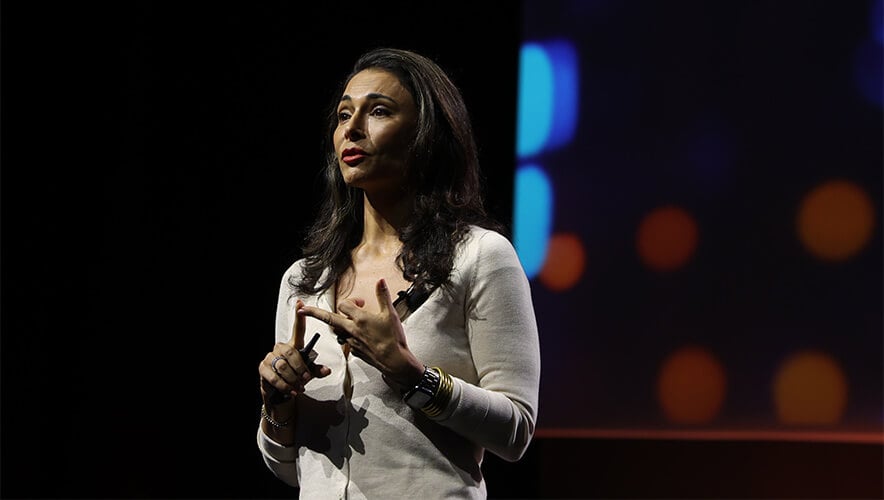
During her keynote speech at GSX 2025 in New Orleans, Louisiana, Sol Rashidi estimated that the amount of information produced in the entire world is growing at a rate faster than ever, doubling every 12 hours. This means that every day there is a constant demand to catch up on the new information.
“From the time you have dinner to the time you wake up for breakfast, the entire World Wide Web has doubled. And then again the next day, and then again the next day. It’s impossible for us to keep up,” Rashidi said. She estimated that we consume an average of 84 gigabytes of data every day, the equivalent of 17 full-length movies. “…We were not meant to consume that much information.”
While we’ve adapted to the information age, it has made most of us codependent on our devices and other technology. It’s influenced how we use artificial intelligence (AI).
When it comes to AI, Rashidi cautioned that the “artificial” in AI is a bit of a misnomer. “The word ‘artificial’ just creates this expectation that it’s kind of like a light switch you get to turn on. ‘Well, throw in a tool and let it fix customer data.’ It doesn’t work like that,” she said.
Instead, depending on how you use an AI tool, Rashidi said to use the acronym to stand for either “automated intelligence,” “augmented intelligence,” or “anticipatory intelligence.” For example, any workflows that are automated fall under automated intelligence while prediction models would be anticipatory intelligence.
From the time you have dinner to the time you wake up for breakfast, the entire World Wide Web has doubled.
But no matter which AI you are using, it still requires a human element for direction and critical thinking. “Even if something does qualify to be solved by artificial intelligence…it still doesn’t mean you should use AI, because of the risk exposure to your data, because your infrastructure and your talent matter,” Rashidi said.
Another aspect of keeping a human hand at the wheel in the security sector requires going beyond data security management. Safeguarding of digital assets will always be crucial and rely on both cybersecurity and physical security, but there’s another element that Rashidi argues is equally crucial for security to involve itself in and guide: workforce preparation.
Workforce preparation is not simply a crash course on how to use Copilot or ChatGPT, along with a generic list of which prompts to use or which to avoid. “It is knowing the fact that we fundamentally underestimate how much goes into our day to day combined with the fact that we are always behind in our to-do list,” Rashidi said. “It’s a mind-shift adjustment.”
Using that awareness, leaders can begin to analyze functions and workflows, determining and reassessing whether these require a human or can somehow benefit from an automated, augmented, or anticipatory tool. This view also gives leaders the opportunity to direct employees in how to become more adept users of AI tools, providing organizational security while maintaining the ability to meet the demands of the modern marketplace.
Determining where to adjust and use these tools or other intelligence as you look to the future is, in Rashidi’s words, “time-consuming, but it’s unavoidable.”
Sol Rashidi, a self-described techno-functional executive, was a GSX 2025 keynote speaker at the Tuesday, 30 September, general session, which was sponsored by Allied Universal. For more about her take on the need for maintaining critical thinking skills (instead of outsourcing them to ChatGPT), as well as the original intentions for AI and what it has become, read “Rashidi on Remembering the Need for Human Critical Thinking in the AI Age.”
Sara Mosqueda is editor-in-chief of the GSX Daily, which is produced by Security Management. If you don’t bump into her at the show, connect with her on LinkedIn or send her an email at [email protected].