Interactive Workshop Focuses on Crime Prevention and CPTED Fundamentals
Security cannot prevent all incidents. But the right security measures with proper maintenance and culture can help discourage unwanted behavior before it turns into harmful activity.
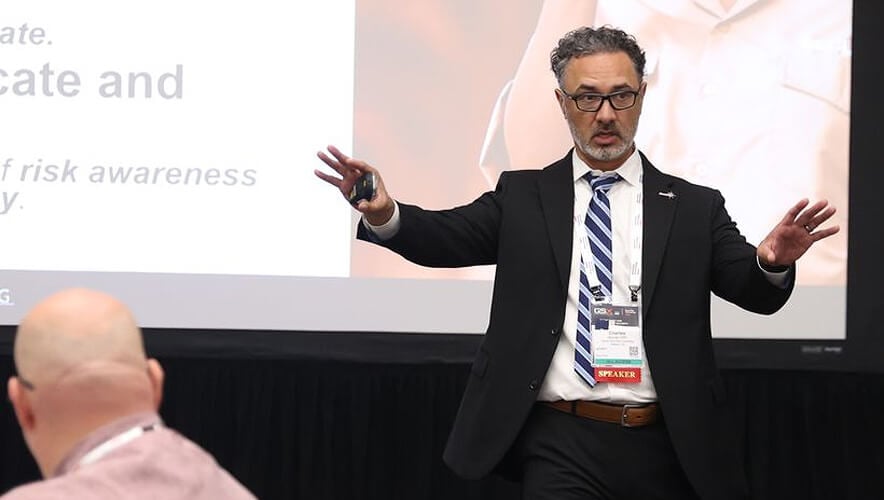
This preventive concept was at the heart of an inaugural “Crime Prevention Workshop” held on 28 September as part of the GSX 2025 pre-conference education offerings. Security veterans Charles Ahmad, CPP, founding partner, Group Nine Risk Consulting; Russell Kolins, CEO/security consultant, Kolins Security Group; and Jeff Putnam, CPP, senior security project leader, Lowers & Associates, led the workshop, which they designed to be interactive and hands-on for attendees to ultimately learn new concepts to take back to their own organizations.
The three panelists designed the eight-hour workshop around a security negligence case involving an apartment complex where a young man was shot and killed in the parking lot.
Attendees were broken up into groups of roughly six people, presented facts about the incident that led to the lawsuit, shown educational materials on risk management and crime prevention from ASIS International, and then tasked with creating their own security plan for the apartment complex.
“You’re going to look at how this could have been prevented and was the crime foreseeable,” Ahmad said to kick-off the interactive eight-hour training.
The Case
It was about 1 a.m. in Florida on 1 June 2017 when a young man drove home from his job at a fast-food restaurant and parked his car outside the apartment building where he lived with his grandmother. A friend of his—planning to sell him a pair of Nike sneakers—met him there.
But while the young man was exiting the vehicle, another car pulled up. A man jumped out of the car with a gun and demanded the young man’s money, watch, and cellphone. He then shot and killed the young man before fleeing—taking the phone and watch with him—according to the young man’s friend, who hid behind a car during the incident.
A police officer patrolling nearby heard the gunshots and drove over to the apartment complex, which had a history of shootings, to respond. The police officer picked up the security officer on duty at the complex and they drove around the perimeter until they discovered the victim’s body. The shooter has not yet been identified or arrested.
Kolins’ firm was later hired as legal representation in a civil lawsuit against the apartment complex—a multi-family section 8 Housing and Urban Development (HUD) facility. One of Kolins’ initial actions was to conduct a risk assessment of the property. He immediately noticed some concerning elements.
The apartment complex had a single point of entry, but both the sliding gate and arm bar to block vehicle traffic did not work—a problem for more than a year before the shooting. The property did have a perimeter fence, which was a combination of cinderblock, brick, chain-link, and wood. However, the fence was only 5 feet high in some locations. The complex also lacked lighting at the entrance to the property, and lighting throughout the property was above the tree canopy—so many areas where people walked or parked their vehicles were not illuminated.
Kolins’s firm also pulled crime data from local police department reports within a 0.75-mile radius of the apartment complex, specifically looking at a two-year period leading up to the shooting. They found that there were more than 211 reports, which included several shootings, robberies, and assaults.
The Workshop
After sharing the above facts, the presenters also shared a blueprint of the apartment complex with the workshop groups and tasked attendees with conducting their own risk assessments.
“The level of risk is going to inform everything we do as security professionals or crime prevention professionals,” Ahmad said.
How can you assess that risk? By using the ASIS International Security Risk Assessment Standard to assess risk and then build out reasonable security measures. The presenters had attendees go through eight steps inspired by the standard:
- Understand the organization. What’s the scope of the assignment? What are we looking to assess? What’s the size of the property and the organization? What do previous risk assessments say? And what is your risk appetite or tolerance?
- Identify assets and their value. What are your tangible and intangible assets? And what is the criticality of those assets?
- Identify threats. What are your intentional or adversarial threats? Your natural threats? And your inadvertent threats?
- Identify vulnerabilities. What are the people, process, and technology that are weaknesses? How observable and exploitable are they?
- Assess risk level. Using a matrix of likelihood and consequence, what is the risk level?
- Treat risks. How will you avoid, transfer, or accept risks?
- Monitor and review. How will you continuously monitor the risk environment and the effectiveness of your controls to treat risks? How often will you update those controls?
- Communicate and consult. How can you foster a culture of risk awareness and transparency?
Class attendees represented a large range of industries, including security practitioners from manufacturing, healthcare, higher education, non-governmental organizations, and government agencies, from Canada, Haiti, and the United States. The diverse group went through the process of rating the risk of shootings and trespassing at the apartment complex, identifying vulnerabilities at the property, and creating presentations about the security measures they would incorporate to address them.
Some of the suggestions aligned with concepts from crime prevention through environmental design (CPTED), which the presenters highlighted in their presentations. These included adding LED lighting at the entrance of the facility, trimming the trees around the complex to allow existing light structures to illuminate pedestrian areas, creating a uniform perimeter fence, and working with residents to improve the security culture of the community.
“Culture is so important,” Ahmad said. “I’ve heard it put that culture eats policy for breakfast. You can have all the policies in the world, but if you don’t have a culture that takes security seriously it doesn’t matter.”
Megan Gates is senior editor at Security Management. Connect with her at [email protected] or on LinkedIn.