Risk Sits Courtside at Basketball Games
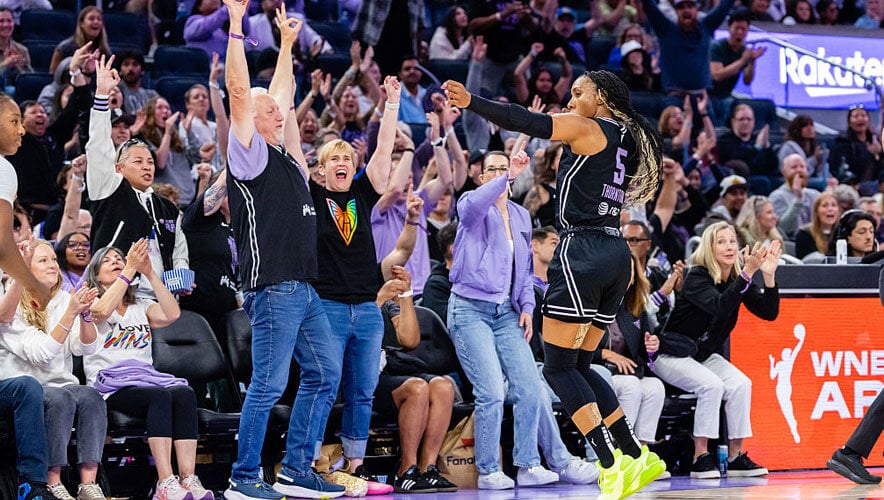
In sports, there’s typically a barrier between the fans in the stands and the action on the field. The one major exception is basketball, where select fans and media have on-court seating.
These prime spots make for a thrilling fan experience—close enough to the action to hear your favorite player talk on the court without any other fans obstructing your view. But it also poses some unique risks.
“As a security person, of course, you kind of hate it,” jokes Larry Thompson, vice president of security for the Orlando Magic.
But there are a few ways to manage that risk. First, tickets for courtside seats are expensive. That high price point can be seen as a deterrent to unruly and unwanted fan behavior because the fans are paying a lot of money to have that courtside experience, Thompson adds.
Second, when courtside fans arrive at their seats, Thompson says that arena security staff will remind the fans of the expectations for their behavior because they are so close to players and team personnel.
“It’s a reminder that you’re not supposed to talk with the players and coaches, you’re to walk this way—or not to walk in front of the bench—and they’re reminded, of course, about not throwing objects,” Thompson says.
Projectiles thrown onto the court had a bit of a moment in 2025. At several WNBA games, fans threw bright green sex toys onto the court as part of a social media campaign by a cryptocurrency company. Some viewed the trend as funny or embarrassing, but it did pose a safety risk for players who could have stepped or tripped on the objects, potentially injuring themselves.
The trend highlights the importance of a layered security approach, since traditional metal detectors would not pick up the objects being tossed onto WNBA courts in 2025. However, security and stadium personnel inside the arena could spot a potential obstruction-tosser before he or she took aim, says Darcy Leutzinger, senior vice president, director of security, United Wholesale Mortgage, who has an extensive background in sports security and executive protection.
Additionally, stadium security and team security personnel can strategically place themselves to observe the crowd in key areas—such as close to team players, key personnel, and officials—so they can intervene quickly to prevent thrown objects or undesirable behavior, Leutzinger says.
Another common mishap can be particularly problematic for players who require traction to achieve their best on the court: spilled drinks.
“You have to be mindful of that and make sure that if that happens, you immediately address it,” Thompson says. “Stop the game and get that cleaned up.” Cue the towel and floor wiping team.
Typically, courtside fans abide by the expected code of conduct. There might be some friendly banter between fans and a player (see mega New York sports fan Spike Lee, for example). But occasionally there is an incident where a courtside fan says something that violates the code of conduct that the league or stadium has in place.
When that happens, Thompson says that game referees—typically three for WNBA and NBA games—have the authority to identify a fan and indicate to arena security that the individual needs to be removed.
“Certainly, if you say something very egregious—a racial slur—that is going to get you tossed,” Thompson says. “If you’re just making aggravating comments and a player is kind of fed up with it, then that is where there will be a conversation [with security] that your behavior is not going to be tolerated. You can’t talk to this person that way. And if it continues to happen, we will remove you from the game.”
During a WNBA Connecticut Sun and Indiana Fever game during the 2025 season, a player alerted an official about offensive fan behavior, and the referee had stadium security remove that individual from the arena.
The power of an official to eject a person from the arena isn’t just limited to fans. Referees can also remove players or team personnel—including coaches—for their behavior. For instance, during the 2025 WNBA post season, officials ejected both Minnesota Lynx Head Coach Cheryl Reeve and Phoenix Mercury Head Coach Nate Tibbetts in separate games for their comments toward officials.
During playoff games, where fan and team emotions can be especially volatile, referees especially need to use their authority to control that behavior and de-escalate situations, Leutzinger adds.
Referees can control this dynamic by issuing technical fouls, as well as talking to coaches and players to calm them down without a security intervention, Leutzinger says. If the situation becomes physical, however, stadium security will step in to separate the groups as quickly as possible, and then a referee is likely to eject a player or coach in response to the activity.
Referees will target “players that seem to be the antagonist—the people that are causing [the altercation]—to get rid of the problem fast,” Leutzinger says. “That should usually bring [the temperature] down.”
De-escalating situations like these is extremely important in basketball because of the proximity between fans and players—what starts on the court can spread to the stands.
One infamous example is from a 2004 Detroit Pistons versus Indiana Pacers matchup, where physical play between players in the last minute of the game led to a fight on the court. As the action seemed to be winding down, though, one of the players—Ron Artest—lay on the scorer’s table next to the court, a fan threw a drink on him, and chaos broke out as Artest went into the stands to go after the fan. Other players joined him, and a brawl ensued. It became known as the Malice at the Palace, with the NBA issuing significant suspensions, including 86 games for Artest, in response.
“It was an incredibly volatile situation, and there were huge fines and penalties and injunctions that occurred because of it,” Leutzinger says. “Nobody has seen anything like it since that Pistons game because the NBA sent a very strong message that that type of behavior will not be tolerated.”
Given their position of power and influence on the game, security of referees is a serious issue. Local law enforcement is responsible for escorting officials on to and off the court during games to ensure their safety. For the NBA, officials are provided with a secure locker room where access is restricted to game officials and an extremely small group of personnel.
“Even team security, we’re not allowed into their locker room except at the beginning of the game when there’s a security meeting that’s usually held in the officials’ locker room,” Thompson says. Access to the referees’ locker room is restricted both for their safety and to protect the integrity of the game—such as preventing the hosting team from influencing officials to throw a game.
In recent years, the NBA has also become concerned about fan comments to players about gambling. Sports betting was legalized in the United States in 2018 and posted a record $13.7 billion in revenue in 2024, according to ESPN.
During the past few seasons, Thompson says the NBA has asked team security to note comments made during games about gambling, in the same way they would track comments made by fans using a racial slur: “In other words, if you heard someone making a comment to a player that ‘you know you’re ruining my parlay’ or ‘don’t make that free throw’ or ‘make that free throw,’ or whatever it might be that had some connection to gambling.”
A parlay in sports betting is a bet that links two or more selections (known as legs) into one ticket. Each leg must win for the bet to be successful. An example from a sports betting website of an NBA Prop Parlay asks for individuals to bet on Sam Merrill scoring more than 11.5 points in a game between the Cavaliers and Pacers, De’Aaron Fox scoring more than 22.5 points in a game between the Spurs and Grizzlies, and Dennis Schroder collecting more than 2.5 rebounds in the game between the Mavericks and the Kings. For the bettor to win, all three legs—Merril’s and Fox’s scores, plus Schroder’s rebounds—must be correct when game play ends.
In December 2025, NBA Commissioner Adam Silver said in an interview on The Pat McAfee Show that more regulation is needed—both to reduce opportunities for game manipulation related to gambling and to address bad fan behavior in arenas, including abuse of players from fans who lose bets.
“It’s often the case that your team wins and a player scores 25 points, but the fan, the bettor, had bet that the player was going to score 28 points or 30 points,” Silver said. “We have to protect the competitors. We want to protect the environment in the arena of people getting out of hand.”
Megan Gates is senior editor of Security Management. Connect with her at [email protected] or on LinkedIn.