4 Ways to Protect Clients from Bad Fan Behavior
U.S. Open champion Emma Raducanu is a tennis phenomenon, achieving a top 10 rank in the sport before turning 23.
But with that fame and profile on the court has come toxic fan behavior, which the world was made aware of in February 2025 when Raducanu broke down in tears at the Dubai Tennis Championships. She’d spotted a man in the crowd who’d followed her the previous day, badgering her for a photo and giving her a letter. He’d attended several of her prior events and appeared to exhibit fixated behavior toward her.
The man was removed from the stadium, given a restraining order by Dubai police, and banned from Women’s Tennis Association (WTA) events. When he attempted to buy tickets to Wimbledon in June 2025 to see Raducanu play, organizers blocked him from finalizing the purchase, ESPN reported.
“Wimbledon and everyone did an amazing job,” Raducanu said about the incident. “I got a notification, the police contacted me and told me everything was okay. I know that I’m not the first athlete to go through this, and I probably won’t be the last—not just as an athlete, but [for] females in general.”
This type of toxic fan behavior has existed for a long time, but the ability to track targets via social media and harass targets digitally has been growing during the past several years—especially toward female tennis and basketball players, says Harry Arruda, CEO of risk mitigation and security solutions provider Cooke & Associates.
In 2024 alone, women tennis players received digital abuse that was so threatening that 15 cases were referred to law enforcement agencies, according to a joint report from the WTA and International Tennis Federation (ITF).
While Raducanu’s case was an extreme example of this undesirable behavior, there are steps executive protection practitioners can take to prevent it from escalating around their principal.
Understand the Social Dynamic
Nowadays, athletes, actors, musicians, and influencers have robust social media accounts where they share content about their lives and their sponsorship deals. While they sometimes run these accounts themselves, often they use a social media manager to bolster their online presence.
Fans will connect with these celebrities through their online persona, liking posts, writing comments, and maybe even sending the occasional direct message. That engagement creates a feeling of connection—say, with that athlete’s journey from college basketball star to professional league All Star player—between fans and celebrities.
It can also lead to the mindset for some fans that they know the celebrity in a personal capacity because they have seen photos of their home, their significant other, and maybe their children, Arruda explains. Some fans might then start to engage in a more ingratiating manner, including by sending unwanted or even threatening messages.
For executive protection practitioners, Arruda says it’s important when working with a client to know the social media manager and to have a conversation with that person about best practices for posting content while maintaining personal safety. Common recommendations include avoiding posting photos about travel locations until after the trip is over and being aware of what is in the background of photos to avoid revealing the location. For athletes and musicians, the times and locations of matches and concerts are public. But where they’re staying and how they’re getting to and from the performance venue should not be made public until after the event.
“I think good principals will listen to you and understand the why behind it, and not just think that you’re trying to kill the connection,” Arruda says.
With that education, the social media manager and principal often understand the concept of when and how to post. Arruda advises discussing with the social media manager the types of observed social media behavior that should be passed on to the executive protection team, such as the account names and information of fans who send increasingly aggressive direct messages or say they plan to be at an upcoming appearance. That list of accounts can then be cross-referenced with those that the executive protection team has on its person of interest list.
If a subsequent incident happens relating to that communication, Arruda says to inform the account manager and thank him or her for sharing the information. For example, alerting the manager that a person who sent a weird direct message was spotted at the principal’s practice facility, the information was shared with security staff, which then used it to take proactive measures. This action creates a positive feedback loop, helping to ensure open communication and collaboration between social media representatives and security personnel.
Use Communication and Rapport
During his career, Arruda has worked executive protection for a variety of prominent individuals including Michael and Janet Jackson, Nicole Richie, and Paris Hilton. When a fan started regularly turning up at one of those celebrities’ appearances, Arruda says he would try to talk to that person. He’d drop his tie and jacket, to walk up to the individual and strike up a conversation with them as informally as possible to find out what they have going on in their life.
“Try to relate to them and you’ll get a bunch of information, and then once you get that information you need to determine what their [mental] state is,” Arruda says, such as whether the individual has plans for the long-term future and the means to carry out those plans. “Do they have the means to keep traveling around and following the person? Do they have prior convictions for anything? Do they have prior restraining orders? Things like that,” Arruda adds.
That information can then be added to a person of interest database and shared with fellow executive protection agents and managers. For instance, an executive protection agent for a tennis player might ask agents for other athletes at the tournament if they have seen or interacted with a suspicious individual.
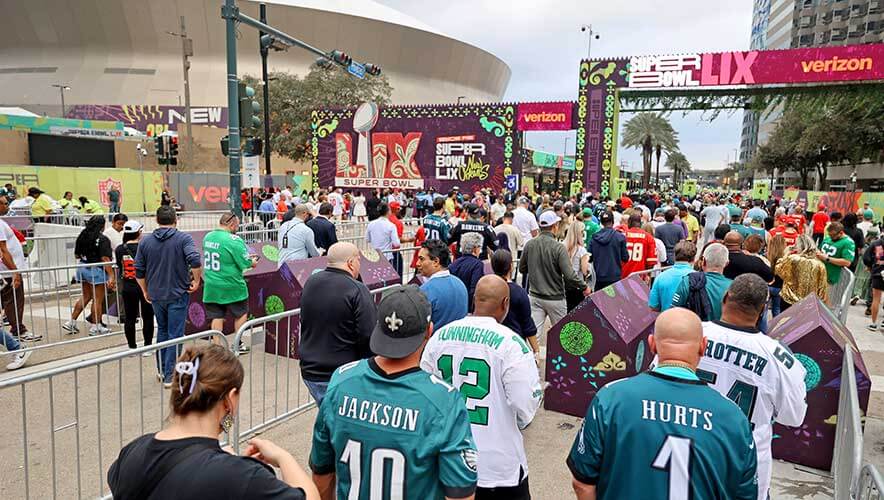
Executive protection should share the names of persons of interest with venue management, especially for musicians or entertainers on a tour. Joseph Frank, assistant chief of public safety stadium operations for Caesars Superdome and Smoothie King Arena in New Orleans, Louisiana, says that tour security for musicians will often provide the venue with a be-on-the-lookout (BOLO) list with photos of individuals and background information about why they are on the list—such as for a current restraining order. Frank’s team will then disseminate the BOLO list to uniformed security officers, public safety personnel, and law enforcement who will be at the venue during the concert.
“Getting those venues to pass those BOLO notices around while being clear that this is just a person of interest—it shows that we’re monitoring this person and it’s to be communicated to me if they show up,” says Arruda. Venue personnel should be advised not to make contact with such a person but rather to alert security or law enforcement personnel that the individual has been spotted.
Security teams should capitalize on their rapport with law enforcement, particularly probation and parole officers. If someone is arrested and convicted of stalking a client, for example, these officers can keep executive protection practitioners informed about that person’s location—as well as whether he or she continues to mention the client or shares plans about upcoming travel that align with the athlete or performer’s schedule.
“There is a professional relationship you should have that will be beneficial to keeping tabs on that person,” Arruda says.
Provide Guidance for Personal Safety
It’s not uncommon for celebrities and other prominent individuals to have executive protection personnel with them on the ground only when they’re working. After the sports season ends or the movie premiere wraps, many clients resume living as normally as possible—with routines like going to the coffee shop or grocery shopping.
Arruda recommends educating clients about the need to be aware of their surroundings and specific actions to take to maintain their personal safety. When getting out of a car, for instance, clients should check the mirrors, avoid sitting in the vehicle while looking at their phone, and check that they have their keys to the vehicle before exiting.
“Pay attention because people will come up behind you with cameras, and there is the potential for stalkers because you’re in a public place,” Arruda says. “It’s wide open when you leave the house, so pay attention to what you’re doing.”
He also suggests educating clients about what to do if they notice something odd when they are out. Executive protection leads should provide contact information for whom clients should call or a location to drive to if they notice they are being followed. Arruda further recommends that clients use a fake name or someone else’s name on deliveries made to their home.
Separately, Arruda encourages creating a protective intelligence practice that includes social media monitoring to better understand the risk landscape and when a client might need more support.
“Setting up a program that can be done 24/7, whether you’re with them or not, is going to be key,” Arruda adds.
Regarding persons of interest, Arruda recommends identifying a solution involving a database, Dark Web monitoring capabilities and image assessment—one that uses keywords with some level of vetting and validation.
The WTA and ITF, for instance, use Signify Group’s Threat Matrix service to protect players and tennis family members from not only online hate but also threatening and violent communication. It provides risk and fixated threat assessment experts for all major social media platforms in more than 40 languages and covers all players competing in WTA Tour and ITF World Tennis Tour events—approximately 8,300 players.
“The Threat Matrix service also includes support for players who receive direct abuse, threat and inappropriate communication via DMs, email, and letter,” according to a WTA press release. “Players use a designated email address to share relevant content, enabling Threat Matrix to conduct threat assessment, provide direct player advice, and liaise with security bodies to manage risk.”
Have the Right Agent
Working with celebrity clients can be exciting and difficult. Executive protection agents who are attentive and do not get starstruck are the most effective for these types of clients.
“A lot of new agents come in and work celebrities, and you will see that oftentimes they’re watching the celebrity instead of the crowd, or you’ll see them engaging with people in line a little too much,” Arruda says. “You really have to be the silent professional, and you have to be able to look more than you talk.”
Based on his experience, he advises always watching the crowd and watching people’s eyes and emotional changes when working with a celebrity client. This awareness allows you to assess people quickly to determine whether they are a person of interest to be kept on your radar or simply a typical fan.
One example he gives is of Craig Castaldo, called Radio Man and known for his hundreds of cameo appearances in movies and TV shows. Radio Man always appears in New York City, and Arruda says that the man tracks when filming is happening to show up at the location. His surprise presence is usually appreciated by actors and actresses, who often will pose with him for photos and say hello.
“He knows the call times, he knows the shoot list, he knows it all,” Arruda says. “Good agents will be able to develop a relationship with that person, even with some paparazzi, so that it’s a benefit to both of them.”
Megan Gates is senior editor at Security Management. Connect with her at [email protected] or on LinkedIn.