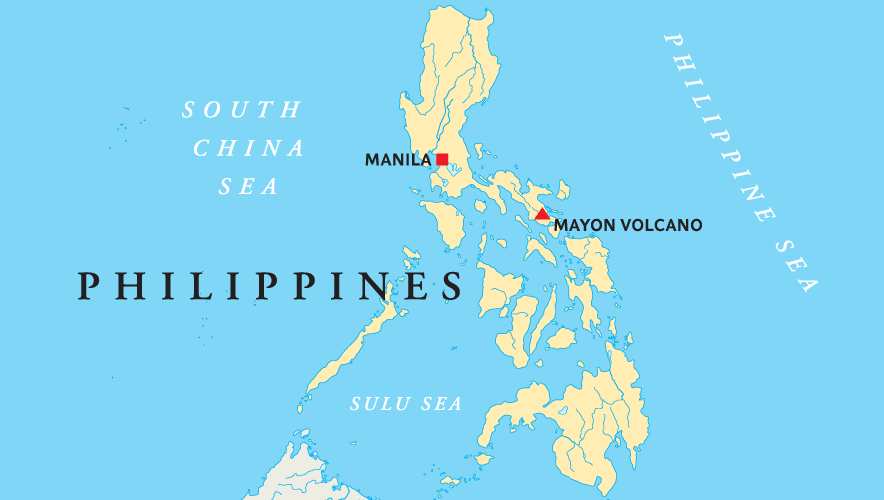
Restless Mayon Volcano Disrupts Philippines with Massive Ashfall
In the Philippines, Mayon volcano recently spewed out huge deposits of lava, hot rocks, ash, and gas, triggering an evacuation that had more than 5,400 people fleeing the impacted areas.
Authorities have not reported any deaths or injuries related to the 2 May eruption, which was not considered explosive, according to the Associated Press (AP).
However, the volcano produced massive ash clouds that spread over more than 100 villages, largely in the Albay province in the eastern region of the nation.
“The ashfall was just so thick, and there was zero visibility even in our national road,” Camalig town’s mayor, Caloy Baldo, told the AP. Video footage shared with Accuweather showed motorists fleeing from an oncoming wall of ash.
Because of the resulting ashfall—and how volcanic ash and airborne particulates can damage airplane engines and disrupt navigation systems—the Civil Aviation Authority of the Philippines banned aircraft from flying within a 6-kilometer (3.7-mile) radius of the volcano’s summit, according to Filippino news outlet BusinessMirror.
Since January 2026, Mayon, the nation’s most active volcano, has erupted mildly and sporadically, causing authorities to raise the alert around the volcano to a level 3. A level 3 alert indicates an increased tendency of a hazardous eruption, characterized by slow lava, rockfalls, pyroclastic flows, and increased volcanic gas emissions, according to the Philippine Institute of Volcanology and Seismology. A level 5 alert is the most extreme, indicating that an explosive and life-threatening eruption has happened or is about to occur.
The ashfall also damaged vegetable farms and killed some cattle. Some agricultural loss has been reported, due to rice fields in the area being buried under ash.
As of 5 May, nearly 5,000 people were taking temporary shelter in 12 evacuation centers in the Bicol region, according to the country’s Department of Social Welfare and Development. The department reported that as of 4 May it has distributed more than 266,000 family food packs to people in the Bicol region as part of its disaster relief efforts for people impacted by Mayon.
NASA satellites have also monitored Mayon’s emissions of sulfur dioxide since January. These emissions have averaged 2,466 tons per day, with the largest amount (7,633 metric tons) released on 6 March 2026. Sulfur dioxide is one of dangerous gasses that volcanoes can emit, toxic to both humans and the environment. Sulfur dioxide irritates the eyes, nose, and lungs, and in high concentrations it can impair breathing. It can also lead to acid rain, which damages foliage and crops and impacts future growth.
The Philippines, which lies on the Ring of Fire, is home to more than 20 volcanoes. Nearly symmetrical and rising more than 8,000 feet above sea level, Mayon is one of the nation’s top tourist attractions. The volcano’s most destructive eruption was on 1 February 1814, which resulted in the deaths of roughly 1,200 people.