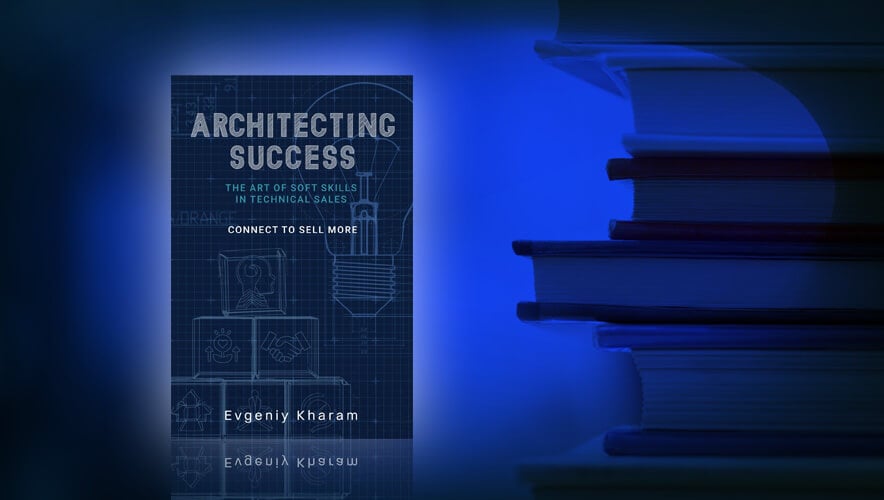
Book Review: Architecting Success—The Art of Soft Skills in Technical Sales
Architecting Success – The Art of Soft Skills in Technical Sales: Connect to Sell More. By Evgeniy Kharam. Publisher: Smiling Eyes Publishing; 134 pages; $17.92 (paperback)
A common mistake technologists make when speaking to the board is using technologist-speak when the board wants to hear business language.
For security and risk professionals who want a resource to help them understand, measure, and analyze information risk of any size or complexity, the Factor Analysis of Information Risk (FAIR) methodology is invaluable.
But when it comes to sales, executives often are surprisingly clueless about how to sell to their customers. In Architecting Success—The Art of Soft Skills in Technical Sales: Connect to Sell More, author Evgeniy Kharam has written a short but highly practical guide to assist salespeople and pretty much everyone else with how to use their soft skills to complete the sale.
Soft skills can be defined as a set of psychosocial skills generally applicable to all professions. These include critical thinking, problem solving, public speaking, professional writing, teamwork, digital literacy, leadership, professional attitude, work ethic, career management, and intercultural fluency.
The term soft skills was created by the U.S. Army in the late 1960s. It refers to any skill that does not employ the use of machinery. The military realized that many important activities were included within this category. In fact, the social skills necessary to lead groups, motivate soldiers, and win wars were encompassed by skills the military had not yet catalogued or fully studied.
While Architecting Success is primarily geared toward sales professionals, it is invaluable for anyone who must interact with others in a professional setting. Far too many salespeople enter a meeting or presentation without the skills needed to close the sale. Kharam has written a guide to close that gap.
A lot of what he writes is common business sense. But as it has long been observed, common sense is not common. An interesting and often overlooked aspect of the book addresses is the human side of sales. Most salespeople focus solely on the software, hardware, or product they are selling, often oblivious to the human element. Soft skills can help bridge that gap and ultimately close the sale.
A key area the book discusses is the fundamental concepts of addressing customer needs. Far too many salespeople focus on the product rather than the value it has for the customer. The book also stresses the importance of listening. Once again, too many salespeople speak too much and listen too little. By listening to the customer, they can better understand what the customer needs and use that insight to close the sale.
At 130 pages, Architecting Success is a book that can be read in a single sitting, but whose value can be immeasurable. The need to architect success is not limited to just those in sales, which makes this such a valuable read.
Reviewer: Ben Rothke, CISSP, CISM, CISA, is a New York City-based senior information security manager with Tapad who has more than 20 years of industry experience in information systems security and privacy. His areas of expertise are risk management and mitigation, security and privacy regulatory issues, design and implementation of systems security, encryption, cryptography, and security policy development. Rothke wrote Computer Security—20 Things Every Employee Should Know.