Lessons Learned from Minnesota on Safeguarding News Crews and Executives in Dynamic Environments
U.S. Department of Homeland Security (DHS) operations have spurred significant unrest in Minneapolis, Minnesota, during the past month.
DHS deployments of Immigration and Customs Enforcement (ICE) and Customs and Border Patrol (CBP) in the city have led to tense confrontations with protestors—including federal agents fatally shooting two people.
DHS officials initially said the agents responsible for the killings felt threatened and that their actions were justified. The response sparked public debate, calls for independent investigations, and reform.
Thousands of demonstrators gathered in sub-zero temperatures to protest the operations. The demonstrations were mostly peaceful, but law enforcement did arrest some individuals and used less-lethal measures to disperse protestors. Minnesotans then held a general strike while many local businesses closed. Federal agents continued their operations in the state, but they cited increased risks to agents from protestors.
These developments highlight the challenges of working amid rapidly evolving, high-tension situations where law enforcement activities intersect with public demonstrations. For news organizations, the priority remains protecting crews—including field reporters, news anchors (treated as high-value principals), and support staff—while enabling accurate, on-the-ground reporting.
The Risks in Covering High-Tension Enforcement and Protest Scenes
Covering protests—especially in winter—involves multiple hazards for media personnel:
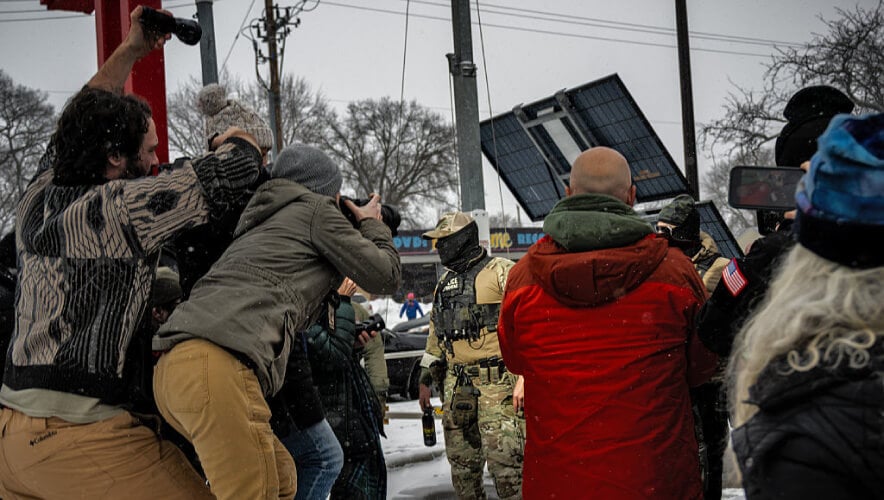
Physical threats. These threats include crowd dynamics, projectiles, close-quarters confrontations, or use of crowd-control measures (e.g., tear gas, less-lethal munitions) by law enforcement. In Minneapolis, federal agents have aggressively interacted with civilians and protestors, some of whom have attempted to then block, approach, or fight back. In other instances, protesters and residents have been the aggressors, approaching federal agents and deterring their progress. The interactions have led to physical encounters and arrests, which could affect media personnel.
Environmental factors. In the winter, Minneapolis regularly experiences extreme cold (below-zero wind chills), increasing risks of hypothermia or impaired mobility during extended outside news coverage.
Legal and operational exposure. Journalists could face temporary detentions, equipment restrictions, or scrutiny if crews are perceived as interfering in the federal agents’ work. High-profile anchors face added personal risks such as targeted harassment or doxxing while working in polarized settings.
Liability concerns. Organizations could face claims related to crew injuries, negligence in deployment, or secondary effects from proximity to incidents.
The value of close news coverage lies in delivering real-time, verifiable accounts that inform the public about unfolding events and public reactions. Distant reporting may miss critical context, while excessive caution can limit comprehensive coverage.
Best Practices for News Crew Protection
Protection teams should implement layered security measures drawn from established journalism safety protocols. These focus on preparation, equipment, legal awareness, and tactical decisions to enable safe proximity without unnecessary exposure.
|
Category |
Best Practices |
Application to Environments Like Minneapolis ICE Operations |
|
Preparation |
Conduct pre-event risk assessments; scout locations for access/exit routes, safe zones, and weather contingencies; establish liaison with local and federal authorities where feasible. |
Identifies hazards like crowd bottlenecks or cold-weather risks; coordinates with officials to understand operational perimeters. |
|
Gear and equipment |
Use cold-weather layering, closed-toe boots, protective eyewear/respirators for potential irritants, first-aid kits, high-visibility press credentials, and encrypted communication tools (e.g., Signal). |
Mitigates hypothermia and exposure to crowd-control agents; ensures clear identification as media to reduce misidentification risks. |
|
Legal rights and support |
Understand First Amendment protections for newsgathering; carry legal hotline contacts and documentation protocols; record interactions professionally. |
Helps navigate potential arrests or restrictions; provides rapid support in dynamic situations involving federal personnel. |
|
On-site strategies |
Employ the buddy system; maintain constant situational awareness with check-ins and pre-set rally points; avoid fixation on single angles by rotating positions and monitoring surroundings. |
Allows teams to approach active scenes for footage while enabling quick withdrawal during escalations or officer movements. |
These practices help crews operate closer to events—capturing visuals of violence, arrests, demonstrations, or agent activities—while prioritizing de-escalation and exit options. Journalists often equip themselves with helmets, high-visibility vests, and cold-weather gear to balance protection and mobility in such conditions.
Executive Protection Considerations for Anchors and Principals
High-profile anchors require additional safeguards akin to executive protection in hostile environments.
Threat intelligence. Monitor real-time developments including official statements, crowd movements, and social media for indicators of potential targeting.
Dedicated support. Use trained teams for close protection, medical response, and secure transport. Conduct scenario-based drills for extraction or medical emergencies.
Contingency planning. Establish multiple evacuation routes, secure staging areas, and post-event debriefs. Integrate digital monitoring for emerging threats.
Adaptive measures. Combine traditional tactics with modern tools like geospatial tracking for dynamic positioning.
These steps reduce exposure to visible figures while allowing them to report from or near active areas, maintaining editorial presence without undue personal risk.
Weighing the Risks: A Balanced Approach
Deploying protection teams near enforcement operations and protests requires careful calculation. Proximity enables immersive, fact-based reporting that documents events as they unfold. However, the potential for injury, legal complications, or escalation demands rigorous safeguards.
Media leaders should view protection as an essential investment, tailoring plans to the specific context, such as the level of violence and tension, crowd size, federal involvement, and weather extremes. By prioritizing preparation, gear, coordination, and adaptive tactics, news organizations can fulfill their public-service role while minimizing harm to personnel and limiting institutional liability. As similar high-tension scenarios continue, ongoing refinement of these protocols will remain critical for safe, effective protection of journalist principals.
Richard Rempo is a seasoned homeland security and counterterrorism expert with 25 years of distinguished service in federal and state law enforcement, complemented by extensive private-sector leadership. He currently serves as chief operating officer at Trend Security Services, where he directs comprehensive security planning and operations and coordinates executive protection details and investigations.