From Midnight Shift to CEO: Leadership and Transformation Lessons from 2026 ASIS President Eddie Sorrells, CPP, PCI, PSP
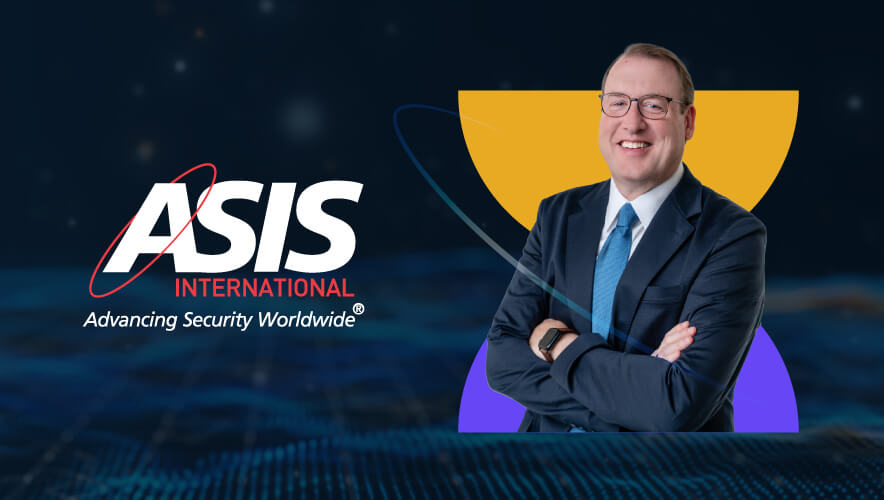
New ASIS International President Eddie Sorrells, CPP, PCI, PSP, learned some of his most valuable lessons about leadership and security after midnight.
His very first security post was as an unarmed security officer working the midnight shift while he went to college. Sorrells didn’t anticipate that the job would reveal his professional purpose.
“In those midnight hours and early in the morning, I learned the fundamentals of what security is, and that’s responsibility, being vigilant, providing quality service, and being present—actually being where you can be seen, being a visible deterrent,” he says.
The shift also taught him valuable leadership qualities, including humility, resilience, self-direction, and empathy.
“I think that my career trajectory was really informed by some of those moments,” he adds.
Although the late shift wasn’t especially glamorous, it shaped the way Sorrells approached his career for the following three decades as he moved up the ranks at DSI Security Services. Now he serves as the company’s CEO. Young professionals frequently ask Sorrells how he got from frontline officer to CEO, but he says he did not have some grand plan or career progression diagram.
“My simple answer is I tried to do the best job with what I was entrusted to do. When I did that, other people recognized, and they invested in me and gave me future opportunities that led to where I’m sitting now,” he says.
That included professional development and mentorship from ASIS International. From the time Sorrells first got involved in ASIS in the 1990s, the association opened doors for him around professional development, certification, global perspectives, and connections with leaders who shaped his understanding of the industry, moving from a narrow view of just contract security to a world of knowledge about risk management.
When asked what the value of ASIS membership is, Sorrells quips, “It’s to know people and to know stuff.” Even after decades of security experience, the field keeps changing, so Sorrells uses his membership to connect with other professionals, explore new developments, and keep up with the pace of business.
“Right now, with our industry, if you’re not investing in your knowledge and enhancing that professional development—and also investing in networking—you’re going to fall behind,” he says.
Sorrells also emphasizes the value of cross-cultural networking. His work with ASIS has enabled him to visit chapters and regional events around the globe, which provided different viewpoints about approaches to regulations, training, leadership, and technology.
Security is undergoing a transformation, and professionals worldwide will need to support each other through it, Sorrells says.
“We have to acknowledge that, with the evolving threats and what is changing, the positive is that security is no longer just the invisible force behind the scenes that, if they’re not heard from or seen, that means things are okay. ...Traditional security doesn’t operate under that philosophy anymore,” he says. “It’s defined now by how we’re relied on—not just for protection but for business continuity, risk strategy, and cultural stability. Security has to become even more visible, and we’re going to accomplish that by being more strategic.
“One of the things that really encourages me, just in the past five years, is security leaders routinely sit at that executive table now,” Sorrells continues. “They’re not just an afterthought if something goes wrong. They participate in organizational planning, and they’re really contributors for enterprise-wide decision making. It’s gone from not just being reactive, and in some cases proactive, but being a solid partner at the table. How do we keep up and transform what’s happening and what is going to happen? Security has to be a catalyst for positive change.”
ASIS International is uniquely positioned to help security professionals through this transformative time, whether through certification, educational resources, benchmarking, or networking, Sorrells says.
“When you talk about transformation, I will tell anyone: Regardless of your geographic location, your experience, your background, ASIS really is going to help professionals build that expertise, that confidence, that influence, but also transform the industry,” he adds. “That’s one of the great things about this industry and this profession: It’s not going to stay stagnant. I tell professionals all the time, ‘If you’re staying stagnant, the industry’s already left you behind.’ You always need to be learning, and ASIS is integral to individuals and organizations transforming the security industry, not just in this year, but in years to come.”
Sorrells notes some ASIS resources in particular.
Certification pathways. “The real heart of [certification] is to learn and go on that lifelong journey of learning… That certification pathway at ASIS is going to continue to lead the way to help security professionals transform their careers, but also transform the way they look at things.”
Education and standards. Security professionals worldwide are facing risks today that they didn’t face 10 years ago, Sorrells says. People are looking for help and best practices on how to mitigate those emerging threats. “Education and standards are going to help set the global benchmark for professionals and organizations. These are tools for individual and organizational understanding, and understanding leads to better decision-making,” he adds.
Networking and mentorship. “When I started in this industry, security professionals didn’t really talk to each other,” he reminisces. “We were very siloed… Now, we’re building a global community. ASIS is leading the way in creating networking and mentorship opportunities that matter to our members.”
Volunteer pathways. “The leader that I am today, in large part, is because of some of the volunteer opportunities I’ve had over the years with ASIS and other organizations that helped me develop my skills as a leader,” Sorrells says. He learned how to look at diverse opinions and navigate strong personalities to make inclusive and long-lasting decisions—a skill that has served him well in professional roles and other volunteer opportunities.
He plans on bringing those volunteer leadership skills to the fore this year while he serves as ASIS president, modeling an industrywide culture of curiosity.
“What I hope to gain is a deeper understanding of the diverse challenges that our members and practitioners are facing across the globe,” he says. That includes issues that ASIS should work to address, innovations emerging from different regions, and how security as a concept is evolving.
“My hope is that I can learn more from our members, that they will really educate me on what the association needs to do moving forward. As I go around the globe, I’m going to encourage our members to start openly sharing those perspectives, challenges, and successes. We need to hear about those things. The more I can learn from our members, the better I can serve our members.”
Sorrells has several key priorities for his tenure as president.
Global engagement. ASIS is standing up a new Sub-Saharan Africa Regional Board this year, in addition to the multiple regional boards already in place. This helps to ensure that “every region has a strong voice” within ASIS and the security industry and that the association reflects its full membership, Sorrells says.
Professional development. Sorrells is especially passionate about elevating professional development for early-career professionals so they see clear pathways forward in the industry. Those paths will look radically different to the one that Sorrells took 35 years ago because the industry and opportunities have evolved. He wants to ensure that future ASIS presidents and board members have opportunities to learn, engage, and grow.
Advancing technology fluency. “We see artificial intelligence (AI) and digital transformation all around us,” Sorrells says. “I hope to continue to push that as the president to really be more fluent in all areas of technology when it comes to the security industry. AI is going to be a huge part of that equation and the digital transformation that our association, but also our industry, is still going through.”
Promoting inclusion. This includes all parts of inclusion, including diversity of thought, experience levels, geographic perspectives, and more. ASIS will continually assess what it can do better around standards, webinars, and events to address different groups’ needs and make sure that every voice is heard, Sorrells says.
Highlighting security’s strategic value to business and society. “I’ve been fortunate to have a front-row seat for the last three decades to see what the men and women of security do, day in and day out. The average member of the public doesn’t get to see that. Sometimes people even in organizations don’t get to see that. I’m going to do all that I can to highlight the strategic value that private security brings to the table—again, not just for business, but what it does for society as a whole.
“Those are often untold stories. Those are often things that don’t make the headlines. You’re not going to see it on the nightly news,” he continues. “Day in and day out, security professionals are protecting our infrastructure, our IT systems, our high-profile officials. Private security plays an enormous role in that. I hope to bring more attention and visibility to the strategic value that private security brings.
“Really, my goal sitting here a year from now is to hopefully be able to say that I’m leaving ASIS stronger, more unified, and more ready for the future.”
Claire Meyer is editor-in-chief of Security Management. Connect with her on LinkedIn or via email at [email protected].