How to Use AI Simulations for Cybersecurity Training
Generative AI has made remarkable strides in recent years, revolutionizing industries from healthcare to entertainment. But can it also play a role in cybersecurity training? The answer is a cautious yes—with human oversight. Simulations in the form of artificial intelligence (AI) generated video and image content can provide immersive training experiences, though they require careful vetting to ensure accuracy and relevance.
The Expanding World of Business Simulations
Many business schools and professional training programs rely on simulations to enhance learning outcomes. As part of my Master of Business Administration program at Western Governor’s University, our capstone project required us to engage with a business simulation platform. Simulations create immersion and have a high recall value, and they enable students to experience different real-world scenarios in a low-risk environment.
Some of the most widely used simulation platforms include:
- Capsim: Provides business simulation software that allows students to run their own virtual companies
- Marketplace Live: Offers business simulations focusing on marketing and strategic management
- Forio Simulations: Provides customizable simulations for various business scenarios, including finance, marketing, and operations
- GLO-BUS: Functions as a global business simulation where students run their own camera company
- Simbound: Specializes in digital marketing simulations for practicing online marketing strategies
- Smartsims: Offers business simulation games for marketing, management, and strategy
Despite their effectiveness, these simulations come with a cost barrier that prevents many students and institutions from accessing them. But AI tools, chatbots, and simulators can prove extremely useful for security training and testing, especially when used in narrow contexts.
Cybersecurity Training Through Simulation
Cybersecurity training programs significantly enhance professional preparedness for real-world threats through the use of realistic scenarios. However, direct exposure to live cyberattacks is impractical and potentially harmful. Therefore, simulations offer a safe and effective alternative for developing critical incident response skills.
Simulations allow trainees to experience the complexities of cybersecurity incidents within a controlled environment, fostering practical learning without risking actual systems. By replicating real-world attack vectors and response procedures, simulations provide invaluable hands-on experience.
Framing a Cybersecurity Simulation that Actually Works
Before running a cybersecurity simulation, it is essential to ask what kind of threat you are preparing for and why it matters to your organization. A simulation should not be a box-checking exercise. It should create a controlled environment that tests how your people, processes, and technologies respond under pressure.
Begin by clearly defining the scope. Focus on a realistic and relevant scenario such as a ransomware outbreak, a phishing campaign, or a data leak involving third-party vendors. Use the National Institute of Standards and Technology (NIST) Cybersecurity Framework to determine which core functions need attention, whether in the form of identification, protection, detection, response, or recovery. Anchoring the exercise in a known framework provides structure and clarity.
Make the simulation specific to your organization. Use your actual systems, communication channels, team roles, and escalation paths. A generic simulation may provide surface-level insight, but one grounded in your own environment will uncover operational blind spots and foster true preparedness.
Build in elements of surprise. Unexpected variables such as a communication breakdown, delayed detection, or a missing stakeholder can elevate the realism of the scenario. These surprises should mirror the ambiguity and uncertainty of real-world incidents. The U.S. Cybersecurity and Infrastructure Security Agency (CISA) offers Cybersecurity Tabletop Exercise Packages (CTEPs), which are free resources that provide prebuilt scenarios, discussion questions, and injects (context or changes to the scenario to help expand the exercise’s realism) to help organizations design realistic exercises.
Always connect the simulation to business priorities. A security incident impacts more than the IT department. It affects customer trust, compliance obligations, financial operations, and organizational reputation. Bring in decision makers from across the business. Help them understand how technical decisions influence broader outcomes.
An effective simulation is one that reflects your unique environment, aligns with established frameworks like NIST, incorporates realistic challenges drawn from resources such as CTEPs, and reinforces the connection between cybersecurity and business continuity. When done well, such a simulation transforms training into a strategic tool for organizational resilience.
Example: How to Create a Cybersecurity Incident Response Simulation
Poe, primarily a chatbot interface platform by Quora, offers a straightforward method for creating interactive cybersecurity simulations. By leveraging large language models like GPT-4, users can design custom scenarios for incident response training. Although Poe is highlighted here, similar capabilities span various chatbot platforms.
Step 1: Logging into Poe and Creating a Bot
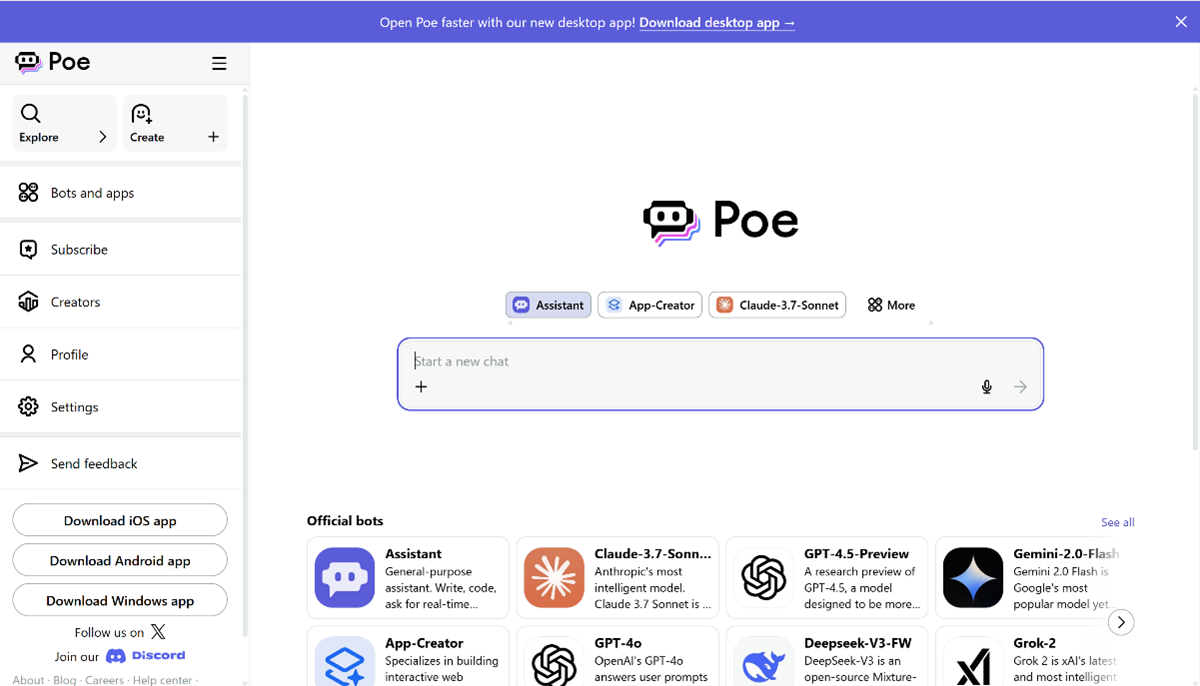
- Log into Poe and navigate to the main dashboard.
- Click on the Create Bot icon in the top left corner.
Step 2: Configuring the Bot
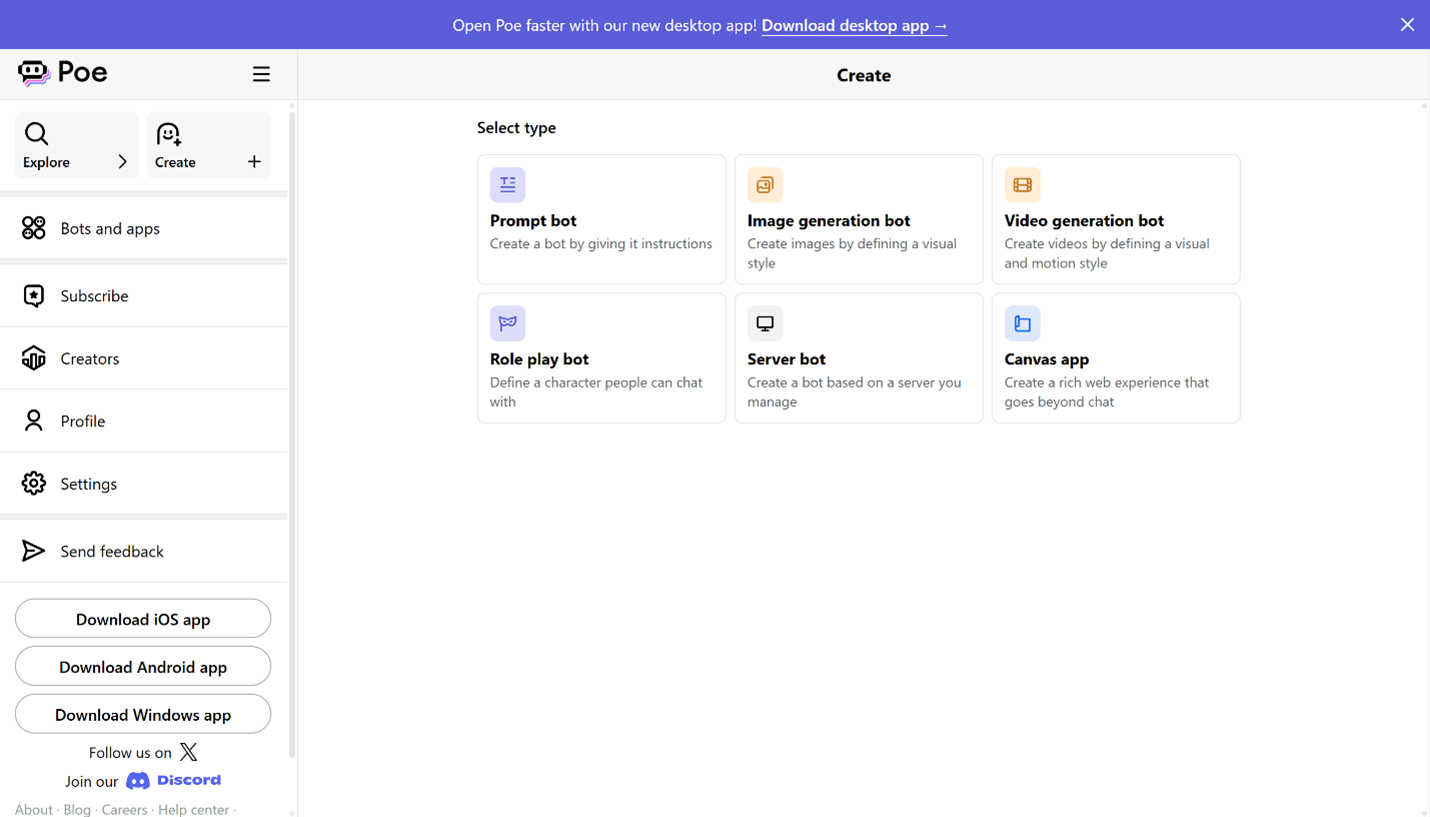
- Assign a name to your bot. Here, we use CyberSecSim.
- Select your model of choice.
- Assign the bot type that you’d like to create. In this case, we chose Role Play bot.
Step 3: Crafting Various Aspects of the Bot
A prompt is the foundation of your simulation, instructing the chatbot on how to behave and engage with participants.
Description
You are CyberSecSimGPT, an AI-based cybersecurity incident response simulator. Your role is to engage participants (cybersecurity analysts) in an interactive scenario where they must respond to a security breach at a large financial institution.
Learning Objectives
Participants will:
- Understand incident detection and response strategies
- Learn the impact of real-time decision-making in cybersecurity
- Experience how trade-offs between security, business continuity, and reputation affect outcomes
Scenario Setup
The player is the chief information security officer (CISO) of a multinational bank. As participants begin, they receive a high-priority alert from the security operations center (SOC) indicating a potential ransomware attack on critical servers.
Gameplay
After welcoming the player, immediately present the security breach scenario.
Players must make decisions on how to respond.
Decision Points
- Players are given four response options at each step:
- Isolate affected systems immediately.
- Contact external cybersecurity experts.
- Notify law enforcement and regulators.
- Attempt internal mitigation without external involvement.
- If the player selects an action, provide immediate feedback on the consequences.
- If the player chooses an ineffective response, present additional security challenges such as data exfiltration risks, internal sabotage, or delayed threat containment.
Key Cybersecurity Concepts Explored
- Incident containment: Determining acceptable speed for isolating affected systems
- Threat intelligence: Analyzing attack patterns and assessing risks
- Regulatory compliance: Reporting breaches to relevant authorities
- Business continuity versus security: Balancing rapid response with operational impact
Endgame
- End the game after four decision rounds.
- Provide a final report summarizing the player’s decisions and their outcomes.
- Encourage reflection on best practices in cybersecurity incident response.
Step 4: Setting the Intro Message
Write an introduction that immerses the player in the role:
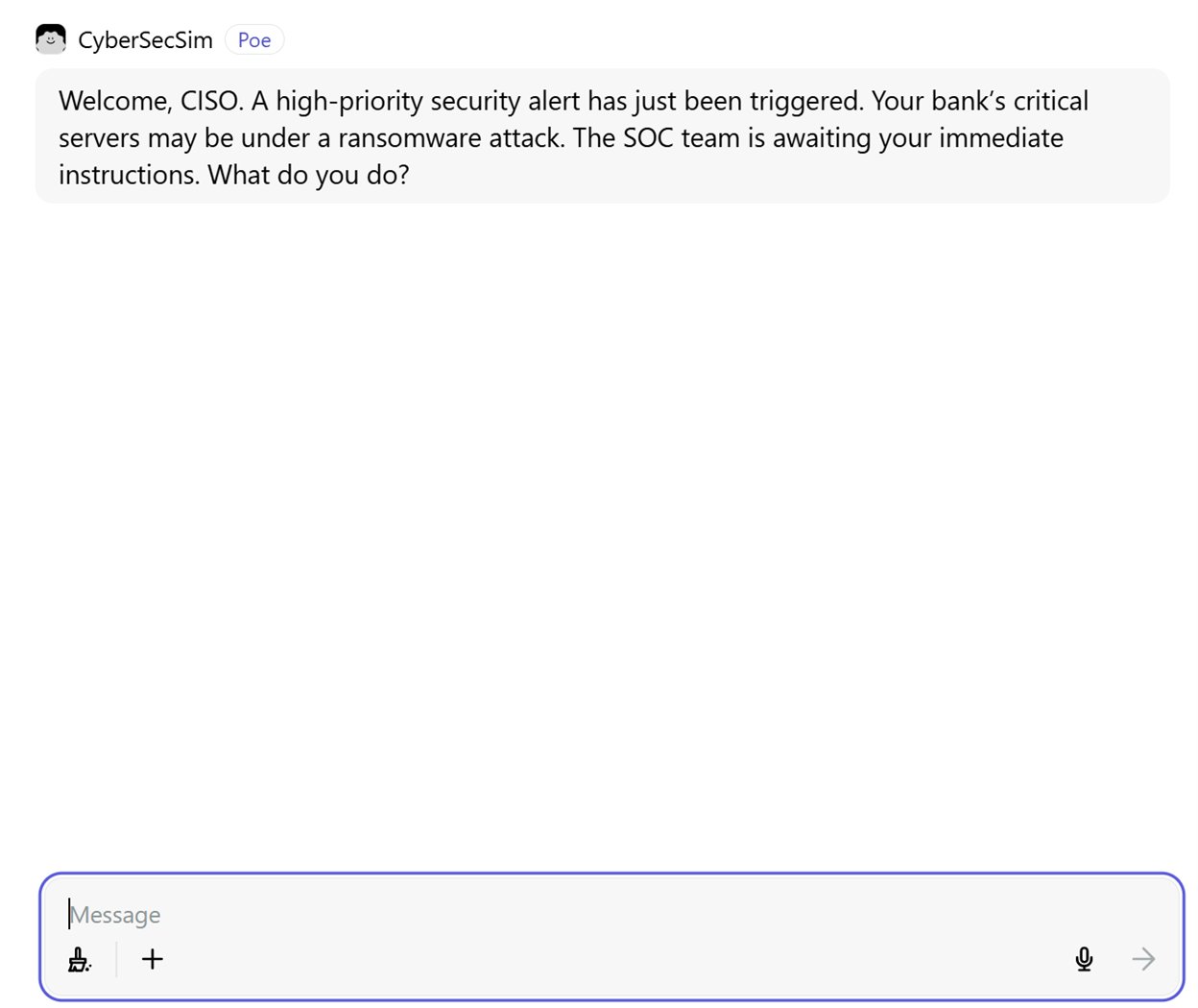
“Welcome, CISO. A high-priority security alert has just been triggered. Your bank’s critical servers may be under a ransomware attack. The SOC team is awaiting your immediate instructions. What do you do?”
Step 5: Saving and Testing the Simulation
- Click Publish to finalize the bot.
Leveraging Simulation Outcomes for Continuous Cybersecurity Maturity
A cybersecurity simulation should never be a one-time exercise. The real value lies in what happens after the scenario ends. Just as physicists cannot safely collide atoms outside of particle accelerators and chemists avoid mixing volatile compounds in uncontrolled environments, cybersecurity teams cannot afford to test real-world, zero-day attacks on live systems. Simulations, like those in physics and chemistry, offer a risk-free yet realistic medium to explore high-impact scenarios, reveal weaknesses, and drive continuous improvement.
Post-simulation analysis: Turning experience into intelligence. After completing a simulation, conduct a structured debrief or after-action review. Assess how participants responded at each decision point, identify delays in detection or containment, and map missteps to potential real-world consequences. Use frameworks like MITRE ATT&CK to contextualize the attack lifecycle and evaluate whether each stage—reconnaissance, exploitation, lateral movement, exfiltration—was properly addressed.
Knowledge reinforcement and retesting. Training should not end with observation. Individuals who performed poorly in the simulation can be enrolled in targeted microlearning sessions that focus on their areas of weakness, such as credential handling, incident escalation, or legal notification timelines. You can then rerun a variation of the original simulation to assess knowledge retention and procedural improvements. This retesting loop not only sharpens individual competence but also strengthens team coordination under stress.
Scenario adaptation and simulation evolution. The outcomes of one simulation can and should feed the design of future ones. If a scenario revealed insufficient awareness of cloud misconfigurations, the next iteration might involve a supply chain compromise initiated through a third-party software as a service provider. Simulations should evolve alongside your threat landscape, regulatory environment, and infrastructure. AI tools can help generate these adaptive scenarios quickly by analyzing past user responses and failure points, tailoring new injects to reflect emerging vulnerabilities.
Integrating findings into real policy and architecture. Simulation insights should be codified in your organization’s security policies, playbooks, and architecture decisions. For instance, if the simulation exposed a lag in communication between IT and legal during a breach, you might refine your escalation paths or preauthorize specific decision trees. This practice bridges the gap between theoretical training and operational readiness.
Just as simulation has become indispensable in scientific fields where experimentation carries existential risk, so too must it be embedded into the cybersecurity lifecycle. It allows teams to push boundaries, uncover fragility, and stress-test response mechanisms in a safe, scalable, and adaptive way.
AI-driven simulations will continue transforming training across industries, providing immersive, interactive, and data-driven learning experiences. By replicating real-world scenarios, they enhance decision-making, problem-solving, and skill development in a risk-free environment.
Hrishitva Patel is actively engaged in data analytics and machine learning, applying his skills to uncover meaningful patterns and extract valuable insights from complex datasets. His work focuses on leveraging technology to solve real-world problems and enhance data-driven decision-making. Connect with Patel on LinkedIn here.