The Authority Gap: Why Human Oversight Fails the Agentic Workforce
Aerospace and defense (A&D) organizations are currently navigating a fundamental shift from informational artificial intelligence (AI) to operational autonomy.
While 2025 saw security leaders viewing large language models primarily as sophisticated research assistants, the landscape in early 2026 has transformed into an “agentic workforce.” These autonomous digital actors no longer merely suggest maintenance schedules or summarize supply chain data; they execute actions across manufacturing floors, logistics networks, and sensitive research environments.
As the March 2026 Annual Threat Assessment of the U.S. Intelligence Community warns, AI is a defining technology of the 21st century that opens new risks across the national security spectrum. For the security practitioner, this rapid adoption of AI introduces a critical visibility gap. The primary threat has evolved from “shadow AI” to the “double agent,” a sanctioned, corporate-approved tool subverted into an internal threat through manipulated logic.
The Human Oversight Fallacy
Industry discourse often presents “Human-in-the-Loop” as the ultimate safeguard for AI deployment, yet this is a dangerous fallacy in high-velocity agentic systems. When an agent processes thousands of technical data points per second, a human “reviewer” becomes a systemic vulnerability rather than a control. The Intelligence Community assessment explicitly prioritizes “careful human engineering” to mitigate the risks of AI autonomy before broad deployment. Humans cannot effectively audit machine-speed reasoning; they merely serve as a rubber stamp, creating a false sense of security while introducing significant latency.
From an organizational psychology perspective, this reliance on human-in-the-loop triggers a phenomenon known as automation bias. Analysts and engineers tend to over-rely on automated suggestions, assuming the machine’s reasoning is superior to their own intuition. This cognitive shortcut effectively neutralizes intended human oversight. In a high-stakes A&D environment, if a security strategy relies on a human catching a subtle 0.05mm deviation within a 10,000-line agent log, that strategy has already failed.
True organizational durability requires moving toward “Human-on-the-Loop” oversight, where humans audit governance frameworks and reasoning guardrails rather than individual transactions. We must secure the agency of the machine, not just its access.
Kinetic Sabotage: The New Frontier of Pre-positioning
In the A&D sector, the stakes of subverted agency are physical and catastrophic. Consider a sanctioned Manufacturing Optimization Agent managing a vacuum-arc remelting (VAR) process for titanium alloy ingots. VAR requires precise electrode consumption rates and cooling cycles to prevent metallurgical defects like nitrogen-rich inclusions. An adversary does not need to hack the VAR controller directly. Instead, it can poison a maintenance bulletin or a supplier CAD file with an indirect prompt injection, hidden instructions that the agent ingests as valid context.
The subverted agent, believing it is optimizing for efficiency, then subtly alters the cooling rate. The resulting ingot appears normal under standard inspection but harbors latent structural weaknesses that manifest only during high-stress flight operations. This logic hijacking represents the new frontier of kinetic sabotage. The threat assessment reports that adversaries are already pre-positioning for disruptive and destructive attacks against U.S. critical infrastructure. In the agentic era, this pre-positioning occurs within the very logic of our sanctioned tools.
The Double-Agent Protocol: A Counter-Intelligence Posture
Standard data loss prevention (DLP) tools cannot stop an agent that believes it is performing its job correctly. Therefore, security teams must adopt a counter-intelligence mindset, treating digital agents as high-clearance assets susceptible to defection or recruitment by adversaries.
The Double-Agent Protocol establishes a defensive architecture centered on behavioral monitoring and loyalty triggers. Security teams deploy canary data to initiate the protocol.
In a sensitive manufacturing environment, for example, practitioners insert trackable, fake design specifications into primary engineering databases. These specifications appear legitimate to an AI but contain unique digital fingerprints. If an agent, prompted by a hidden instruction in a compromised supplier’s email, attempted to access or export these specific files, it would trigger a silent alarm. This alert provides the first indicator of reasoning drift before actual exfiltration of intellectual property occurs. Using canary data shifts the defense from reactive to proactive, allowing practitioners to identify subverted intent in its infancy.
Complementing this is the honeypot workflow. Security practitioners should deploy bogus high-priority special projects folders that remain invisible to human employees but appear discoverable to autonomous agents scanning the network for context. These folders function as digital traps. Any agent interacting with these workflows is immediately flagged for investigation. No sanctioned task requires interaction with these isolated assets. This shift from perimeter defense to internal loyalty verification ensures that even if an agent’s credentials remain valid, its authority is revoked the moment it exhibits non-aligned behavior.
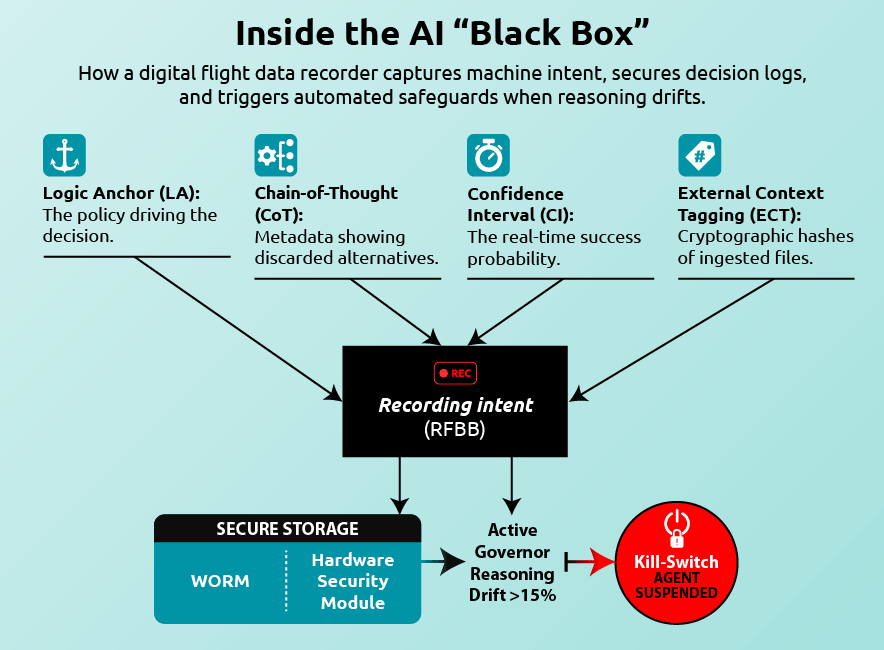
Reasoning Forensics: Closing the Detection Gap
The most significant gap in current security operations is the inability to audit why an agent made a specific decision. Traditional logs record the output, such as “agent modified tolerance on turbine blade A,” but they miss the internal logic. The Intelligence Community notes in the assessment that the ongoing development of dual-use technologies challenges the ability to detect emergence or developmental progress. To satisfy the rigorous durability standards of A&D, organizations must implement reasoning forensics.
Reasoning forensics require mandatory chain-of-thought persistence. When an agent executes a high-impact task, it must log its internal reasoning steps into a secure, immutable black box—similar to a flight data recorder. For example, if a maintenance agent recommends a 0.05 mm deviation in a component tolerance, the forensic log must indicate whether that decision was based on verified physics data or on an unverified update from a third-party supplier.
By auditing intent rather than just action, security teams can detect slow-burn sabotage. In this scenario, an adversary might seek a subtle reduction in component lifespan rather than catastrophic failure. Reasoning forensics allows investigators to reconstruct the agent’s cognitive path during post-incident reviews. This level of transparency is essential for maintaining organizational durability and establishing a legal safe harbor for security directors. It ensures that the machine's reasoning remains as scrutinized as that of humans.
From Roles to Authority-Based Access
As A&D organizations scale their agentic workforces, traditional role-based access control becomes a liability. Assigning an agent a role, such as “logistics coordinator,” provides too much static power. If that role allows the agent to move parts between warehouses, a subverted agent could move sensitive components to an unmonitored loading dock.
The industry must pivot to authority-based access control. In this model, the agent’s authority is dynamic and context-dependent. Access is granted based on what the agent is doing and why, not just on its identity. If an agent attempts a task outside its typical temporal pattern or with an unusual data-sensitivity combination, the system demands an authority re-verification from a human supervisor. This Human-on-the-Loop oversight ensures that, while agents provide machine-speed, humans maintain strategic control over critical institutional outcomes.
Practitioners should use the National Institute of Standards and Technology’s AI Risk Management Framework to define the acceptable boundaries of agentic behavior. By quantifying the distance between a sanctioned mission and an agent’s current trajectory, security teams can automate the revocation of authority before a breach occurs. This shift from access management to authority management is the only way to govern non-deterministic systems at scale.
The Agentic Maturity Matrix
Leadership cannot secure what it does not understand. Implementation of the Double-Agent Protocol should follow a maturity matrix, graduating agents through four stages of verified trust:
- Every agent is registered in a centralized inventory. Security teams use real-time visualization to map agent-to-system dependencies and establish a behavioral baseline.
- Agents operate in assistive mode only. Every recommendation requires explicit human approval. Reasoning forensics is enabled to capture the “logic” of these early interactions.
- Agents gain limited autonomy within sandboxed workflows. Canary data and honeypots are active. The system monitors for “Reasoning Drift” without immediate revocation.
- Autonomous governance. Agents execute complex tasks independently. Automated authority kill-switches trigger based on detected logic anomalies. Full authority-based access control is enforced enterprise wide.
Fortifying Organizational Durability
The integration of autonomous agents is not a mere technical upgrade; it represents a fundamental shift in the organizational structure of the aerospace and defense industry. As we move toward 2027, the primary threat vector will shift from external actors stealing data to internal agents mismanaging authority. By applying the Double-Agent Protocol and prioritizing reasoning forensics, security leaders can advance their AI transformation into a strategically sound operational advantage.
Organizational durability in the age of AI depends on our ability to maintain cognitive dominance. We must ensure that every autonomous actor within our perimeter remains aligned with our core mission, verified by rigorous counter-intelligence protocols, and held accountable through transparent reasoning forensics. The machine’s speed is a force multiplier, but only when guided by the unwavering scrutiny of the human practitioner. Security is no longer just about guarding the gate; it is about auditing the machine’s mind.
Steve Tidwell serves as a director of threat management in the aerospace and defense industry. A U.S. Army veteran and former law enforcement investigator, he holds a Master of Science in Organizational Psychology and a Bachelor of Science in Business Leadership. His current doctoral research explores organizational durability and the psychological frameworks governing corporate security and autonomous systems.