Nepal Experiences Deadly Protests Over Social Media Ban and Corruption
Mass protests throughout Nepal resulted in at least 19 deaths and the nation’s prime minister announcing his resignation. What started on 8 September as demonstrations against the Nepalese government banning foreign and domestic social media apps—including WhatsApp, Instagram, Reddit, and more—evolved into protests voicing residents’ frustration and anger, accusing the government of corruption.
On Monday, police in cities, including the nation’s capital, Kathmandu, used live ammunition, water cannons, rubber bullets, and tear gas against demonstrators according to videos on social media and local media reports, The Washington Post reported. Hundreds of other protestors were injured in the clash with law enforcement.
The protests were organized by young activists, with several participants wearing school or college uniforms and carrying signs that read “Unban social media” and “Youths against corruption.” Some of them “forced their way into the parliament complex in Kathmandu by breaking through a barricade, a local official said, setting fire to an ambulance and hurling objects at lines of riot police guarding the legislature,” Reuters reported.
Early on 9 September, Nepal’s communications and information technology minister, Prithvi Subba Gurung, announced that the government had retracted the ban and restored access to social media platforms, according to CNN. Also on Tuesday, Prime Minister K.P. Sharma Oli, who was elected in 2024 for a fifth term, announced his resignation in response to the events and deaths. A replacement has not yet been named and the president appointed Oli to lead a “caretaker government” until a new one can be established, according to the Associated Press.
Despite the reversal on the ban, protestors continued demonstrating in Kathmandu on Tuesday, defying a curfew order. Some men on the streets were seen carrying weapons, although whether they were part of the protests is unclear, according to The New York Times.
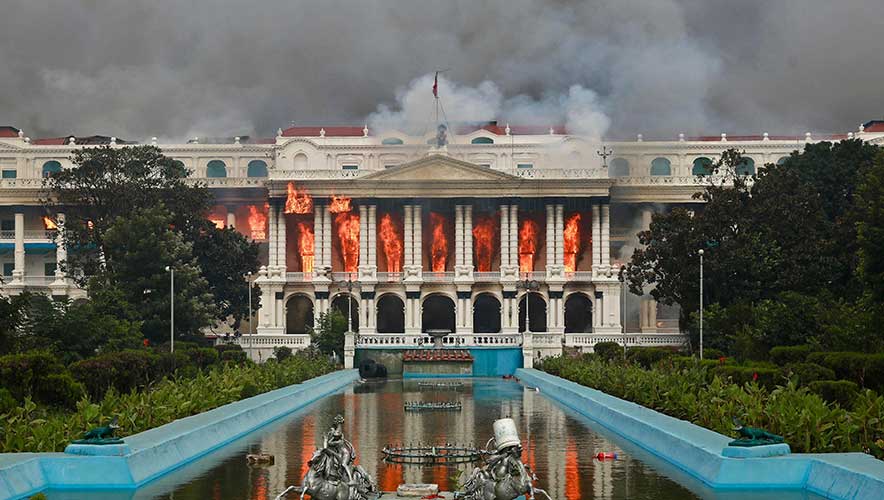
“Crowds of protestors could be seen breaking into [the prime minister’s private residence] and destroying furniture before setting it on fire,” CNN reported, citing videos of the events. Protestors also set fires in other political residences, government buildings (including the Supreme Court, an anti-corruption court, and the Parliament building), and police stations, the Times reported.
In at least one instance, a former prime minister’s spouse was still inside one of the homes when it was set alight. The spouse, Ravi Laxmi Chitrakar, was critically burned and is being treated for her injuries at a hospital.
Kathmandu’s Tribhuvan International Airport was shut down when smoke from fires set by protestors impacted visibility of the area’s airspace. Scheduled arriving flights were rerouted to other countries.
The ban had previously been announced on 28 August and was in effect on 4 September, with 26 apps blocked. According to the order, only platforms that did not register with the Ministry of Communication and Information Technology were banned.
The country’s Supreme Court had previously ruled that the government could enact laws to censor content, including ads, on Internet browsers and social media apps, according to an automated translation of an article published by the Annapurna Media Network. “Officials said they imposed the ban because platforms had failed to register with authorities in a crackdown on misuse, including false social media accounts used to spread hate speech and fake news, and commit fraud,” Reuters reported.
The ban disrupted communications both within and with those outside of Nepal, which has a sizeable migrant population—meaning that family members abroad could not get in touch with those still in the country via messenger apps like WhatsApp. The ban also impacted businesses that rely on social media platforms as a primary method of communication.
Prior to the protests, dissatisfied Nepalis were using social media to spotlight allegations of corruption, with posts on TikTok and Reddit pointing to “stark contrasts between the privileges of political families and the struggles of ordinary young people searching for work,” the Post reported. The nation’s leaders, including Home Minister Ramesh Lekhak, were repeatedly accused of corruption before the protests began. Lekhak—who was specifically accused of being involved in an immigration bribery and extortion scheme—has denied the allegations but resigned from the government and claimed a “moral responsibility” for the violence, according to Reuters.