White House Releases AI Executive Order for Voluntary Model Pre-Review
As a journalist, it’s my job to be skeptical. Sometimes, that means bringing a bit of an unpopular Cassandra-esque vibe to the artificial intelligence (AI) hype function. And it appears that I’m not alone, since just after a major AI developer announced plans to take its company public, the White House released an executive order to request those same innovators submit their new AI models for government review before release.
Why did U.S. President Donald Trump do this? Because his administration has major national security concerns about the ability of America’s most sensitive government agencies to withstand new attack methods that will leverage the sophisticated AI capabilities of the future.
And with that, let’s get into our June Legal Report.
- The White House released its long-awaited executive order on AI.
- The European Commission released a major technology sovereignty plan.
- A teenager injured in a school shooting is suing a weapons detection system vendor.
- The suspect in the White House Correspondents Dinner shooting pled not guilty to all charges.
- Dutch authorities blocked an American corporate acquisition of cloud company Solvinity Group.
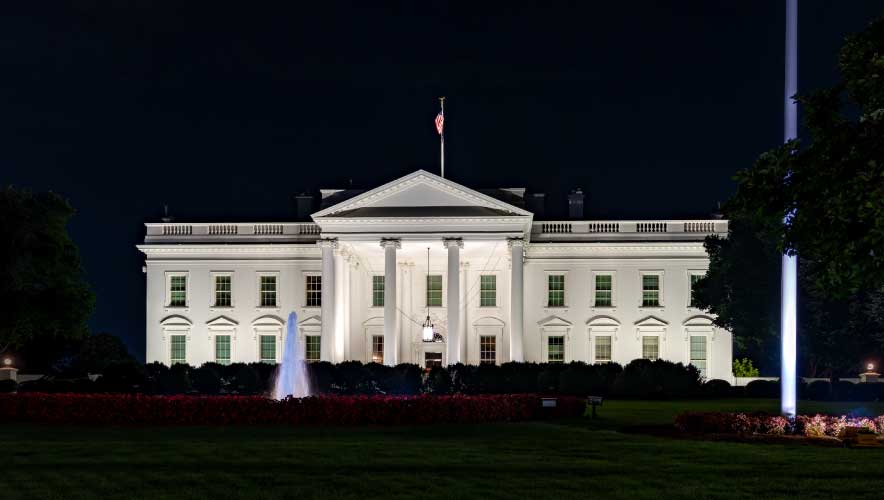
White House Releases AI Executive Order for Voluntary Model Pre-Review
Amidst mounting concern about the potential ineffectiveness of current robust security safeguards against AI, U.S. President Trump signed an executive order on 2 June to give the federal government the right to prior-review of new AI models before they are publicly released.
The order tasks federal executives with developing and maintaining a classified benchmarking process to assess the advanced cyber capabilities of AI models and determine the threshold where an AI model should be designated as a “covered frontier model.” The executives will then work with AI developers to design a voluntary framework to determine if their models under development meet the designation of a covered frontier model, provide the federal government with access to those covered models for up to 30 days before release, and collaborate to select trusted partners to gain early access to covered frontier models to promote secure innovation while strengthening the cybersecurity of critical infrastructure.
“Advanced AI capabilities make our nation stronger, but also introduce new national security considerations that require coordinated action across executive departments, agencies, and components,” Trump explained in the order.
The order also tasks the U.S. federal government with prioritizing its cyber defenses for the National Security Systems and the U.S. Department of Defense against AI threats. The secretary of homeland security and the director of the U.S. Cybersecurity and Infrastructure Security Agency (CISA) are to release binding operational directives to then prioritize cyber defense of civilian federal government information systems to protect them, establish or expand federal programs and cybersecurity services that enhance AI-enabled defensive tools, and facilitate access to cybersecurity tools and services for covered frontier models for agencies, state and local authorities, and operators of critical infrastructure.
A sense of déjà vu? If all of this sounds familiar, it’s because Trump actually revoked this authority after being inaugurated for a second term and rescinding an executive order by his predecessor, former U.S. President Joe Biden. U.S. Senator Mark Warner (D-VA), the vice chairman of the U.S. Senate Select Committee on Intelligence, pointed out the irony of the moment in a statement shared with Security Management.
Warner strongly advocated for reinstating prior review via voluntary partnerships by including the requirement in intelligence authorization bills his committee passed in 2024 and 2025.
“While I hope that this new [executive order] represents a dramatic change of course, I will also be watchful for indications the administration has reverted to his prior, ideological approach—for instance, by using these new pre-deployment partnerships as vectors to pressure U.S. firms into making changes to their products or Terms of Service to suit partisan or legally questionable objectives of the president and his allies,” Warner said.
The word on the street. So far, leading AI developers have been publicly supportive of the order. Anthropic, which filed to go public this week, posted on X that the executive order is “an important step in strengthening America’s leadership in AI.” OpenAI CEO Sam Altman also posted that the United States “should lead on AI by continuing to develop the very best models, making sure they’re safe, and getting cyber tools into the hands of trusted defenders. The new [executive order] gets the balance right.”
While AI developers appear pleased with the order, some security practitioners fear that the federal government is not providing the resources to adequately support the initiative.
Jacob Krell, senior director of secure AI solutions and cybersecurity at Suzu Labs, said in a statement to Security Management that the Trump administration is asking for greater oversight of frontier AI models due to cybersecurity and national security concerns. Yet the administration has also significantly reduced funding and staffing at CISA—the lead civilian cyber defense agency. It has also proposed cutting $707 million from CISA’s budget for fiscal year 2027, about 30 percent of the agency’s 2025 budget.
“That creates a capacity question,” Krell added. “Expanding the government’s role in AI security oversight while reducing resources available for cyber defense and risk management sends mixed signals about how these risks should be addressed.”
It could also push companies to look to other AI developers not subject to reviews, including less transparent, foreign alternatives, to maintain their competitive advantage.
Security practitioners also have concerns that the executive order reinforces the existing approach from AI labs of limiting access to the most capable tools while excluding most cybersecurity practitioners.
“Meanwhile malicious actors are finding new ways to leverage available AI tooling to accelerate and enhance their attacks,” said Don McConnell, head of policy and compliance at Finite State, in a statement shared with Security Management. McConnell previously served as a CISA branch chief and a former senior advisor for cybersecurity policy in the U.S. Office of Management and Budget.
“The cybersecurity community is strongest when it works together—transparently identifying, managing, and discussing the risks that affect all technology users,” McConnell added. “The path to stronger cybersecurity is more information sharing, not less. Classified benchmarking, nondisclosure requirements, and early access pilots will delay getting these models into the hands of the cyber defenders who can put them to use today.”
Anthropic may be heading off some of that criticism. On the same day as the executive order release, the company announced that it’s expanding Project Glasswing to 150 new organizations that meet its security requirements for access. The organizations in this new cohort are based in more than 15 countries and mostly provide critical infrastructure services, including power, water, healthcare, communications, and hardware. Many of them are also vendors—companies or nonprofits that maintain codebases relied upon by other organizations and governments.
“What each partner has in common is that a successful attack on their codebase could be catastrophic,” Anthropic said in the announcement. “For most partners, we estimate that a major attack could affect more than 100 million people, with important ramifications for both global and national security.”
But wait, there’s more. Ironically, Anthropic continues to collaborate on Project Glasswing with support from the U.S. federal government amid a court battle about the U.S. Department of Defense (DOD) attempt to designate it a supply chain risk that threatens national security. Anthropic won a preliminary injunction in San Francisco that allows U.S. government agencies—except the DOD—to use its models while the case continues.
Meanwhile, lawyers for Anthropic and the DOD presented their cases to a U.S. federal appeals court in Washington, D.C., on 19 May. The panel of judges will issue a written opinion in the coming weeks. But CNBC reports that Judge Karen Henderson said from the bench that the DOD’s actions appear to be a “spectacular overreach.”
She added that “I don’t see that the department has in any way supported its determination that there is a supply chain risk with Anthropic, much less a significant supply chain risk.”
Other News to Note…
Europe unveils tech sovereignty plans. The European Commission released the European Technological Sovereignty Package on 2 June, which is designed to reduce the bloc’s dependence on U.S. technology by increasing its capacity in semiconductors, AI, cloud, and open source.
“We cannot afford to depend on others for the technologies that keep our hospitals running, our energy grids stable, and our services secure,” said Commission President Ursula von der Leyen in a press release. “This is about protecting our citizens, defending our interests, and making our own choices.”
Your digital future is made in Europe. 🇪🇺
— European Commission (@EU_Commission) June 3, 2026
We are building a stronger European tech ecosystem, reducing reliance on critical technologies from outside the EU.
Our new Technological Sovereignty plan will help to change that ↓ pic.twitter.com/atU0DaDDNz
The package includes two major legislative proposals—the Chips Act 2.0 and the Cloud and AI Development Act—designed to reduce Europe’s structural dependencies and ensure it can develop, deploy, and secure its own technologies. Both legislative proposals will be negotiated by the European Parliament and the Council of the European Union before going into effect.
Ebola quarantine plans, stalled. Kenya’s high court scheduled a hearing for 23 June for deliberation on the U.S. government’s plans to open an Ebola quarantine unit in the country to treat Americans. The Katiba Institute—a Kenyan civil society group—has sued to stop the U.S. effort, calling it unconstitutional.
The unit at Laikipia Air Base in Kenya was meant to treat Americans who were exposed to or infected by the Ebola outbreak in the Democratic Republic of Congo. The Trump administration announced it was creating the unit to limit the spread of the disease, in contrast to long-standing policy of transporting Americans back to the United States to receive treatment.
Mind the gap. The UK Information Commissioner’s Office (ICO) fined South Staffordshire Water and its parent company, South Staffordshire, £963,900 ($1.29 million) for failing to address longstanding security gaps in its corporate network in 2020. Hackers used those gaps in 2022 to infect the water supplier with ransomware and expose the personal information of more than 633,000 people.
“The steps that South Staffordshire failed to take are established, widely understood, and effective controls to protect computer networks,” said Ian Hulme, ICO interim executive director for regulatory supervision, in a press release. “The ICO expects all organizations—and particularly those handling large volumes of personal information as part of critical national infrastructure—to have these in place. Waiting for performance issues or a ransom note to discover a breach is not acceptable. Proactive security is a legal requirement, not an optional extra.”
Failure to alarm. A teenager injured in a school shooting in Tennessee sued Omnilert and Systems Integration for negligence and violations of Tennessee’s Consumer Protection Act. Antonyous Henin, 18, is claiming that Omnilert’s weapons detection system was marketed as being capable of detecting firearms before a shot is fired and within fractions of a second to prevent school shootings.
Yet that system failed to perform as advertised when it did not detect a firearm a gunman used at Antioch High School in January 2025 to kill one student and injure two others. Henin’s lawsuit claims that Omnilert made substantial changes to its marketing of its weapons detection solutions in the wake of the shooting because of its failure to prevent the incident. He is seeking compensatory and treble damages, as well as other relief.
Omnilert and Systems Integration did not respond to Security Management’s request for comment on the lawsuit.
Aid abroad. The Russian Duma passed new legislation that gives the Kremlin the authority to use military force abroad to defend Russian citizens’ rights if they are arrested or charged abroad, including by international court systems that Russia does not recognize.
“This measure is clearly designed to intimidate other countries and international courts, causing them to avoid charging Russians, including possibly Russian President Vladimir Putin, lest such moves lead Moscow to use force to rescue its citizens and punish those who act against them,” according to the thinktank Jamestown.
Experts at Jamestown and elsewhere believe that Russia enacted the law to better shield Putin and other government figures from charges related to its invasion of and continued military assault on Ukraine.
Speed Reads
Below is a quick recap of recent court cases, legislation, and regulations that affect the security industry and employers.
Court Cases
Assassination attempt. Cole Tomas Allen pled not guilty to charges that he attempted to kill U.S. President Trump at the White House Correspondents Dinner on 26 April. Allen is being held in custody while awaiting trial on one count of attempting to assassinate the president, assaulting a U.S. government agent with a deadly weapon, interstate transportation of a firearm and ammunition with the intent to commit a felony, and discharging a firearm during a crime of violence.
Credential theft. A U.S. district judge sentenced Romanian citizen Catalin Dragomir, 46, to more than four years in federal prison for selling stolen login credentials to access Oregon’s emergency management computer network.
Intellectual property. The U.S. Department of Justice charged Michele Spagnuolo, a Google software engineer, with insider trading for allegedly using confidential business information to make $1.2 million on Polymarket wagers.
Negligence. A Virginia judge dismissed child abuse and neglect charges against a former school administrator accused of failing to act on several warnings that a student had a gun, which he used later that day to shoot his teacher at Richneck Elementary School in Newport News, Virginia.
Terrorism. An Austrian court sentenced a 21-year-old man to 15 years in prison after he admitted he planned a terrorist attack at a Taylor Swift concert in Vienna in 2024. Swift canceled all three of her Vienna shows in response to the threat out of an abundance of caution.
Legislation
Border security. The U.S. Senate passed legislation during an overnight session to fund two U.S. Department of Homeland Security agencies for the next three years: Border Patrol and Immigration and Customs Enforcement. The $70 billion authorization bill will now go to the U.S. House of Representatives for consideration next week.
Regulation
Data sovereignty. Wilhelmina Aerdts, the Dutch state secretary for the digital economy and digital sovereignty, blocked an American corporate acquisition of cloud company Solvinity Group. Dutch investment screening authority BTI advised Aerdts not to allow the sale to go through since Solvinity Group provides the infrastructure for the DigiD identity verification system and portal that Dutch residents use to access government services.
Fraud. The U.S. Department of the Treasury’s Office of Foreign Assets Control (OFAC) sanctioned Nobitex, Iran’s biggest digital asset exchange, and three other Iranian digital asset exchanges for providing support to the Iranian regime.
Sanctions. FTI Consulting, Inc., will pay $1.05 million to settle alleged violations of OFAC sanctions targeting Russia’s financial sector between April 2019 and May 2021. The financial penalty was assessed after OFAC determined FTI’s conduct was “non-egregious and not voluntarily self-disclosed.”
Terrorism. The U.S. Department of State designated Brazilian gangs Comando Vermelho and Primeiro Comando da Capital as Specially Designated Global Terrorists and Foreign Terrorist Organizations (FTO). The designation makes it illegal for people in the United States—or those subject to its jurisdiction—to knowingly provide “material support or resources” to an FTO group. It also requires U.S. financial institutions that possess—or have control over—funds that a designated FTO or its agent has an interest in continue to control the assets and report them to the U.S. Department of the Treasury.
Workforce development. California Governor Gavin Newsom signed an executive order requiring state agencies to work with other stakeholders to study how to subsidize companies that keep their employees instead of replacing them with technology, such as AI.
Thanks for reading! We’ll be back with more legal analysis in July!
What security-related regulatory developments are you following? Please email your thoughts to [email protected].
Megan Gates is the senior editor at Security Management. Connect with her via email or on LinkedIn.